

Report Overview
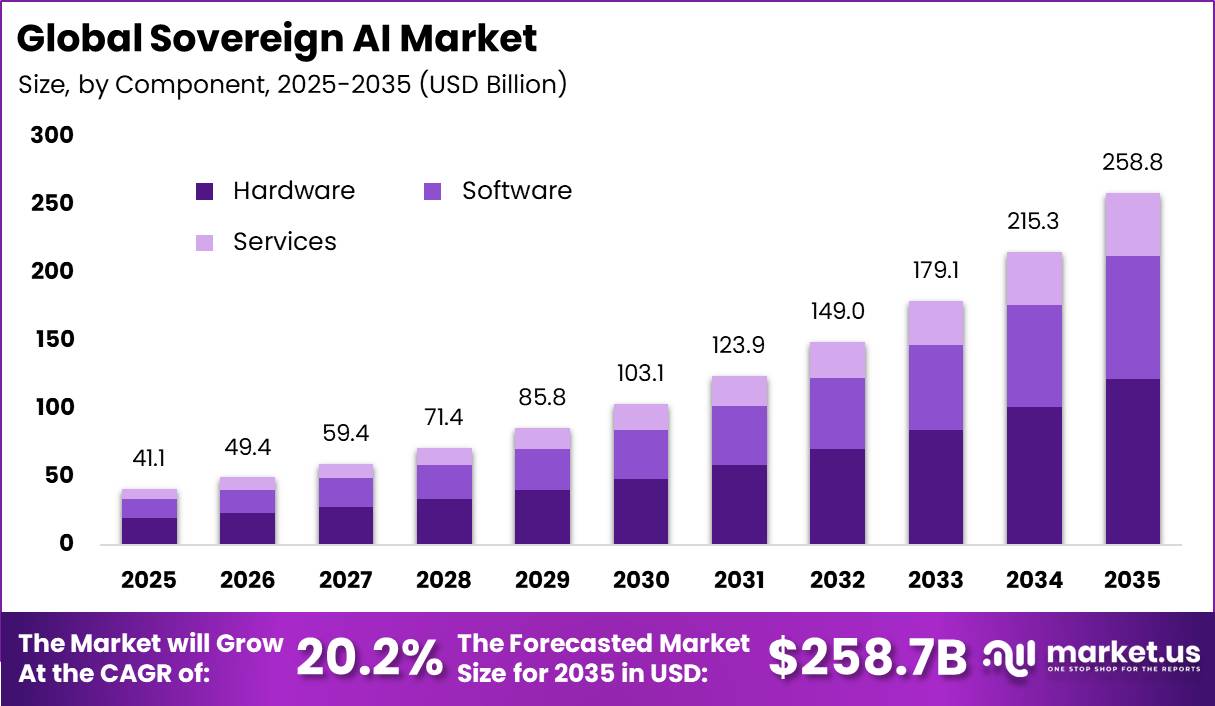
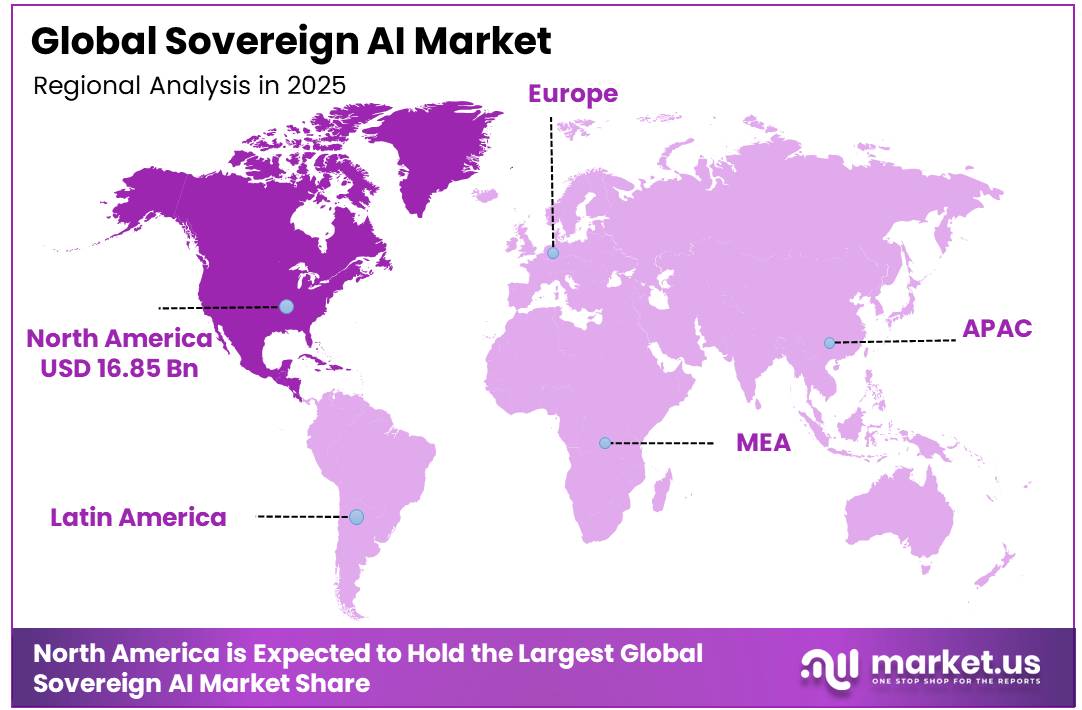
In 2025, the Global Sovereign AI Market was valued at USD 41.1 billion. The market is projected to grow at a CAGR of 20.2% during 2026–2035, reaching approximately USD 258.7 billion by 2035. North America dominated the global market in 2025, accounting for more than 41.0% of the total market share and generating approximately USD 16.8 billion in revenue.
Government funding is a major driver of AI infrastructure demand. In July 2026, the European Commission opened a tender for up to 7 AI gigafactories, supported by up to EUR 10 billion in public funding and at least EUR 20 billion in expected private investment. Construction is expected to begin in 2027.
The UK Government committed GBP 1.1 billion in June 2026, including GBP 750 million for a national AI supercomputer and GBP 400 million for advanced AI chips. India’s IndiaAI Mission has also developed computing capacity exceeding 18,000 GPUs through public-private partnerships and disbursed INR 7.61 billion in subsidies.
North America remains the centre of large-scale AI computing infrastructure development. Amazon, Google, and Microsoft plan approximately USD 610 billion in combined capital spending in 2026, largely directed toward AI data centres, computing, and networking. This compares with around USD 410 billion across leading hyperscalers in 2025.
This investment base provides US and Canadian agencies with strong access to AI accelerators, secure cloud infrastructure, and skilled technical resources. The first Stargate facility in Texas is targeting 1.2 gigawatts of capacity, while the US Government coordinated the US-UAE AI Acceleration Partnership in May 2025, supporting additional sovereign investment in US-based AI infrastructure and technology providers.
Key Takeaways
- The Global Sovereign AI Market was valued at USD 41.1 billion in 2025 and will hit USD 258.7 billion by 2035. The market will grow at a CAGR of 20.2% during 2026 to 2035.
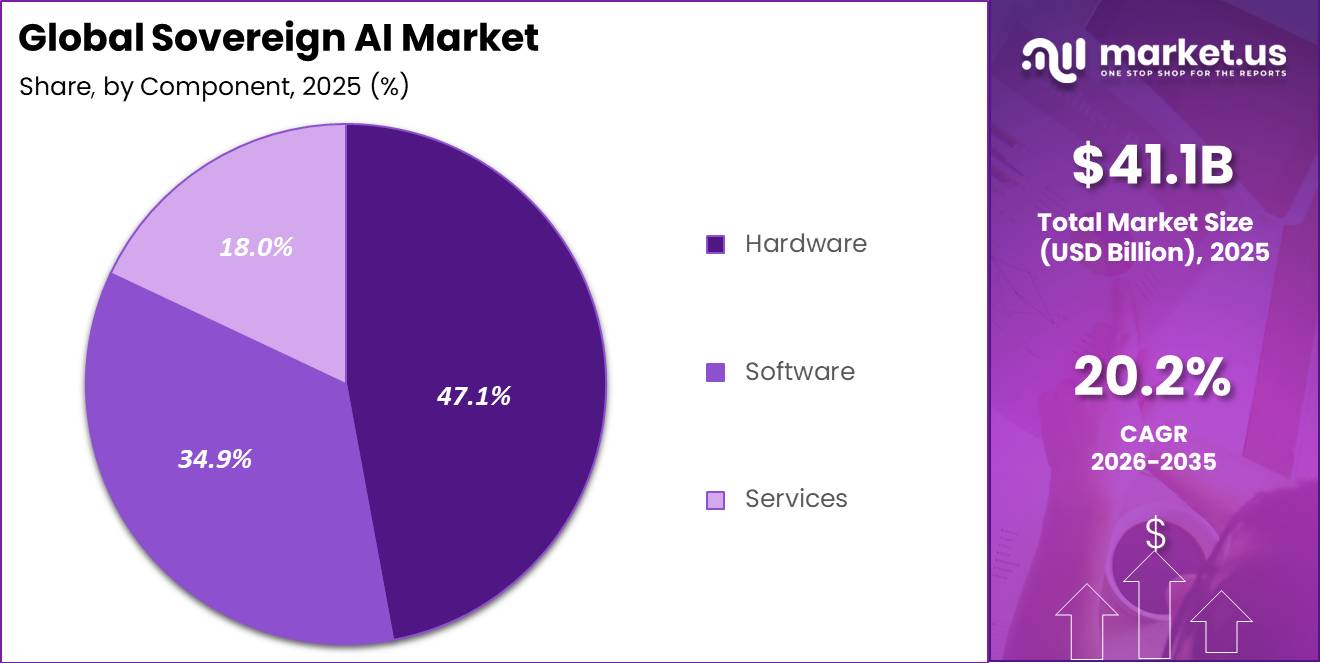
- Hardware leads the component segment with a 47% share.
- Software is the fastest-growing component with a 34.9% share.
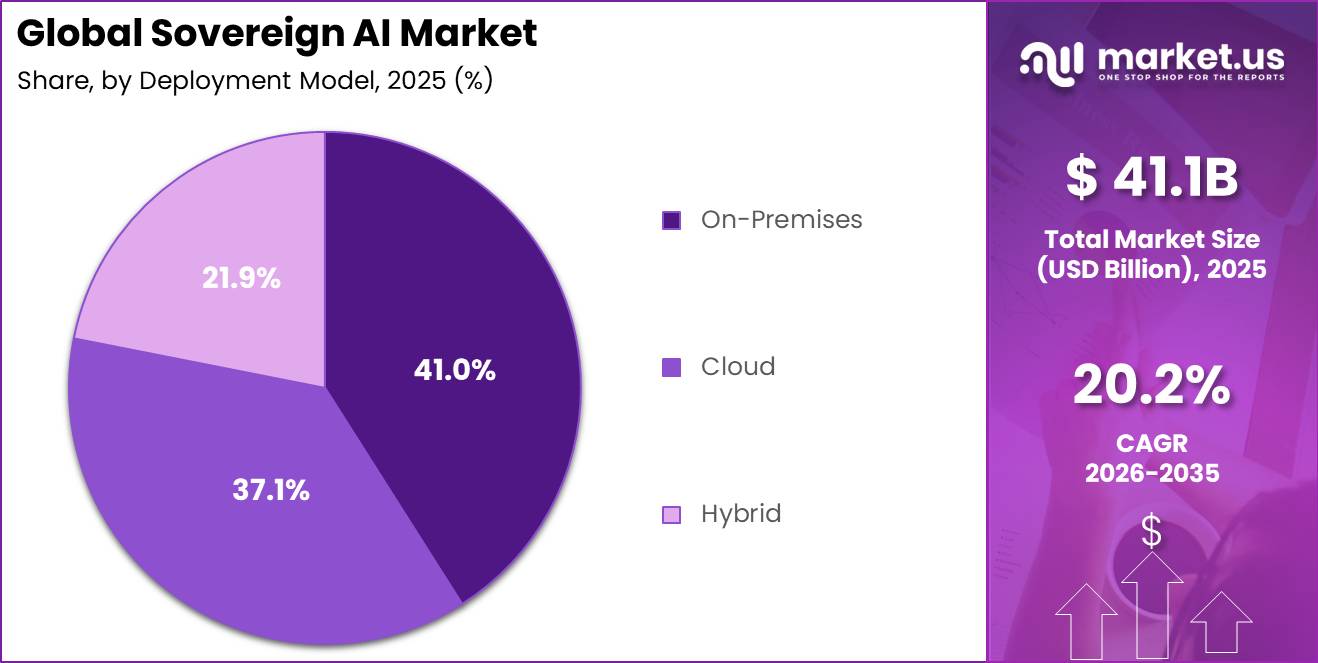
- On-Premises leads the deployment model segment with a 41.0% share.
- Cloud is the fastest-growing deployment model with a 37.1% share.
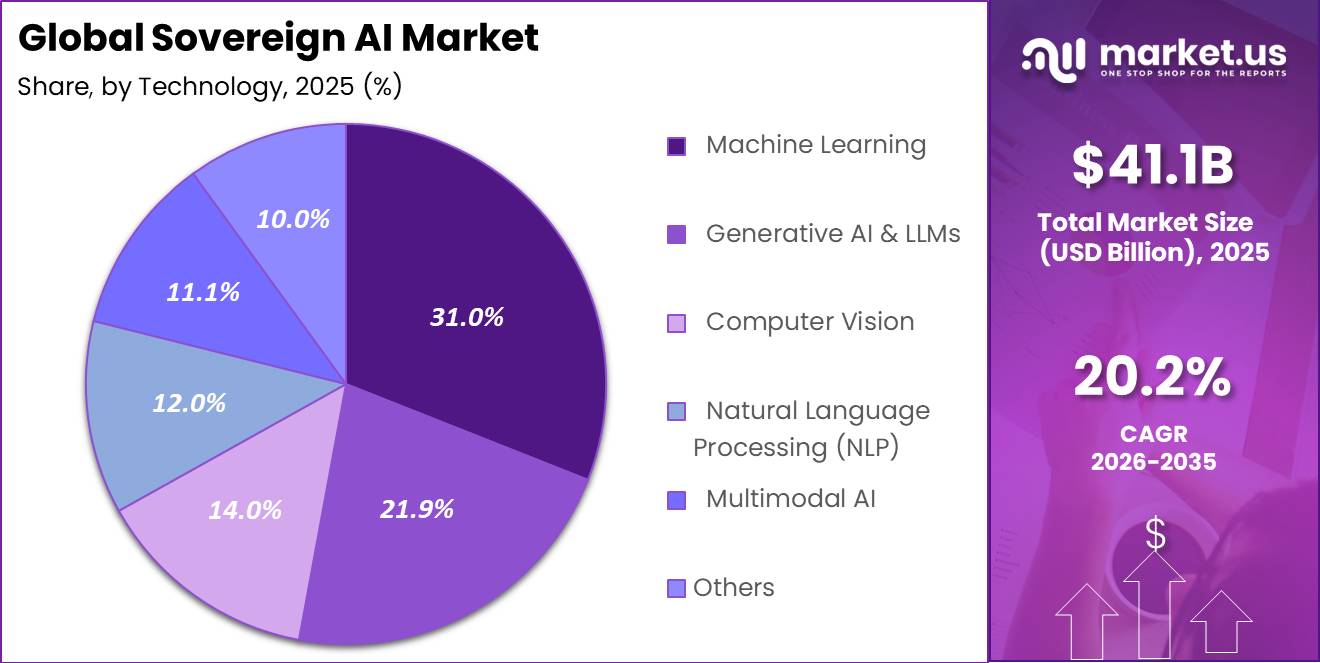
- Machine Learning leads the technology segment with a 31.0% share.
- Generative AI and LLMs form the fastest-growing technology with a 21.9% share.
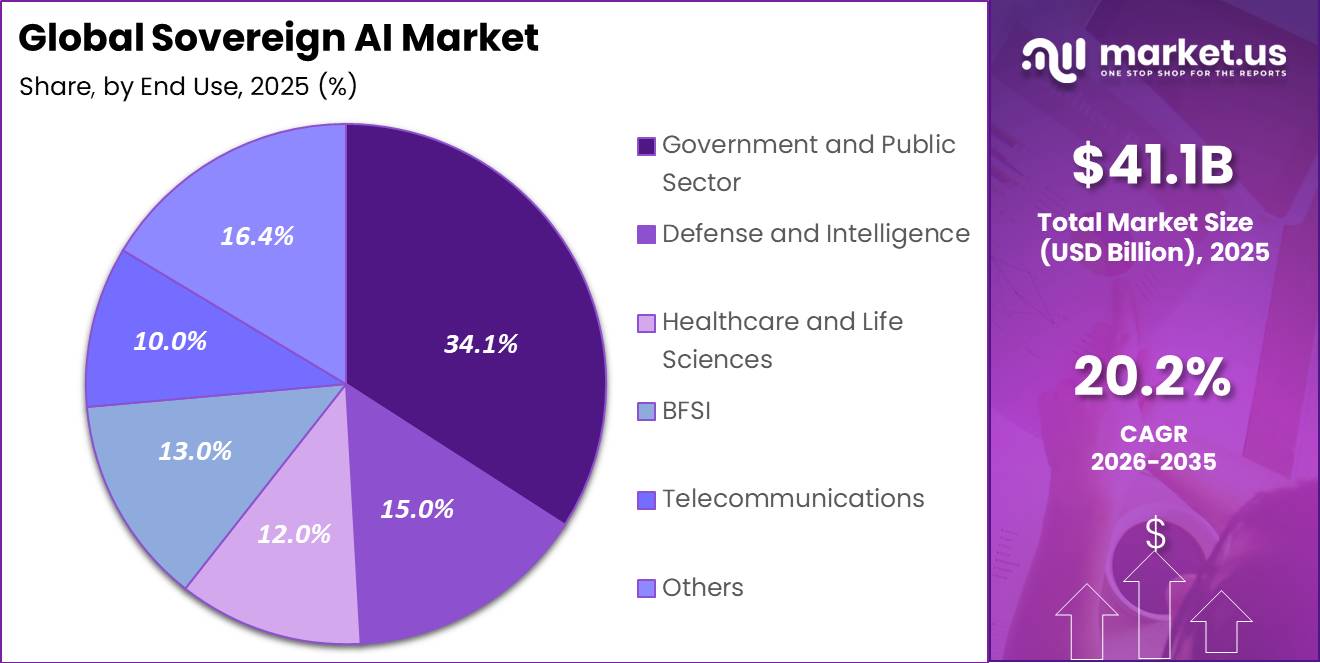
- Government and Public Sector leads end use with a 34.1% share.
- BFSI is the fastest-growing end use with a 13% share.
- North America dominates with a 41.0% share and USD 16.8 billion in revenue.
- Asia Pacific holds 21.5% and ranks as the fastest-growing region.
- Europe holds 23% and ranks as the second-fastest-growing region.
- Latin America holds 8%, and the Middle East and Africa hold 7.0% of the market.
Market Statistics and Data Insights
Compute Infrastructure and Capacity Deployment
- As of the latest government count, 38,231 GPUs have been onboarded from 14 empanelled cloud service providers under India’s IndiaAI Compute Capacity framework.
- The UK’s Isambard-AI supercomputer delivers 21 exaflops of AI performance from 5,448 NVIDIA GH200 Grace Hopper Superchips, is more than 10x faster than the next-fastest UK system, and has more computing power than all other UK supercomputers combined.
- Europe’s JUPITER became the fourth exascale system worldwide and the first outside the US, reaching 1.000 exaflop/s (HPL) and 16.7 exaflop/s on the HPL-MxP mixed-precision benchmark relevant to AI workloads.
- JUPITER’s booster module comprises roughly 24,000 NVIDIA GH200 Grace Hopper Superchips across ~6,000 nodes and delivers about 40 exaflop/s of AI compute at 8-bit precision (80 exaflop/s in sparsity mode), enough to train a 100-billion-parameter foundation model in about one week.
- South Korea’s A.X K1 sovereign foundation model was pretrained in ~73 days on NVIDIA H200 GPUs scaled from 1,024 to 1,536 units in FP8 precision, using a ~10-trillion-token curated corpus within a roughly four-month project.
- Stargate UAE’s first 200 MW tranche is scheduled to go live in 2026 as part of a 1 GW Abu Dhabi cluster; analyst estimates put that first phase at roughly 1,400 GB300-class servers, or about 100,000 NVIDIA chips.
Energy Efficiency and Sustainability Metrics
- Isambard-AI achieves a power usage effectiveness of around 1.08, meaning only 8% of total energy goes to cooling, versus roughly 2.0 for traditional air-cooled supercomputers, and its modular build cut construction emissions by about 72% compared with traditional data-centre construction.
- Isambard-AI uses HPE 100% fanless direct liquid cooling, delivering up to a 90% reduction in cooling power consumption, packs 440 GPUs per cabinet, operates hybrid cooling towers that are >90% dry (waterless), and runs entirely on zero-carbon electricity.
- India’s Ministry of Electronics and IT (MeitY) has imposed a PUE requirement below 1.35 in its IndiaAI Mission GPU tender covering 10,000 GPUs of public-private cloud infrastructure, against an Indian data-centre average PUE of roughly 1.5–1.6.
- Direct-to-chip liquid cooling reduces cooling energy use by up to 60% versus mechanical air cooling, and designing a new build to sub-1.4 PUE costs less than retrofitting to a stricter benchmark later.
- France’s Adastra2 partition (112 AMD MI300A APUs, 2.53 PFLOP/s HPL) operates at 36.60 kW using 100% fanless direct liquid cooling, with 97% of heat removed via warm water.
Environmental Cost of Sovereign Compute (Peer-Reviewed Modelling)
- A 1,024-GPU sovereign cluster with evaporative cooling would consume an estimated 34.3 million litres of water per year in the UAE, 32.0 million in Bangladesh, 22.9 million in India, and 13.7 million in Kenya; switching to immersion cooling cuts UAE consumption to 0.57 million litres, a 98.3% reduction.
- The same 1,024-GPU cluster at PUE 1.80 emits an estimated 14,330 tCO2/yr on Bangladesh’s grid (696.1 gCO2/kWh), 13,795 t in India (670.1 g), 9,624 t in the UAE (467.5 g), and 1,964 t in Kenya (95.4 g), a 7.3x spread driven purely by grid mix.
- Of 52 developing countries with active sovereign AI programmes, 70.6% face high overall water risk on the WRI Aqueduct index, and those countries average grid carbon intensities 44% higher than high-income countries (457 vs. 318 gCO2/kWh).
- Frugal AI approaches show an energy ratio of roughly 40,000:1 versus frontier pretraining: 25,000-GPU frontier pretraining consumes 68,850 MWh, 103.3 million litres of water and 37,052 tCO2, while LoRA fine-tuning on 8 GPUs for 7 days consumes 1.7 MWh, 3,427 litres and 2.1 tCO2.
- In hot climates, evaporative cooling for sovereign AI facilities consumes 1.8 to 3.0 litres of water per kWh of IT load, and the IEA-reported global average PUE is 1.41 (hyperscale 1.14, enterprise 1.92).
Vendor Demand, Dependency, and Concentration
- NVIDIA’s sovereign AI business more than tripled year over year in fiscal 2026 to over $30 billion, roughly 14% of total revenue, driven primarily by customers in Canada, France, the Netherlands, Singapore, and the UK.
- NVIDIA supplies GPUs for 45% of all tracked sovereign AI infrastructure projects globally.
- Across 185 tracked sovereign AI projects, infrastructure accounts for 59%, models 32%, and data initiatives just 9%; more infrastructure projects were announced in Q1 2026 alone than in all of 2024.
- More than three-fifths of tracked sovereign AI projects disclose at least one foreign partner, and four-fifths of those involve a U.S. company; projects with no disclosed foreign partner rose from 31% to 37% between April and August 2026.
- As of June 2026, 21 sovereign projects train sub-frontier models from scratch, more than double the count at the end of 2024, while Meta’s Llama family appears in 14 of the 25 model projects that disclose a base model.
- Ninety percent of the computing power needed to develop and deploy frontier AI is located in the United States and China, and the Middle East plus East Asia together account for more than 80% of all tracked, publicly disclosed sovereign AI investment.
Utilisation and Operational Efficiency
- Only 12,638 of 33,099 GPUs committed by IndiaAI’s empanelled providers (38%) had been assigned AI workloads, with just 7,418 (22%) actually utilised by end users and 5,317 (16%) entirely unused, a utilisation gap despite world-leading sub-$1 hourly pricing.
- EuroHPC AI Factory access is tiered by operational turnaround: Playground access within 2 working days for SMEs and startups, Fast Lane (up to 50,000 GPU hours, 3-month allocation) approved within 4 working days, and Large Scale for requirements above 50,000 GPU hours.
- EuroHPC’s access policy allocates up to 25% of the overall EuroHPC access time share to “AI for Science and Collaborative EU Projects” and up to 30% to “AI for Industrial Innovation,” free of charge for AI SMEs and startups.
- UK research teams have logged large sovereign-compute workloads on Isambard-AI, including 180,000 GPU hours for a 3D digital twin of human daily life and over half a million GPU hours for a single non-English-language sovereign AI groundwork project.
- Isambard-AI’s 5 MW grid connection, equivalent to the power needs of about 2,000 homes, was enabled by installing hundreds of metres of underground cable and a new high-voltage substation in just three weeks.
Model Performance and Technical Improvements
- NVIDIA-Sarvam co-engineering delivered a 4x inference speedup for India’s sovereign Sarvam 30B model: a 2x gain from H100 kernel and scheduling fixes (including a 4.1x improvement in MoE routing via fused CUDA kernels) and a further 2x from Blackwell with NVFP4 quantisation; kernel work alone cut transformer layer time by 34%, from 3.4 ms to 2.5 ms per layer.
- At higher concurrency, Blackwell delivered a 2.8x throughput improvement at 100 tokens per second per user versus optimised H100 performance for the sovereign model, with a single Blackwell GPU handling the 30B model more efficiently than multiple H100s in parallel.
- Indic-optimised sovereign tokenizers cut token fertility from 4–8 tokens per word (typical for global multilingual models on Indic scripts) to 1.4–2.1 tokens per word, yielding 4–6x faster inference and an effective training signal equivalent to 6–8 trillion tokens from a 2-trillion-token corpus.
- Korea’s sovereign foundation-model programme sets an explicit performance target of at least 95% of the performance of leading global models released within the previous six months, with six-month evaluation cycles eliminating underperforming consortia until two national champions remain.
- India’s sovereign models launched at the IndiaAI Impact Summit 2026 have shown strong Indic-language benchmark performance, in some cases outperforming leading frontier models on specific tasks; Sarvam 105B uses ~10.3B active parameters of 105B with a 128K context window, and BharatGen’s PARAM 2 is a 17B-parameter MoE model covering 22 Indian languages.
- Government adoption of AI had increased by over 1.5 times by 2024 versus 2021, driven by national LLMs that outperform global models on localised benchmarks in cases such as Brazil and Albania.
By Component
Hardware dominates with 47.0% due to sovereign data centre and chip purchases.
Hardware remains the leading segment, accounting for 47% of the market, because sovereign AI programmes first require chips, servers, networking equipment, cooling systems, and power infrastructure. NVIDIA reported data centre revenue of USD 115.2 billion in fiscal 2025, representing growth of 142% in one year. In Europe, the European Commission plans to mobilise EUR 20 billion for AI gigafactories, with each facility expected to host more than 100,000 advanced AI processors.
Software accounts for 34.9% of the market and is the fastest-growing segment as installed hardware requires orchestration platforms, model-training tools, cybersecurity systems, and local-language applications. Software is generally renewed annually, while hardware can remain in operation for around 5 to 6 years, creating recurring licence and subscription spending. Services represent 18% of the market, supported by growing demand for system integration, deployment, maintenance, cybersecurity, and technical support.
On-premises deployment continues to lead because governments require greater physical control over sensitive defence, tax, identity, and public-sector data. The EuroHPC Joint Undertaking oversees 19 AI factories, supported by 13 AI Factory Antennas, and operates 14 shared supercomputers. Cloud deployment is also expanding, with India’s IndiaAI Mission onboarding more than 38,000 GPUs after previously reaching 34,333 empanelled GPUs, enabling wider access to subsidised computing capacity.
By Deployment Model
On-Premises dominates with 41.0% due to strict national data residency rules.
On-Premises remains the leading deployment model, accounting for 41.0% of the market, as governments require greater control over sensitive public, defence, healthcare, tax, and citizen data. UNCTAD reports that 137 of 194 countries have enacted data protection and privacy legislation, reinforcing demand for locally hosted AI infrastructure and stronger data residency controls.
Cloud accounts for 37.1% and is the fastest-growing deployment model, supported by faster deployment, lower infrastructure requirements, and access to domestic computing capacity through certified providers. Canada allocated USD 2 billion over 5 years for AI compute, including up to USD 700 million to expand domestic capacity through commercial partners. Rising power requirements are also supporting shared infrastructure, with the IEA projecting data-centre electricity consumption to increase from 485 TWh in 2025 to around 950 TWh by 2030.
Hybrid deployment represents 21.9% of the market as governments combine sensitive on-premises workloads with scalable cloud capacity. Europe demonstrates the importance of sovereign infrastructure, with the EuroHPC Joint Undertaking operating 14 supercomputers and 19 AI factories under a EUR 7 billion budget covering 2021 to 2027, enabling public institutions to retain domestic control while expanding access to advanced AI computing.
By Technology
Machine Learning dominates with 31.0% due to proven, auditable models across public workflows.
Machine Learning remains the largest technology segment, accounting for 31.0% of the market, supported by its established use in government forecasting, fraud detection, benefit processing, traffic management, and public-service automation. OECD findings show that 57% of public-sector AI cases focus on automating or improving services, 45% support decision-making and forecasting, and 30% are used for accountability and anomaly detection.
Generative AI and Large Language Models account for 21.9% and represent the fastest-growing segment. Governments are increasingly developing models trained on national languages, laws, regulations, and public records. UNESCO’s AI ethics framework has commitments from 193 Member States, while its Readiness Assessment Methodology is being adopted across multiple countries to support national AI development and governance.
Other important technologies include Computer Vision at 14.1%, Natural Language Processing at 12%, Multimodal AI at 11.1%, and other technologies at 10%. Falling model-training costs, open-weight models, and wider access to computing infrastructure are enabling more countries to develop national AI systems, creating recurring demand for model fine-tuning, security controls, evaluation, and ongoing software support.
By End Use
Government and Public Sector dominates with 34.1% due to largest budgets and nationwide citizen services.
Government and Public Sector remains the largest end-use segment, accounting for 34.1% of the market. Demand is supported by large-scale use of AI for digital records, citizen services, document translation, fraud detection, and administrative automation. ITU estimates that around 6 billion people, nearly 75% of the global population, used the internet in 2025, with more than 240 million new users added during the year.
Defense and Intelligence accounts for 15.0%, supported by rising government investment in AI-enabled surveillance, autonomy, decision support, and national security systems. The United States requested USD 13.4 billion for artificial intelligence and autonomy in its fiscal 2026 defence budget. Healthcare and Life Sciences represents 12%, Telecommunications 10.0%, Energy and Utilities 6.0%, Manufacturing and Industrial 5%, and other sectors 5.0%.
BFSI represents 13% of the market and is the fastest-growing segment, driven by fraud detection, credit assessment, payment monitoring, regulatory compliance, and multilingual customer services. BIS findings indicate that more than 70% of surveyed central banks are already testing AI or machine learning, while over 50% are piloting supervisory technology, supporting wider adoption of sovereign AI platforms across financial institutions.
Key Market Segments
By Component
- Hardware
- Software
- Services
By Deployment Model
By Technology
By End Use
- Government and Public Sector
- Defense and Intelligence
- Healthcare and Life Sciences
- BFSI
- Telecommunications
- Manufacturing and Industrial
- Energy and Utilities
- Others
Geopolitical Impact Analysis
Export controls and tariffs have become a major factor in sovereign AI infrastructure planning. On 14 January 2026, the US President signed a proclamation under Section 232 of the Trade Expansion Act, introducing a 25% tariff on certain advanced computing chips and derivative products from 15 January 2026. The measure applies to products classified under HTSUS subheadings 8471.50, 8471.80, and 8473.30 that meet specified processing performance and DRAM bandwidth thresholds.
The tariff directly affects accelerator boards, GPU servers, and add-in cards used in national AI factories. Official US trade data show that semiconductor imports reached USD 48.1 billion in 2025, representing about 1.4% of total US imports. Expectations of a broader phase 2 tariff programme also increase procurement uncertainty, encouraging agencies to secure supply contracts earlier and maintain larger inventories of critical spare components.
Logistics disruptions are adding further pressure to infrastructure costs and delivery schedules. UNCTAD has reported continued diversion of container traffic away from the Suez Canal, with some carriers using the Cape of Good Hope route in 2026. This route can add approximately 10 to 14 days to Asia-Europe transit times, affecting the delivery of server racks, cooling systems, transformers, cabling, and other AI data centre equipment.
Longer lead times increase working capital requirements and create delivery risks for integrators working under fixed government project schedules. As a result, local assembly is becoming more important in sovereign AI procurement. Governments are increasingly including local-content and repair requirements in tenders, shifting part of hardware spending from imported finished systems toward regional integration, testing, maintenance, and long-term service contracts.
Regional Analysis
North America dominates the Sovereign AI Market with a 41.0% share, representing approximately USD 16.8 billion in revenue. The regional lead is supported by strong access to advanced GPUs, hyperscale and secure data centres, specialised AI talent, and direct government investment in sovereign computing infrastructure.
Asia Pacific holds approximately 21.5% of the Sovereign AI Market and is the fastest-growing region. Government-backed AI infrastructure programmes are expanding rapidly across South Korea, Japan, India, China, and Australia. South Korea approved around KRW 8.4 trillion, equivalent to approximately USD 5.71 billion.
Europe accounts for around 23.0% of the market and represents the second major growth region. Growth is being supported by the European Union’s AI factory and gigafactory strategy, with public funding being used to attract private infrastructure investment. France has established a target of 1.2 million GPUs, while Poland launched the EUR 70 million Gaia AI Factory.
Latin America represents approximately 8.0% of the market, with Brazil and Mexico emerging as the key regional demand centres. Sovereign AI investments are being driven by government cloud modernisation, data residency requirements, and growing demand for locally hosted AI services.
Key Regions and Countries
North America
Europe
- Germany
- France
- The UK
- Spain
- Italy
- Rest of Europe
Asia Pacific
- China
- Japan
- South Korea
- India
- Australia
- Rest of APAC
Latin America
- Brazil
- Mexico
- Rest of Latin America
Middle East and Africa
- GCC
- South Africa
- Rest of MEA
Market Dynamics
Drivers
National Compute Procurement Programmes
Sovereign AI funding is shifting from grants to long-term public investment programmes, creating more predictable demand. India has expanded national compute capacity to 34,333 GPUs at around ₹65 per GPU-hour, while Canada has committed CAD 2 billion over five years to sovereign AI infrastructure and subsidised access.
Europe is following a similar approach, with a €20 billion facility supporting up to five AI gigafactories of around 100,000 accelerators each. This shift is moving vendor revenue toward multi-year managed-capacity contracts, often supporting 3 to 5 years of utilisation, while increasing demand for networking, orchestration, and inference software.
Restraints
Export Licensing Regime on Advanced Accelerators
US export controls and tariffs are raising sovereign AI project costs and procurement risks. The 15 January 2026 rules introduced tighter chip licensing thresholds, while selected semiconductor imports face tariffs of up to 25%. These restrictions can delay projects by 2 to 4 quarters and push governments toward lower-performance compliant chips, increasing effective training costs by around 15% to 30%.
Challenges
HBM and Packaging Allocation Scarcity
Supply constraints in HBM, advanced packaging, and power equipment are delaying sovereign AI projects. 2026 HBM capacity was largely pre-contracted, while advanced-packaging slots remain allocated into mid-2027 and some GPU lead times extend to 36 to 52 weeks.
Power infrastructure adds further pressure, with transformer lead times reaching 48 to 60 months in parts of Europe. As a result, governments are moving toward multi-year supply contracts and lower-memory architectures, as each quarter of commissioning delay can reduce project returns by around 150 to 300 basis points.
Opportunities
Regional Compute Export and Sovereign Inference Wholesaling
Cross-border sale of surplus sovereign AI capacity remains largely untapped. In India, only 12,638 of 33,099 committed GPUs had assigned workloads and just 7,418, or 22%, were actually consumed, leaving significant capacity underused. Similar surplus could emerge as Saudi Arabia targets 1.9 GW of compute by 2030 and 6.6 GW by 2034, while Europe plans access to nearly 400,000 accelerators from 2027–2028.
The opportunity is to sell excess capacity to smaller countries through sovereign, residency-compliant compute services. Domestic subsidised pricing near USD 0.78 per GPU-hour could potentially be exceeded by 2.5 to 4 times in cross-border wholesale contracts, with gross margins rising toward 35% to 50% once utilisation exceeds around 60%.
Key Players Analysis
NVIDIA leads Tier 1, supported by strong AI infrastructure demand. In fiscal 2026, revenue reached USD 215.9 billion, up 65%, while Data Center revenue increased 68%. R&D spending was about USD 18.5 billion, alongside USD 17.5 billion invested in private AI companies and infrastructure funds.
Momentum continued in fiscal 2027, with second-quarter revenue of USD 96.22 billion and Data Center revenue of USD 89.0 billion, representing about 92% of total revenue. NVIDIA also agreed to invest up to USD 100 billion in OpenAI to support a planned 10 GW deployment beginning in late 2026.
Microsoft, Amazon Web Services, Alphabet, and Oracle also form Tier 1, supported by large-scale cloud infrastructure and sovereign-ready regions. Oracle is guided to approximately USD 50 billion in capital expenditure for 2026, while IBM, HPE, Dell, Cisco, Intel, AMD, Lenovo, and SAP support sovereign projects through computing, networking, security, and software solutions.
Tier 2 companies compete through regional presence, local data control, and specialised AI technologies. Mistral AI raised EUR 1.7 billion in September 2025 at an EUR 11.7 billion valuation, with ASML investing EUR 1.3 billion for approximately an 11% stake. Alibaba Cloud, Huawei, Atos, G42, SambaNova Systems, and Cerebras Systems also compete for sovereign AI contracts.
Top Key Players in the Market
- NVIDIA Corporation
- Microsoft Corporation
- Amazon Web Services (AWS)
- Alphabet Inc. (Google)
- IBM Corporation
- Oracle Corporation
- Hewlett Packard Enterprise (HPE)
- Dell Technologies
- Cisco Systems, Inc.
- Intel Corporation
- AMD
- Lenovo
- Alibaba Cloud
- Huawei Technologies
- SAP SE
- Atos SE
- G42
- Mistral AI
- SambaNova Systems
- Cerebras Systems
Recent Developments
- In August 2026, Marvell Technology and Google expanded their custom-AI-silicon partnership through a warrant allowing Google to acquire up to 58.97 million Marvell common shares at an exercise price of $206.58 per share, representing up to $12.18 billion of potential equity value. The arrangement directly supports the companies’ custom AI-chip collaboration and ties Marvell’s strategic capacity to Google’s AI infrastructure roadmap.
- In July 2026, Apple and Broadcom entered a multiyear custom-ASIC and wireless-connectivity supply agreement valued at roughly $30 billion. Broadcom is expected to manufacture more than 15 billion U.S.-made chips and invest $1.5 billion to expand and modernize production capability for the program.
- In December 2025, Broadcom identified Anthropic as the customer behind a $10 billion order for its latest TPU Ironwood rack systems, a major commercial commitment for AI-specific custom silicon and associated infrastructure. The order followed Broadcom’s earlier disclosure that a fourth AI developer had placed a one-time $10 billion custom-chip server-rack order.
- In July 2025, Samsung Electronics secured a $16.5 billion, or approximately KRW 22.8 trillion, semiconductor-supply contract with Tesla. Tesla confirmed that Samsung’s Taylor, Texas fab would manufacture its next-generation AI6 application-specific chip, placing the program among the largest disclosed dedicated-ASIC fabrication contracts of the period.
Report Scope


