

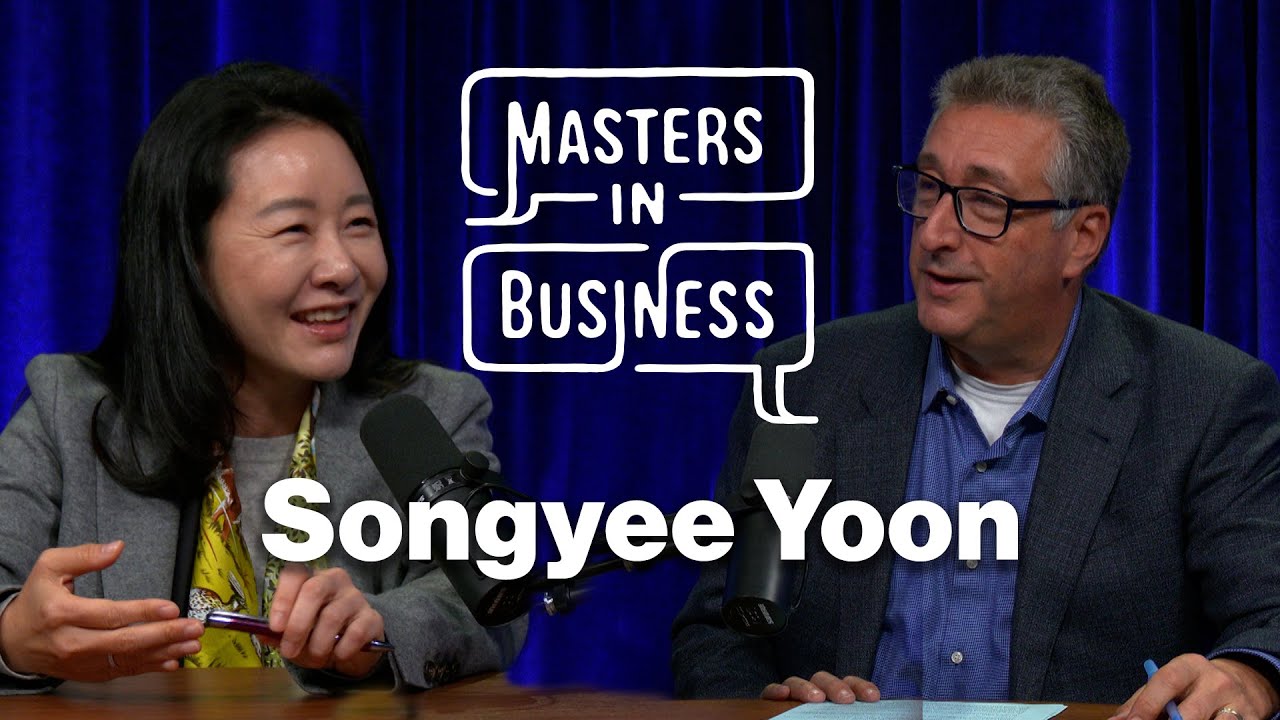
In a recent discussion on Bloomberg’s “Masters in Business” podcast, Songhee Yoon, founder and managing partner of Principal Venture Partners, shared insights about the intersection of artificial intelligence, gaming, and the future of work. With a background spanning computational neuroscience from MIT to venture capital, Yoon brings a unique perspective to the rapidly evolving technology landscape.
Yoon Sung Hee’s journey
Yun’s academic journey began at the Korea Advanced Institute of Science and Technology (KAIST) from 1993 to 1996, followed by undergraduate studies at the Massachusetts Institute of Technology (MIT) from 1996 to 2000, where she earned a PhD in computational neuroscience. This interdisciplinary foundation in understanding the human brain and computational systems deeply influenced her approach to technology and investing. She also briefly attended the Stanford Graduate School of Business in July 1996, where she gained business acumen alongside her scientific pursuits. From 2016 to 2020, she pursued her Juris Doctorate degree at Santa Clara University School of Law, further deepening her understanding of the legal and ethical frameworks surrounding technology.
Her career trajectory has been a transition from the academic realm to the fast-paced world of venture capital. Prior to founding Principal Venture Partners, he worked at McKinsey & Company and then at SK Telecom, a leading telecommunications company in South Korea. These experiences have given her a deep understanding of both corporate strategy and the practical application of technology in real-world scenarios.
The full discussion can be found at: bloomberg podcastYouTube channel.
AI and the future of work
Yun’s discussion highlighted her interest in how AI can be leveraged to improve human productivity and creativity. She emphasized that AI should not be seen simply as a tool for automation, but as a collaborator that can augment human capabilities. “We don’t want to simply replace humans with AI; we want to create a synergy where AI enhances what humans do best,” Yoon said.
She elaborated on the concept of ‘play’ in the workplace, suggesting that gamified elements and engaging experiences can significantly improve productivity and employee satisfaction. This perspective is reflected in her book Push Play: Gaming for a Better World, which examines how interactive technology can foster innovation and address societal challenges.
Mr. Yun also touched on the evolving nature of the skills required in the workforce. She believes that skills such as critical thinking, problem-solving, creativity, and adaptability will become increasingly important as AI advances rapidly. “The ability to learn and unlearn will be paramount to navigating the future job market,” she said.
investment philosophy
As a venture capitalist, Yoon focuses on identifying and supporting companies at the forefront of technological innovation, particularly in the AI and gaming space. Her investment philosophy is based on a belief in the long-term potential of technology to positively impact society. She looks for companies with strong founding teams, innovative products, and a clear vision of how their technology can solve real-world problems.
Asked about the challenges of evaluating AI startups, Yun acknowledged that it is difficult to distinguish true technological advances from hype. She emphasized the importance of rigorous due diligence, focusing on the underlying technology, team expertise and scalability of the business model. “It’s important to look beyond the buzzwords and understand the fundamental value proposition of the technology,” she advised.
The role of play in AI
Yun’s insights about the role of play in AI development were particularly thought-provoking. She suggested that incorporating playful elements into AI systems can not only make them more appealing, but also make them more effective in certain applications, particularly in areas such as education and training. “Play is more than just entertainment. It is a fundamental aspect of learning and innovation,” Yun explained.
She believes that by taking a playful approach, AI can open up new possibilities for interacting with humans in more intuitive and collaborative ways. This perspective challenges the traditional view of AI as a purely logical and deterministic system and highlights the potential for AI to be more adaptive and creative.
The conversation ended with Yun’s optimistic outlook for the future. She expressed confidence that the continued development and responsible deployment of AI will lead to significant advances in various fields and ultimately benefit society as a whole. Her insights highlight the transformative potential of AI when guided by a human-centered approach that prioritizes creativity, collaboration, and social well-being.


