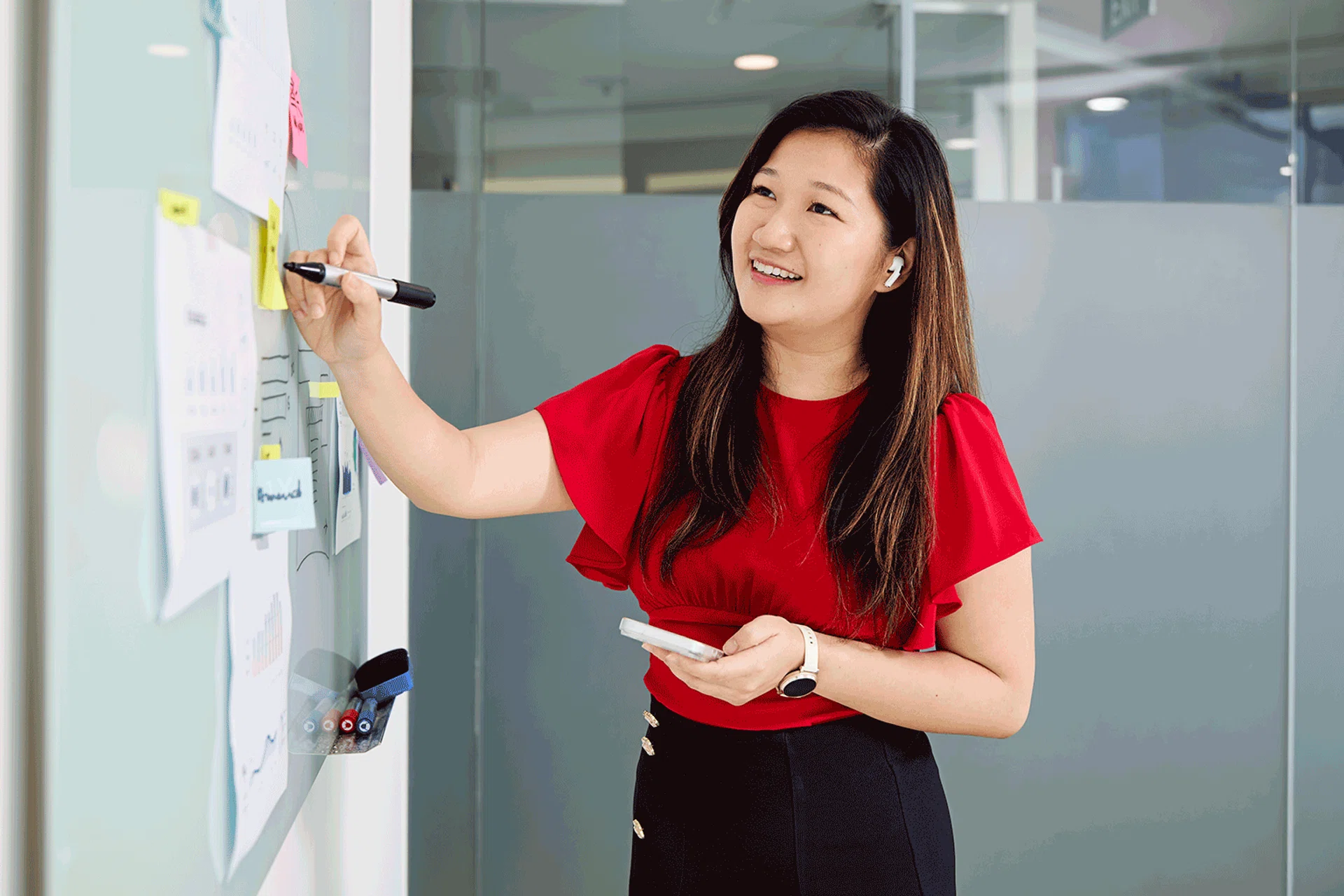
At digital solutions company Business Buddy, staff have taken on redesigned roles that will give them new skills and greater scope for growth.
Conversations about AI in the workplace often consist of one straightforward question: “What jobs will AI eliminate?”
For business founder Laing Goh, the more useful question is which parts of work should be handed over to AI, so that people can spend more time on tasks that require judgment, empathy, and trust.
In this episode of Suite Talk, learn how small businesses can leverage AI to engage their staff in more meaningful work.
“My philosophy is to use AI to remove boring tasks and give people more time to build relationships,” says the owner of digital solutions company Business Buddy.
“Take a quote, for example,” she says. “What used to take consultants over a week now takes about an hour. That time goes back to the relationship with the client, as it should always be.”
Since founding Business Buddy in 2013, Goh has been exploring ways to remove repetitive tasks from the workday and also experimenting with machine learning before generative AI became part of everyday business conversations.
So when tools like ChatGPT arrived in 2022, she saw it as an opportunity rather than a threat.
“I was really excited because it was already pre-trained with data from all over the world,” she says. “You don’t need to feed it data like you would with machine learning. You just need to customize it to make it work.”
As AI absorbed the burden of tasks like writing code and drafting content, business benefits quickly followed, including increased revenue, faster turnaround times, and leaner processes.
But the most important change for Go has been in its employees.
She used AI to help redesign the scope of each person’s work by asking what each person already does well, instead of asking what technology can do. The result is a workforce that remains relevant as technology reshapes operations at a pace that most companies are unprepared for.
Don’t let AI take your job
Rather than pitting employees against AI, Go decisively steered them toward human-dominated work: reading the situation, building trust, and understanding what clients really needed.
With AI handling routine reporting and basic troubleshooting, her consultants can spend more time building relationships and having “more exciting conversations” about how clients can improve their businesses.
Similarly, business development managers like Yvonne Wu are embracing AI in much the same way.
“Once I started using AI, I realized that it wasn’t going to replace the value I brought to my work. Rather, it became a tool that allowed me to work faster, think more broadly, and focus on areas where human judgment, communication, and client understanding were still very important,” she says.
Mr. Wu now has more time to listen to his clients’ needs, explain them, test them, and make sure the solution fits into their workflow.

Meanwhile, Goh’s content writers are now known as prompt writers and are trained to give instructions to AI tools on what to write and produce.
Citing a recent project building an AI customer service agent, her writers no longer just write copy, but shape the outline, define the tone, and determine the intent behind every AI output.
This meant teaching agents when frustrated customers needed to feel heard before they needed answers, and when longtime customers resented responses they felt were too formal or too quick.
“AI should not replace humans,” Goh says. “If anything, it should make us more human.”
Overcoming fear of AI adoption
But Go first needed to address their concerns in order for his team to see AI as an enabler rather than a threat. It turns out that the challenge is not technology, but mindset.
“The hardest part was getting people to change what they were used to,” she says.
To reassure them, she rolled out AI training to the entire team. The goal was to first build familiarity and curiosity before introducing changes.
For Wu, having a room where she could learn at her own pace was helpful.
“This freedom to explore AI has helped us see it as a helpful partner rather than a threat,” she says. “I think the real nail-biter for me was seeing how much time I could save on day-to-day tasks while still being in control of the final decisions.”

The most important thing, Go says, was the desire to learn.
“People think, ‘Oh, with AI, we’re going to be able to phase out humans,’ but I don’t think that’s true,” she says. “I like to work with people who have been working with me for a long time.”
Not everyone survived the transition. Some staff members have chosen to move forward. Those who stayed and embraced change found new ways of working and alternative career paths they hadn’t considered before.
The learning hasn’t stopped since then. Every few weeks, staff receive short online lessons on new tools and a sharper way of working.
“When something is unknown, it’s scarier,” she says. “Once we understand how we can contribute in this new world, that fear disappears.”
As AI continues to reshape jobs and transform businesses, she hopes more small business owners will see technology not as a reason to replace people, but as an opportunity to support more meaningful work.
“The first step is always the hardest,” she says. “But once you take it, you start to enjoy it even more.”
Tap the Enterprise Workforce Transformation Package for guidance and financial support to prepare for workforce change.