
The hottest livestream in Silicon Valley this week is a humanoid robot documenting a warehouse shift.
It started Wednesday when Figure AI CEO Brett Adcock tried to prove to skeptics that his company’s robots could complete eight hours of autonomous labor. Within hours, Figure AI had a film crew at its San Jose headquarters and was streaming a humanoid doing one of the most boring tasks imaginable: sorting packages.
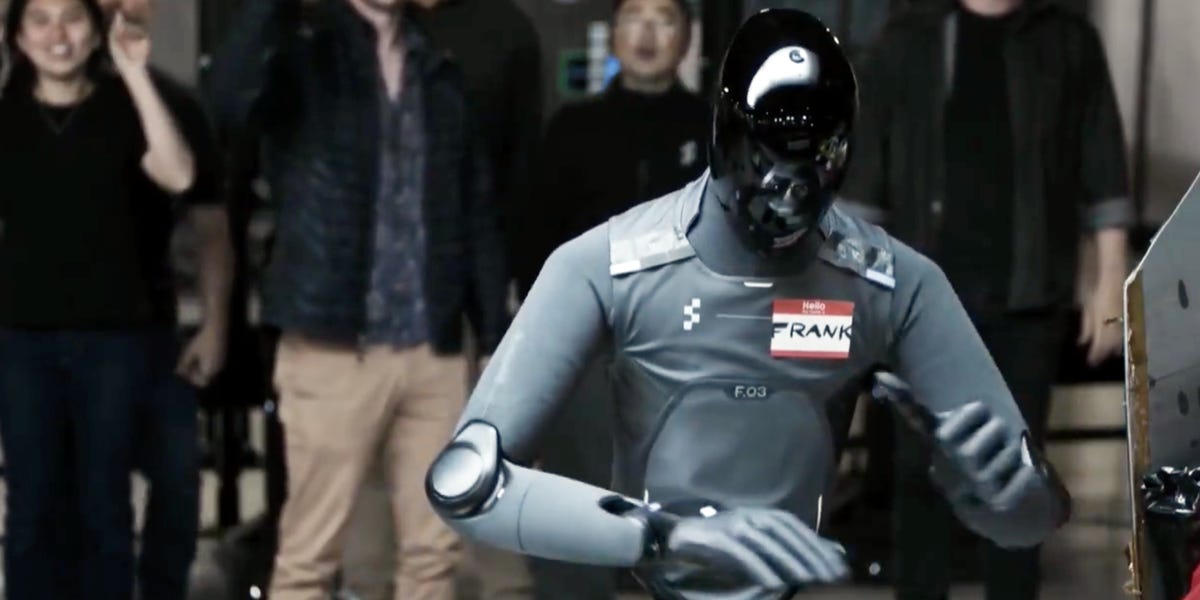
The internet was fascinated. Millions of people watched as a robot picked up a small package and placed it, barcode side down, on a conveyor belt. Two humanoids stand on a charger in the background, ready to recharge the robot they’re working on if its battery runs out. One viewer called the feed “amazingly addictive” and asked for a 24/7 live stream, while investor Jason Calacanis wrote, “ASMR on robots is weirdly comforting.” When the livestream on X received more than 1.5 million views in the first eight hours, some viewers named the three robots Bob, Frank, and Gary.
Adcock said Figure AI achieved its goal of having the robot run for eight hours with “zero failures” and decided to continue. By the end of 24 hours Thursday morning, Humanoid had sorted more than 30,000 packages and had more than 3 million cumulative views.
This viral flow is more than just robotics. For Figure AI, a startup with a market capitalization of about $40 billion, this is an open audition for a future in which humanoids can work long hours in warehouses, factories, and eventually homes. The demo gave investors and potential customers a rare opportunity to see if the company’s robots can reliably perform repetitive tasks.
It also exposed the gap between spectacle and readiness for commercialization. Figure humanoid robots may be approaching human speed, but experts say they still have a long way to go before they can handle the chaotic realities of distribution centers.
“A completely new economy”
Many tasks that are mindless for humans remain difficult for robots, requiring dexterity, perception, balance, and judgment that humans hardly realize they are using. That’s part of what makes videos of humanoids doing routine tasks so fascinating.
Last week, Figure AI released a video of two of its humanoids making a bed together, and Genesis AI, a French startup backed by former Google CEO Eric Schmidt, unveiled an egg-cracking robot and a piano-playing robot.
Among the viewers of this week’s livestream were Figure investor and director Jesse Coors Blankenship and Parkway Venture Capital’s Greg Hill, who were watching from their New York offices and said they planned to celebrate the milestone later.
Watch a team of humanoid robots perform a full 8-hour shift at human performance levels. This is a fully autonomous Helix-02 https://t.co/IdZR0T1F5I
— Brett Adcock (@adcock_brett) May 13, 2026
Coors Blankenship said the conveyor belts are in large loops, with the same packages circulating over and over again. The key, he said, was to demonstrate to potential customers that Figure AI’s humanoid robots can work reliably over extended periods of time, including 24-hour shifts.
“It’s something that’s never been done before, except maybe in a movie,” Coors Blankenship said. “This is very attractive because everyone recognizes that we are moving into a whole new economy.”
Livestream raises the stakes in the race to develop commercially useful humanoids. Figure AI faces stiff competition from Tesla, Agility Robotics, and China’s Unitree.
“I think 50,000 of our viewers are Tesla investors,” Hill said.
“It’s almost like a science project.”
“Congratulations, we did that two years ago,” Agility Robotics co-founder Jonathan Hurst said when asked about Figure AI’s livestream at an event in San Francisco on Wednesday night. The Oregon-based startup has deployed its humanoid robot, Digit, to customers including Amazon, Schaeffler Group, and logistics company GXO.
Figure AI came under intense scrutiny last year after Fortune reported that Adcock appeared to be exaggerating the company’s efforts with major customer BMW. Adcock disputed the report, and the company said the previous humanoid model worked at BMW’s Spartanburg plant for 11 months, working 10-hour weekday shifts and contributing to the production of more than 30,000 X3 vehicles.
Brett Adcock, CEO of Figure AI, is betting on the future of “general purpose humanoids.” Bloomberg/Getty Images
Figure AI’s livestream didn’t have any major glitches, but the robot did exhibit long pauses and odd gestures, such as touching its helmet-like head with its arms. The moment sparked speculation that the humanoids were getting help from a remote human operator. Adcock stressed that the robot is fully autonomous and will decide what to do based on what it sees through its camera.
Adcock said that when the robot gets stuck, its AI model triggers an automatic reset, which viewers sometimes saw during the stream. He added that if a robot experiences a software or hardware problem, it can autonomously leave for maintenance while another robot takes over.
“It hasn’t failed yet, but statistically it probably will at some point,” Adcock wrote of X.
Figure AI’s robots are now roughly on par with humans, according to Adcock, who takes an average of about three seconds per package to sort a package. But speed is just one measure of readiness, said Ayanna Howard, a roboticist and dean of the Ohio State University College of Engineering.
Howard said the livestream was impressive because the robot appeared to be working without failure for a very long time. Still, she said the humanoids looked more like a “science project” than a machine ready for deployment, citing accuracy issues she saw during the stream, including packages being placed on conveyor belts with barcodes facing backwards and one package being knocked off the belt.
“It’s not ready for prime time yet,” Howard said, adding that the robots are only performing a small part of the package sorting process.
“We are still far from having fully autonomous humanoids installed in distribution centers.”
By Thursday evening, the livestream was still running and the humanoid had logged 30 hours of continuous work. Adcock also introduced a new member to the robot crew, Rose.