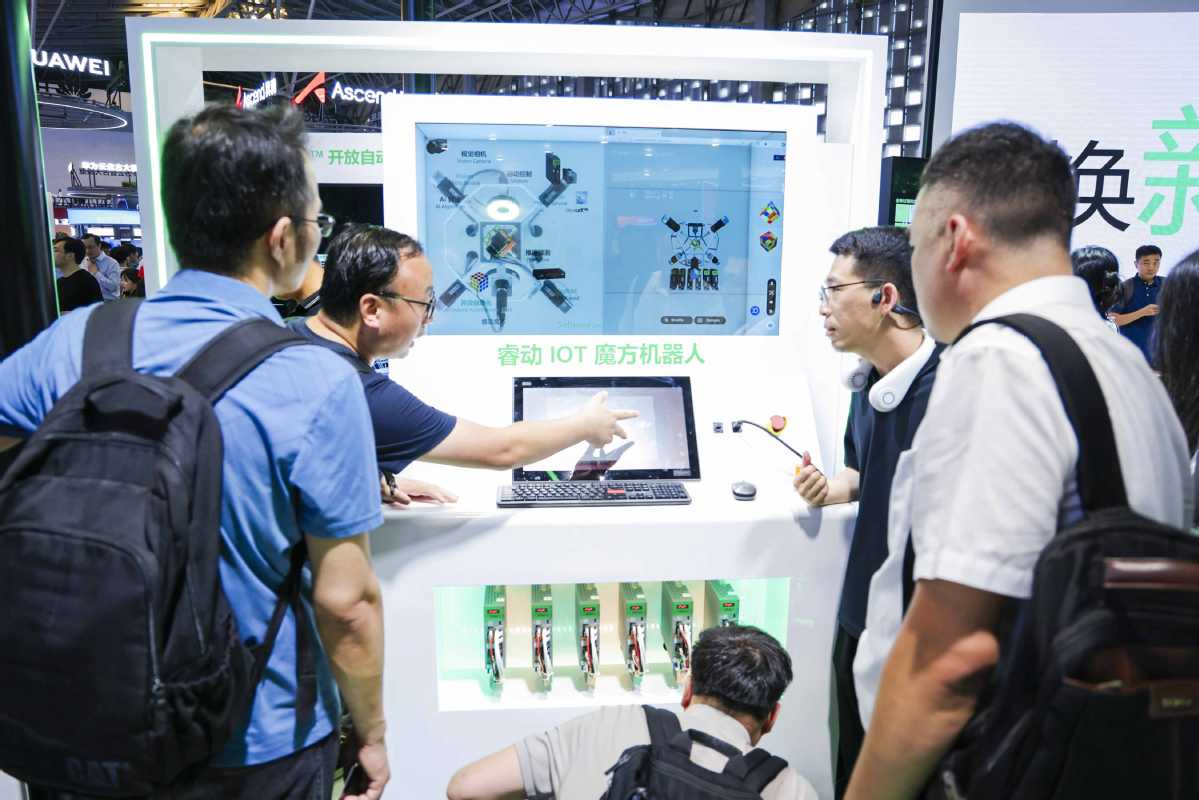
Schneider Electric's booth at the 2024 World AI Congress in Shanghai. [Photo provided to China Daily]
Peter Weckesser, executive vice president and chief digital officer at Schneider Electric, said that while most companies may be using artificial intelligence to increase efficiency by replacing repetitive tasks, some companies, including in China, are using it to optimize energy consumption.
Weckesser made the comments during a recent visit to Shanghai to attend the four-day 2024 World AI Conference.
Weckesser said the value of AI lies in its applicability to industrial scenarios, helping to improve productivity efficiency and address the pressing issues of the energy transition.
China has seen demand for energy management in various industries, including automobiles, steel, cement, glass, water, food and beverages, and chemicals. Energy management is also needed in energy-hungry data centers and buildings, which account for 40 percent of the world's energy consumption, he said.
Schneider Electric's latest financial results also reflected surging market demand: First-quarter revenue reached 8.6 billion euros ($9.3 billion), up more than 5 percent from the same period last year and a record first-quarter result.
Energy management sales increased about 9% year over year. Revenue from its energy management business in China increased in the high single digits. According to the company's Q1 2024 financial report, renewable energy, transportation infrastructure projects, and energy management services sold to power grids, buildings, and manufacturing companies are the major drivers of Schneider Electric's expansion of its energy management business in China.
But there's still a lot of room to grow: Applied at scale, AI can significantly improve energy consumption efficiency by collecting energy flow data and creating insights and analytics, Weckesser said.
One example is Schneider Electric's EcoStruxure AI module, demonstrated at WAIC this year: Offering proven AI foundation models and real-world application scenarios, the module can help industries such as automotive, food and beverage, semiconductor and machinery improve efficiency by an additional 3-5 percent and reduce annual energy consumption by up to 10 percent.
Schneider Electric's AI applications for Chinese customers are quite extensive: The company used AI algorithms to provide intelligent control strategies for Budweiser's production lines in China, improving filtration efficiency by 15 percent.
Based on AI algorithms and machine learning, Schneider Electric has helped Dalian Bank adjust dynamic cooling capacity based on the real-time demand of IT loads, optimize the control of computer room cold stations, and reduce energy costs by 31 percent.
Weckesser said there's reason to expect bigger changes around AI: For example, Schneider Electric says industrial sites and buildings will all grow into microgrids amid the energy transition and the “prosumer” trend (people who both produce and consume energy).
“This will be a huge playground for AI to not only optimize microgrids internally, but how they interact with each other, making the network a significant source of renewable green energy in the future,” he said.
Weckesser said China is leading the world in the use of 5G, which will enable the real-time collection and processing of data that AI can provide.
One of Schneider Electric's factories in Shanghai uses 5G to communicate with mobile robots and incorporates cameras for quality inspection.
“The rest of the world appears to be relatively conservative in deploying 5G in industrial and IoT (Internet of Things) environments. But China is moving ahead at a faster pace than the rest of the world in deploying 5G in industrial applications and factories,” he said.
shijing@chinadaily.com.cn