# introduction
AI architects are not senior engineers who do more of the same work. As engineers implement components, architects design the end-to-end system and manage tradeoffs such as which technologies to choose, how to scale the system and maintain reliability, where risks exist, and how AI investments create measurable value. The work is done not only in code but also in diagrams and decision records.
Demand for this role will skyrocket in 2026. The organization has amassed AI prototypes built over the past two years and now needs someone who can translate them into managed, cost-aware production systems. That transition requires a different set of skills than those that built the prototype.
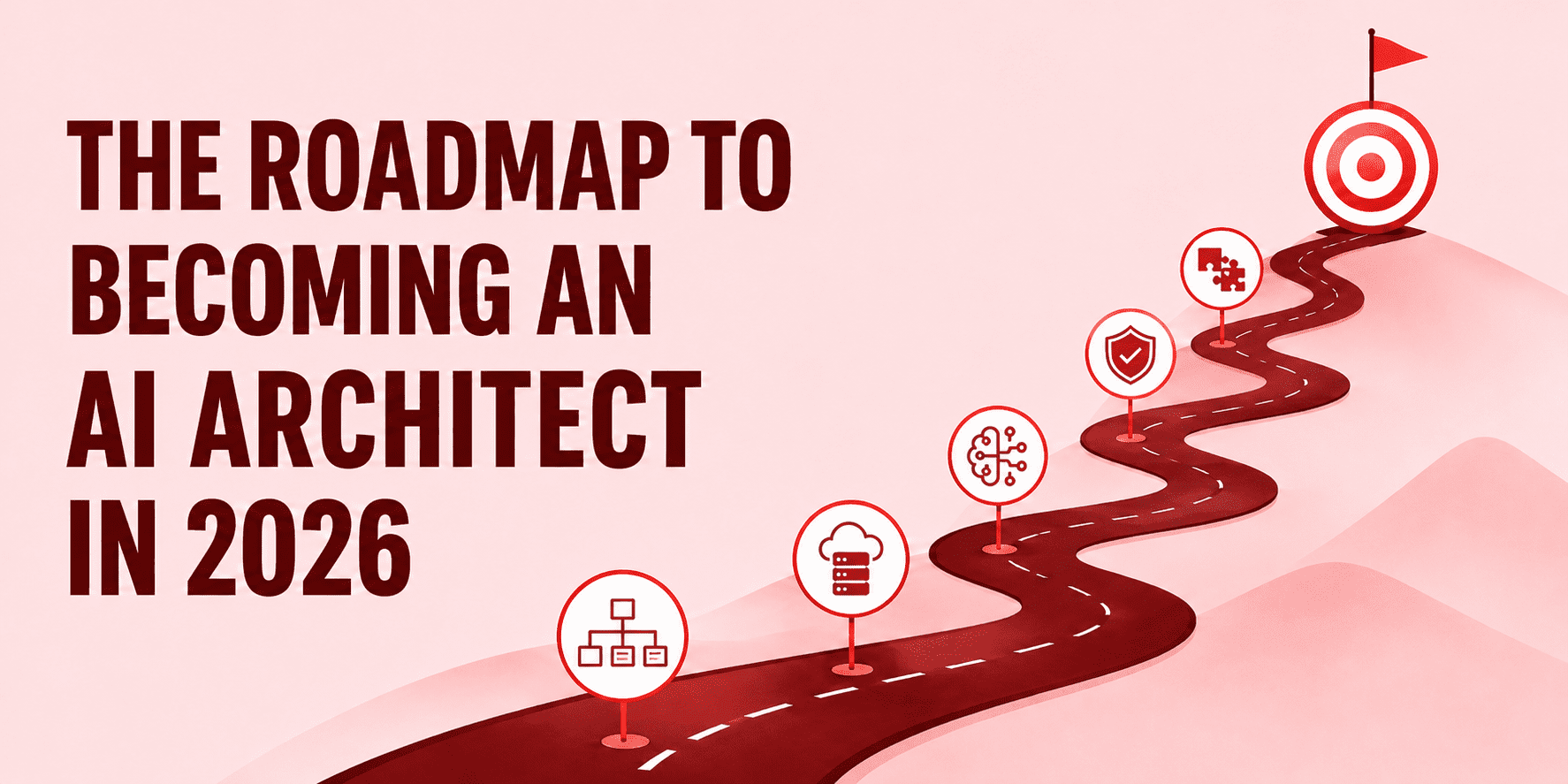
The roadmap sequentially covers five competency areas: technology and data foundations, system architecture design, technology selection, scale and cost, and governance and business alignment. Each step builds on the last and ends with an exercise you can do right now, regardless of your current title. By the end, you will have a clear understanding of what an architect’s job is and how it will grow.
This path assumes you already have engineering experience. If you’re early in your career and want to get your first hands-on builder path, the included LLM Engineer Roadmap covers the basics.
# Strengthening technology and data infrastructure
The architect’s version of technical fundamentals is breadth rather than depth. No need to implement transformers. A thorough understanding of how large-scale language models (LLMs) work is necessary to determine whether a proposed AI feature is feasible, what it will cost, and where it might fail.
Data architecture has equal weight here, but it doesn’t get the attention it deserves in most learning paths. Where the data resides and how fast it can be retrieved will drive all subsequent architectural decisions. Related concepts are data lakes (centralized repositories of raw, unstructured data), streaming pipelines (moving data continuously rather than in batches), and vector databases (storing and querying high-dimensional embeddings for semantic search). You don’t need to build these. You need to know the costs, constraints, and enablements of each so you can specify the right one for your particular system.
The foundation of cloud and infrastructure lies beneath everything: containers, orchestration, and more. KubernetesInfrastructure as Code terraformand the AI service layer provided by Amazon SageMaker and Amazon bedrock, Microsoft Azure AIand Google Vertex AI. Frame all of this as a decision-level understanding.
exercise: Sketch out the components of the AI functionality you’re already using and label them where their data resides, what each part depends on, and what breaks first under load.
# Designing an AI system architecture
Architectural thinking means reasoning about components, data flows, interfaces, and where states and failures exist. This is a core intellectual skill for this role and is developed through the practice of drawing and critiquing rather than reading about it.
Architects compose systems from a set of established patterns. The most relevant for AI systems in 2026 are search augmentation generation (RAG) pipelines (connecting models to external knowledge at query time), multi-agent orchestration (networks of specialized models or agents that delegate work to each other), batch processing and real-time processing (choosing when to perform computations based on latency requirements), and model routing gateways (sending requests to different models based on cost, functionality, or load). Langgraf is a practical framework for implementing and inferring agent patterns.
Designing for change is just as important as designing for today. Models and providers are replaced as fields move. Systems built with loose coupling allow components to interact through well-defined interfaces rather than direct dependencies, and model providers can be exchanged without rewriting. This is an architectural discipline, not a coding detail.
The architect’s main deliverable at this stage is the architecture diagram. You are expected to read and write them fluently as a professional.
exercise: Design a reference architecture for a multi-agent customer support application. Document the interfaces between components, where state is stored, and what happens if one agent fails.
# Selecting technology and weighing build vs. buy technology
Technology selection is one of the decisions that architects are hired to make especially well. An example that characterizes this era is the choice between open weight models and managed proprietary models.
Self-hosted openweight model family and more Llama or Mistral Gain control of your data, predictable costs at scale, and freedom from vendor lock-in. There are also operational burdens such as infrastructure, updates, and engineering time to maintain them. Managed proprietary models from providers like OpenAI and Anthropic offer powerful out-of-the-box functionality and low operational overhead, but incur per-token fees as you scale and data leaves your environment.
Neither is universally correct. The right answer will depend on certain criteria, such as cost at expected volumes, latency requirements, data privacy constraints, tolerance for vendor lock-in, team capabilities, and long-term maintenance commitments. Architects who learn how to evaluate along these dimensions, rather than defaulting to the most discussed tools, can make better decisions.
Two failure modes to watch out for: over-engineering (building a custom infrastructure for a system that a managed service can handle well) and lack of resources (adopting a self-hosted setup that your team can’t support). Both are common and both are expensive.
Document all critical technology decisions as an architecture decision record (ADR). In other words, record what you choose, what you consider, and why. A record that can be revisited as the field changes is more valuable than a decision that exists only in someone’s memory.
exercise: Create a decision matrix comparing self-hosted Openweight vs. managed proprietary for a sample application with defined requirements for latency, data privacy, monthly request volume, and team size.
# Designed for scale, reliability, and cost
A system that works at low volumes will not automatically work at high volumes. Scale requires deliberate design. horizontal scaling (adding instances rather than upgrading a single machine), queuing (absorbing traffic spikes without dropping requests), and graceful degradation (even if a component fails, it continues to provide limited functionality rather than failing completely).
AI systems raise reliability concerns that most distributed systems do not have. The model’s inference time is not constant, so the latency varies. The output is non-deterministic, so the same input may not produce the same output.
Fallback routing is a standard design pattern for managing both, where requests are redirected to a secondary model or cached results if the primary fails or a latency threshold is exceeded.
Semantic caching is worth a special mention. Unlike traditional caches, which return hits only when the strings match exactly, semantic caches return hits when the meaning of the received query is sufficiently similar to one previously answered. At scale, this significantly reduces both cost and latency, and should be in an architect’s toolkit as a design tool rather than just an optimization.
Cost is a design constraint, not an afterthought. In AI systems, spending is concentrated in a few places, such as consuming tokens, computing model inferences, and retrieving data. The discipline of managing this at the system and vendor level is sometimes referred to as FinOps. Architects who cannot model the cost impact of design decisions are missing an important part of their job. Ray Supports distributed computing designs. ML flow and cube flow Supports large-scale experiment tracking and pipeline operations.
exercise: Add scaling and cost planning using the architecture you designed in the previous step. Specify how the system handles a 10x traffic spike, where semantic caching is applied, and what the estimated monthly token cost is at the baseline volume.
# Managing AI and aligning it with business strategy
Where many technically brilliant architects get stuck is governance and business alignment. This step is the top half of the role.
Security, data governance, compliance, and responsible AI are design requirements, not audit checkboxes. They belong to architecture from the beginning. An established framework provides architects with a common vocabulary for this work. Well-designed frameworks from AWS Covers system-level reliability and security. of NIST AI Risk Management Framework (RMF) Provides structured guidance for identifying and mitigating AI-specific risks. and recognition EU AI law Considering the risk stage compliance requirements are relevant for systems serving European users or built by European organizations.
Aligning AI work to business goals requires a different mode of communication than technical design. Stakeholders making investment decisions require tradeoffs expressed in terms of costs, risks, and outcomes rather than in terms of models and infrastructure. Architects who can fluently translate between both registers are much more capable than those who cannot.
The loop ends when the value is measured. Many AI projects fail not because the technology doesn’t work, but because no one defined what success meant. Defining success metrics before implementation and tracking return on investment after implementation is part of the architect’s remit and is not the job of a separate business analyst.
exercise: A one-page record of the architectural decisions you have made for the system you have designed over these steps. Include a risk and governance section, a compliance checklist relevant to your industry, and a success metrics section with at least two measurable outcomes.
# Recommended learning resources
Certifications and structured learning:
- Cloud Architect Certification AWS, google cloudand azur Provides a structured framework for infrastructure and system design
- System design courses for platforms such as Deep learning.AI Cover AI-specific patterns
Books:
Standards and frameworks:
# final thoughts
These five competencies form progress. The breadth of technical and data provides a vocabulary for assessing feasibility. System design provides a language for specifying how components are connected. Technology selection provides the judgment to choose appropriately among options. Our scale and cost design allows us to keep our systems running reliably without surprising anyone with a bill. Governance and business alignment provides leverage for AI work to create value.
The architect’s role rewards judgment built over time. The most direct way to grow to this level is to start creating the deliverables that the role currently requires, such as architecture diagrams, decision records, and written trade-off analyses, regardless of your current role. Design reviews and documented decisions become complex. These portfolios demonstrate readiness more specifically than any certification.
If you prefer building at the code level rather than designing at the system level, the accompanying LLM Engineer Roadmap covers that path in detail.
Start creating charts and decision records today. The practice itself accelerates the transition.
Vinod Chugani He is an AI and data science educator who bridges the gap between emerging AI technologies and practical applications for practicing professionals. His areas of focus include agent AI, machine learning applications, and automated workflows. Vinod has supported data professionals through skill development and career transition through his work as a technical mentor and instructor. He incorporates analytical expertise from quantitative finance into a practical teaching approach. His content highlights actionable strategies and frameworks that professionals can apply right away.