
Eyring, V. et al. Pushing the frontiers in climate modelling and analysis with machine learning. Nat. Clim. Change 14, 916–928 (2024).
Google Scholar
Bordoni, S., Kang, S., Shaw, T. A., Simpson, I. & Zanna, L. The futures of climate modeling. npj Clim. Atmos. Sci. 8, 99 (2025).
Google Scholar
IPCC. Climate Change 2021: The Physical Science Basis. Contribution of Working Group I to the Sixth Assessment Report of the Intergovernmental Panel on Climate Change (Cambridge University Press, Cambridge, United Kingdom and New York, NY, USA, 2021).
Schneider, T. et al. Harnessing AI and computing to advance climate modelling and prediction. Nat. Clim. Change 13, 887–889 (2023).
Google Scholar
Bauer, P., Stevens, B. & Hazeleger, W. A digital twin of Earth for the green transition. Nat. Clim. Change 11, 80–83 (2021).
Google Scholar
Tebaldi, C., Snyder, A. & Dorheim, K. STITCHES: creating new scenarios of climate model output by stitching together pieces of existing simulations. Earth Syst. Dyn. Discuss. 2022, 1–58 (2022).
Holden, P. B., Edwards, N. R., Hensman, J. & Wilkinson, R. D. ABC for Climate: Dealing with Expensive Simulators. In Sisson, S. A., Fan, Y. & Beaumont, M. (eds.) Handbook of approximate Bayesian computation, 569–595 (Chapman and Hall/CRC, Boca Raton, FL, 2018).
Hartin, C. A., Patel, P., Schwarber, A., Link, R. P. & Bond-Lamberty, B. A simple object-oriented and open-source model for scientific and policy analyses of the global climate system – Hector v1.0. Geosci. Model Dev. 8, 939–955 (2015).
Google Scholar
Nicholls, Z. R. et al. Reduced Complexity Model Intercomparison Project Phase 1: introduction and evaluation of global-mean temperature response. Geosci. Model Dev. 13, 5175–5190 (2020).
Google Scholar
Kikstra, J. S. et al. The IPCC Sixth Assessment Report WGIII climate assessment of mitigation pathways: from emissions to global temperatures. Geosci. Model Dev. 15, 9075–9109 (2022).
Google Scholar
Watt-Meyer, O. et al. ACE: A fast, skillful learned global atmospheric model for climate prediction. In Tackling Climate Change with Machine Learning Workshop, Conference on Neural Information Processing Systems (NeurIPS) (2023).
Watt-Meyer, O. et al. ACE2: accurately learning subseasonal to decadal atmospheric variability and forced responses. npj Clim. Atmos. Sci. 8, 205 (2025).
Google Scholar
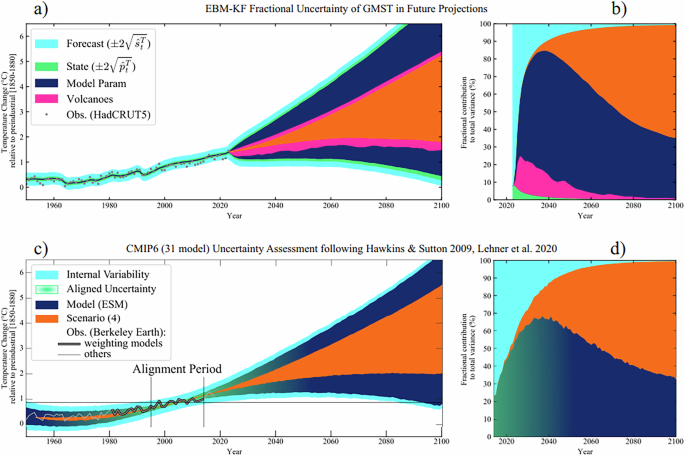
Nicklas, J. M., Fox-Kemper, B. & Lawrence, C. Efficient estimation of climate state and its uncertainty using Kalman filtering with application to policy thresholds and volcanism. J. Clim. 38, 1235–1270 (2025).
Google Scholar
Wu, E. et al. Applying the ACE2 emulator to SST green’s functions for the E3SMv3 global atmosphere model. JGR: Machine Learning and Computation. 2, e2025JH000774 (2025).
Guan, H., Arcomano, T., Chattopadhyay, A. & Maulik, R. LUCIE: A Lightweight Uncoupled ClImate Emulator with long-term stability and physical consistency for O(1000)-member ensembles. In Machine Learning for Earth System Modeling Workshop, International Conference on Machine Learning (ICML) (2024).
Mathison, C. et al. A rapid-application emissions-to-impacts tool for scenario assessment: Probabilistic Regional Impacts from Model patterns and Emissions (PRIME). Geosci. Model Dev. 18, 1785–1808 (2025).
Google Scholar
Kitsios, V., O’Kane, T. J. & Newth, D. A machine learning approach to rapidly project climate responses under a multitude of net-zero emission pathways. Commun. Earth Environ. 4, 355 (2023).
Google Scholar
Tebaldi, C., Selin, N., Ferrari, R. & Flierl, G. Emulators of Climate Model Output. Annual Review of Environment and Resources. 50 (2025).
De Burgh-Day, C. O. & Leeuwenburg, T. Machine learning for numerical weather and climate modelling: a review. Geosci. Model Dev. 16, 6433–6477 (2023).
Google Scholar
Dunne, J. P. et al. An evolving Coupled Model Intercomparison Project phase 7 (CMIP7) and Fast Track in support of future climate assessment. EGUsphere 2024, 1–51 (2024).
Eyring, V. et al. Overview of the Coupled Model Intercomparison Project Phase 6 (CMIP6) experimental design and organization. Geosci. Model Dev. 9, 1937–1958 (2016).
Google Scholar
Balaji, V. et al. Are general circulation models obsolete? Proc. Natl. Acad. Sci. 119, e2202075119 (2022).
Google Scholar
Wang, H. et al. Scientific discovery in the age of artificial intelligence. Nature 620, 47–60 (2023).
Google Scholar
Tebaldi, C. & Arblaster, J. M. Pattern scaling: Its strengths and limitations, and an update on the latest model simulations. Clim. Change 122, 459–471 (2014).
Google Scholar
Beusch, L., Gudmundsson, L. & Seneviratne, S. I. Emulating Earth system model temperatures with MESMER: from global mean temperature trajectories to grid-point-level realizations on land. Earth Syst. Dyn. 11, 139–159 (2020).
Google Scholar
Lee, L., Carslaw, K., Pringle, K., Mann, G. & Spracklen, D. Emulation of a complex global aerosol model to quantify sensitivity to uncertain parameters. Atmos. Chem. Phys. 11, 12253–12273 (2011).
Google Scholar
Edwards, T. L. et al. Projected land ice contributions to twenty-first-century sea level rise. Nature 593, 74–82 (2021).
Google Scholar
Bocquet, M. Surrogate modeling for the climate sciences dynamics with machine learning and data assimilation. Front. Appl. Math. Stat. 9, 1133226 (2023).
Google Scholar
Van Katwyk, P., Fox-Kemper, B., Seroussi, H., Nowicki, S. & Bergen, K. J. A Variational LSTM Emulator of Sea Level Contribution From the Antarctic Ice Sheet. J. Adv. Model. Earth Syst. 15, e2023MS003899 (2023).
Google Scholar
Gasser, T. et al. Historical co2 emissions from land use and land cover change and their uncertainty. Biogeosciences 17, 4075–4101 (2020).
Google Scholar
Nicholls, R. J. et al. A global analysis of subsidence, relative sea-level change and coastal flood exposure. Nat. Clim. Change 11, 338–342 (2021).
Google Scholar
Quilcaille, Y., Gasser, T., Ciais, P. & Boucher, O. Cmip6 simulations with the compact earth system model oscar v3.1. Geosci. Model Dev. 16, 1129–1161 (2023).
Google Scholar
Zhou, L. et al. Toward Convective-Scale Prediction within the Next Generation Global Prediction System. Bull. Am. Meteorol. Soc. 100, 1225–1243 (2019).
Google Scholar
Addison, H., Kendon, E., Ravuri, S., Aitchison, L. & Watson, P. A. Machine learning emulation of a local-scale UK climate model. In Tackling Climate Change with Machine Learning workshop at NeurIPS 2022 (2022).
Addison, H., Kendon, E., Ravuri, S., Aitchison, L. & Watson, P. A. Machine learning emulation of precipitation from km-scale regional climate simulations using a diffusion model. arXiv preprint arXiv:2407.14158 (2024).
Van Katwyk, P., Fox-Kemper, B., Nowicki, S., Seroussi, H. & Bergen, K. J. Iseflow v1.0: A flow-based neural network emulator for improved sea level projections and uncertainty quantification. EGUsphere 2025, 1–32 (2025).
Wu, B., Zheng, S., Li, S. & Wang, S. Neural emulator based on physical fields for accelerating the simulation of surface chlorophyll in an Earth System Model. Ocean Model. 102491 (2025).
Bassetti, S., Hutchinson, B., Tebaldi, C. & Kravitz, B. DiffESM: Conditional Emulation of Temperature and Precipitation in Earth System Models With 3D Diffusion Models. J. Adv. Model. Earth Syst. 16, e2023MS004194 (2024).
Google Scholar
Cachay, S. R., Ramesh, V., Cole, J., Barker, H. & Rolnick, D. ClimART: A Benchmark Dataset for Emulating Atmospheric Radiative Transfer in Weather and Climate Models. In Proceedings of the Neural Information Processing Systems Track on Datasets and Benchmarks, vol. 1 (2021).
Beucler, T. et al. Climate-invariant machine learning. Sci. Adv. 10, eadj7250 (2024).
Google Scholar
Perezhogin, P., Zhang, C., Adcroft, A., Fernandez-Granda, C. & Zanna, L. A stable implementation of a data-driven scale-aware mesoscale parameterization. J. Adv. Model. Earth Syst. 16, e2023MS004104 (2024).
Google Scholar
Smith, C. J. et al. Fair v1. 3: a simple emissions-based impulse response and carbon cycle model. Geosci. Model Dev. 11, 2273–2297 (2018).
Google Scholar
Lai, C.-Y. et al. Machine Learning for Climate Physics and Simulations. Ann. Rev. Condens. Matter Phys. 16 (2024).
van Vuuren, D. et al. The Scenario Model Intercomparison Project for CMIP7 (ScenarioMIP-CMIP7). EGUsphere 2025, 1–38 (2025).
O’Neill, B. C. et al. The scenario model intercomparison project (ScenarioMIP) for CMIP6. Geosci. Model Dev. 9, 3461–3482 (2016).
Google Scholar
Nowicki, S. et al. Experimental protocol for sea level projections from ISMIP6 stand-alone ice sheet models. Cryosphere 14, 2331–2368 (2020).
Google Scholar
Jones, C. D. et al. C4MIP – the coupled climate–carbon cycle model intercomparison project: experimental protocol for CMIP6. Geosci. Model Dev. 9, 2853–2880 (2016).
Google Scholar
Hausfather, Z. An assessment of current policy scenarios over the 21st century and the reduced plausibility of high-emissions pathways. Dialogues Clim. Change 2, 26–32 (2025).
Google Scholar
Hausfather, Z. & Peters, G. P. Emissions–the ‘business as usual’ story is misleading. Nature 577, 618–620 (2020).
Google Scholar
Jones, C. G. et al. Bringing it all together: science priorities for improved understanding of Earth system change and to support international climate policy. Earth Syst. Dyn. 15, 1319–1351 (2024).
Google Scholar
Yang, Q., Elsaesser, G. S., Van Lier-Walqui, M. & Eidhammer, T. A simple emulator that enables interpretation of parameter-output relationships, applied to two climate model PPEs. J. Adv. Model. Earth Syst. 17, e2024MS004766 (2025).
Google Scholar
Hourdin, F. et al. Toward machine-assisted tuning avoiding the underestimation of uncertainty in climate change projections. Sci. Adv. 9, eadf2758 (2023).
Google Scholar
Fu, L.-L. et al. The surface water and ocean topography mission: A breakthrough in radar remote sensing of the ocean and land surface water. Geophys. Res. Lett. 51, e2023GL107652 (2024).
Google Scholar
Durack, P. J. et al. The Coupled Model Intercomparison Project (CMIP): Reviewing project history, evolution, infrastructure and implementation. EGUsphere 2025, 1–74 (2025).
Cinquini, L. et al. The Earth System Grid Federation: An open infrastructure for access to distributed geospatial data. Future Gener. Comput. Syst. 36, 400–417 (2014).
Google Scholar
Hassell, D., Gregory, J., Blower, J., Lawrence, B. N. & Taylor, K. E. A data model of the climate and forecast metadata conventions (cf-1.6) with a software implementation (cf-python v2.1). Geosci. Model Dev. 10, 4619–4646 (2017).
Google Scholar
Juckes, M. et al. The CMIP6 Data Request (DREQ, version 01.00.31). Geosci. Model Dev. 13, 201–224 (2020).
Google Scholar
Dueben, P. D. et al. Challenges and benchmark datasets for machine learning in the atmospheric sciences: Definition, status, and outlook. Artif. Intell. Earth Syst. 1, e210002 (2022).
Watson-Parris, D. et al. ClimateBench v1. 0: A benchmark for data-driven climate projections. J. Adv. Model. Earth Syst. 14, e2021MS002954 (2022).
Google Scholar
Kaltenborn, J. et al. ClimateSet: A Large-Scale Climate Model Dataset for Machine Learning. In Thirty-seventh Conference on Neural Information Processing Systems Datasets and Benchmarks Track (2023).
Hoffman, F. M. et al. Rapid evaluation framework for the CMIP7 assessment fast track. EGUsphere 2025, 1–57 (2025).
Lütjens, B., Ferrari, R., Watson-Parris, D. & Selin, N. E. The impact of internal variability on benchmarking deep learning climate emulators. J. Adv. Model. Earth Syst. 17, e2024MS004619 (2025).
Google Scholar
Ullrich, P. A. et al. Recommendations for comprehensive and independent evaluation of machine learning-based Earth system models. J. Geophys. Res.: Mach. Learn. Comput. 2, e2024JH000496 (2025).
Woollam, J. et al. SeisBench-a toolbox for machine learning in seismology. Seismol. Res. Lett. 93, 1695–1709 (2022).
Google Scholar
Münchmeyer, J. et al. Which picker fits my data? A quantitative evaluation of deep learning based seismic pickers. J. Geophys. Res.: Solid Earth 127, e2021JB023499 (2022).
Google Scholar
Wilson, G. et al. Best practices for scientific computing. PLOS Biol. 12, e1001745 (2014).
Google Scholar
Pedregosa, F. et al. Scikit-learn: Machine Learning in Python. J. Mach. Learn. Res. 12, 2825–2830 (2011).
Hoyer, S. & Hamman, J. xarray: N-D labeled arrays and datasets in Python. J. Open Res. Softw. 5 (2017).
Kurth, T. et al. FourCastNet: Accelerating Global High-Resolution Weather Forecasting Using Adaptive Fourier Neural Operators. PASC ’23: Proceedings of the Platform for Advanced Scientific Computing Conference, 13. (ACM, New York, NY, 2023).
Duncan, J. P. C. et al. Application of the AI2 climate emulator to E3SMv2’s global atmosphere model, with a focus on precipitation fidelity. J. Geophys. Res.: Mach. Learn. Comput. 1, e2024JH000136 (2024).
Kent, C. et al. Skilful global seasonal predictions from a machine learning weather model trained on reanalysis data. npj Clim. Atmos. Sci. 8, 314 (2025).
Kopp, R. E. et al. The Framework for Assessing Changes To Sea-level (FACTS) v1.0: a platform for characterizing parametric and structural uncertainty in future global, relative, and extreme sea-level change. Geosci. Model Dev. 16, 7461–7489 (2023).
Google Scholar
Nicholls, Z. R. J. et al. Reduced complexity model intercomparison project phase 1: introduction and evaluation of global-mean temperature response. Geosci. Model Dev. 13, 5175–5190 (2020).
Google Scholar
Windisch, M. et al. Fastmip-coordinating experiments of regional emulators for intercomparison and fast regional projections. In AGU Fall Meeting Abstracts, vol. 2024, GC01–113 (2024).
Hawkins, E. & Sutton, R. The potential to narrow uncertainty in regional climate predictions. Bull. Am. Meteorol. Soc. 90, 1095–1108 (2009).
Google Scholar
Lehner, F. et al. Partitioning climate projection uncertainty with multiple large ensembles and CMIP5/6. Earth Syst. Dyn. 11, 491–508 (2020).
Google Scholar
Lam, R. et al. Learning skillful medium-range global weather forecasting. Science 382, 1416–1421 (2023).
Nguyen, T., Brandstetter, J., Kapoor, A., Gupta, J. K. & Grover, A. ClimaX: A foundation model for weather and climate. In Proceedings of the 40th International Conference on Machine Learning (ICML), vol. 202 of Proceedings of Machine Learning Research (PMLR), 25904–25938 https://proceedings.mlr.press/v202/nguyen23a.html (2023).
Kochkov, D. et al. Neural general circulation models for weather and climate. Nature 632, 1060–1066 (2024).
Google Scholar
Holden, P. B. & Edwards, N. R. Dimensionally reduced emulation of an AOGCM for application to integrated assessment modelling. Geophys. Res. Lett. 37 (2010).
Castruccio, S. et al. Statistical Emulation of Climate Model Projections Based on Precomputed GCM Runs. J. Clim. 27, 1829–1844 (2014).
Google Scholar
Geoffroy, O. et al. Transient Climate Response in a Two-Layer Energy-Balance Model. Part II: Representation of the Efficacy of Deep-Ocean Heat Uptake and Validation for CMIP5 AOGCMs. J. Clim. 26, 1859–1876 (2013).
Google Scholar
Mitchell, T. D. Pattern Scaling: An Examination of the Accuracy of the Technique for Describing Future Climates. Clim. Change 60, 217–242 (2003).
Google Scholar
Kravitz, B. & Snyder, A. Pangeo-Enabled ESM Pattern Scaling (PEEPS): A customizable dataset of emulated Earth System Model output. PLOS Clim. 2, e0000159 (2023).
Google Scholar
Nath, S., Lejeune, Q., Beusch, L., Schleussner, C.-F. & Seneviratne, S. I. MESMER-M: an Earth system model emulator for spatially resolved monthly temperature. Earth Syst. Dyn. Discuss. 2021, 1–38 (2021).
Carzon, J. et al. Statistical constraints on climate model parameters using a scalable cloud-based inference framework. Environ. Data Sci. 2, e24 (2023).
Google Scholar
Baker, E., Harper, A. B., Williamson, D. & Challenor, P. Emulation of high-resolution land surface models using sparse Gaussian processes with application to JULES. Geosci. Model Dev. 15, 1913–1929 (2022).
Google Scholar
Ming, D., Williamson, D. & Guillas, S. Deep Gaussian process emulation using stochastic imputation. Technometrics 65, 150–161 (2023).
Google Scholar
Cachay, S. R., Henn, B., Watt-Meyer, O., Bretherton, C. S. & Yu, R. Probabilistic Emulation of a Global Climate Model with Spherical DYffusion. In Conference on Neural Information Processing Systems (NeurIPS) (2024).
Bi, K. et al. Accurate medium-range global weather forecasting with 3D neural networks. Nature 619, 533–538 (2023).
Google Scholar
Dheeshjith, S. et al. Samudra: An AI Global Ocean Emulator for Climate. Geophys. Res. Lett. 52, e2024GL114318 (2025).
Google Scholar
George, T. M., Manucharyan, G. E. & Thompson, A. F. Deep learning to infer eddy heat fluxes from sea surface height patterns of mesoscale turbulence. Nat. Commun. 12, 800 (2021).
Google Scholar
Bolton, T. & Zanna, L. Applications of Deep Learning to Ocean Data Inference and Subgrid Parameterization. J. Adv. Model. Earth Syst. 11, 376–399 (2019).
Google Scholar
Palmer, M. D., Harris, G. R. & Gregory, J. M. Extending CMIP5 projections of global mean temperature change and sea level rise due to thermal expansion using a physically-based emulator. Environ. Res. Lett. 13, 084003 (2018).
Google Scholar
Tang, G., Nicholls, Z., Norton, A., Zaehle, S. & Meinshausen, M. Synthesizing global carbon–nitrogen coupling effects – the MAGICC coupled carbon–nitrogen cycle model v1.0. Geosci. Model Dev. 18, 2193–2230 (2025).
Google Scholar
Gasser, T., Guivarch, C., Tachiiri, K., Jones, C. & Ciais, P. The compact Earth system model OSCAR v2.2: description and first results. Geosci. Model Dev. 10, 271–319 (2017).
Google Scholar


