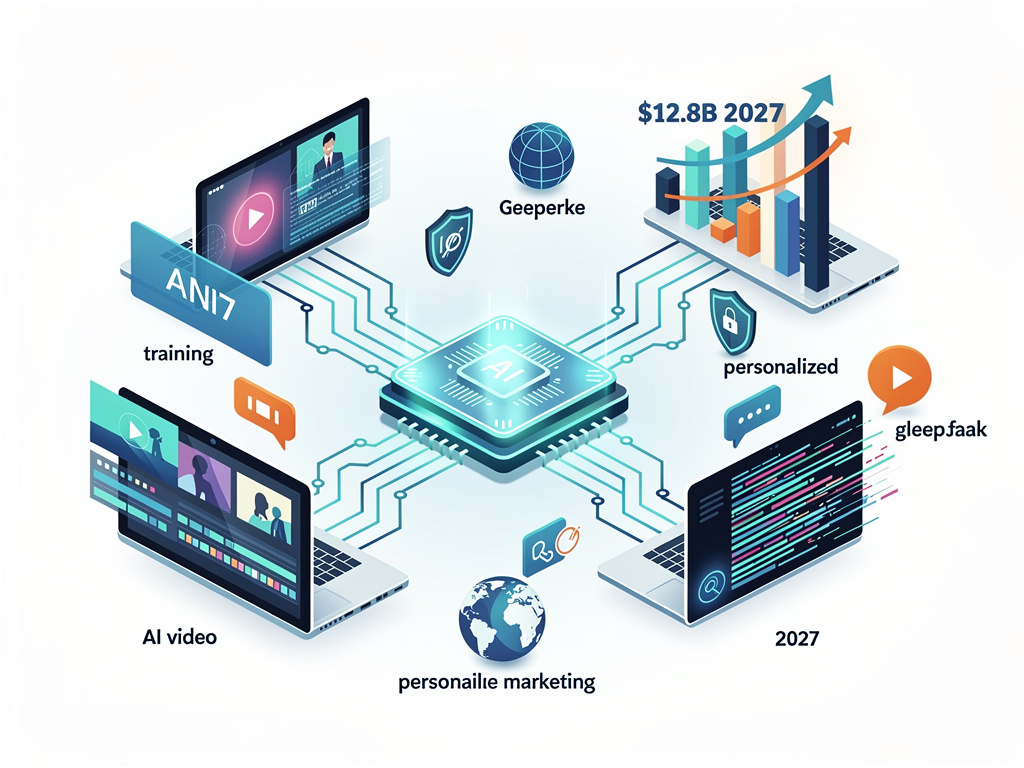
In the high-stakes field of business communications, artificial intelligence is rewriting the rules of video production, compressing timelines from weeks to hours, and allowing executives to deliver sophisticated content without staff or studios. “AI video tools allow businesses to significantly reduce the effort and time required to create video content across ads, instructions, tutorials, and more,” Victor Erukhimov, CEO of CraftStory, told BetaNews. Tasks that once required specialized teams can now be completed in hours, and mobile and social platforms are exploding the demand for video.
This change comes amid explosive market growth. According to data from MarketsandMarkets cited by Clippie.ai, the AI video tools sector is expected to reach $4.2 billion in 2025 and $12.8 billion by 2027. Meanwhile, Glean’s analysis shows that 89% of businesses now use video as a marketing staple, 95% of video marketers believe video is central to their strategy, and 68% of non-users plan to enter in 2025. Deepfakes grab the headlines, but legitimate enterprise applications, from training modules to personalized sales pitches, are driving real adoption.
Technological advances that facilitate scalable production
Core challenges such as long-form consistency have been reduced. Erukhimov explained to BetaNews how CraftStory is rethinking generation. “Rather than forcing a single diffusion process to cover a long interval, we split the video into short segments and run multiple diffusion processes in parallel while preserving character identity, motion, and visual consistency.” This produces footage several minutes long and reduces rendering time to 30 minutes for a one-minute clip, allowing for rapid iteration.
Tools like Google’s Veo 3 provide a great example of this. As detailed in Robotics & Automation News on January 24, 2026, Veo 3 allows companies to “automatically create high-quality videos with minimal effort,” making it ideal for robotics demos and e-commerce promotions from CAD files. Meanwhile, Synthesia says Avatar supports more than 140 languages for global consistency and dominates training and internal communications, with “companies using it for internal communications, onboarding new employees, and creating videos for customer support and knowledge bases,” as tested in Synthesia’s 2026 Roundup.
Runway Gen-4 and HeyGen further enrich your arsenal with HeyGen, which enables real-time interactive avatars for promotional purposes. According to Glean, these platforms compress production time from days to minutes, saving up to 14 hours and $1,500 per project while ensuring brand consistency.
Training and instructional videos lead adoption
Erkhimov predicts that training videos will lead the way because they can be easily updated without reshooting. “We are already seeing adoption in training and educational videos,” he told BetaNews, with AI avatars delivering a consistent message across global teams. Synthesia follows suit, positioning itself as the go-to company for L&D with seamless LMS integration for on-demand modules.
In manufacturing and healthcare, AI is animating CAD designs to create assembly guides and surgical simulations to reduce errors and risk, notes Robotics & Automation News. “Safer, more cost-effective learning,” he says, and small businesses that once required a physical setup can save thousands of dollars on demos. Seagate CEO Dave Mosley highlighted the scale in a December 2025 Seagate article, predicting that “more video content will be created in 2026 than at any point in history.”
For distributed teams, a collaborative platform like LTX Studio enables real-time editing and asset sharing, eliminating version confusion. According to LTX Studio, “The efficiency gains come not from the speed of individual tools, but from the elimination of communication overhead.”
Marketing and sales become highly personalized
Product demos and lightweight marketing will closely follow. “The next wave will be product demos, instructional and lightweight marketing videos,” Erukhimov said, highlighting the large number of formats that require rapid localization. Tools like Clippie automate long to short clips, generate 5-20 virality per video in 15 minutes, and score virality with Opus Clip (70-85% accuracy).
Glean reports that 58% of YouTube ads and 52% of TikTok/Instagram Reels are now powered by AI, with edited thumbnails increasing click-throughs by 38%. Veo 3 creates platform-optimized variants. “Campaigns can be created faster, updated in real-time, and customized for specific customer segments,” says Robotics & Automation News. HeyGen is personalized with your audience’s name and pain points, making it perfect for B2B outreach.
According to Clippie.ai, top creators earn between $500,000 and $5 million annually with 5-10x more output, while agencies are scaling up to produce more than 400 client videos per month with small teams. Coca-Cola’s controversial AI Christmas ad shows the brand’s appetite for high-stakes creativity, Erkhimov said.
Avoid risks in crowded arenas
The proliferation of deepfakes (projected from 500,000 files in 2023 to 8 million files in 2025) has raised concerns about fraud, with numbers in North America increasing by 1,740% and losses expected to exceed $200 million in the first quarter of 2025, Green warns. Delayed detection: Listeners only recognize AI voices half the time.
Erukhimov emphasizes selective data. CraftStory’s high-frame-rate, multi-camera system captures blurry, subtle movements in scraped web video and produces “crisp, detailed hand and facial movements.” LTX Studio further adds, “Transparency is not about regulatory compliance, it is about market differentiation.”
Ethics tools prioritize disclosure and YouTube requires labeling. Clippie.ai says, “AI will eliminate commodity video work, but amplify the value of human creativity,” so companies must balance speed and trust.
2026 Horizon: End-to-end simplicity wins
Erkhimov foresees a platform that bridges the gap from clips to full video. “The winner will be a platform that really simplifies end-to-end video creation,” says CraftStory’s text-to-video conversion, which specifies tone, gesture, and choreography. Clippie.ai predicts autonomous agents that handle minutes of photorealism, real-time editing, and complete workflows.
According to the LTX Studio project, AI video analytics will grow from $32 billion in 2025 to $133 billion by 2030 at a 33% CAGR. Hyper-personalization, or videos that adapt to viewer data, promises 2 to 5 times more engagement. Robotics & Automation News looks at AR/VR immersion and multilingual lip-sync for global reach.
According to NewscastStudio, Agentic AI has the potential to automate media operations, but organizational hurdles remain. Seagate’s Mosley said, “We are at a pivotal time in stimulating and expanding creativity.” For insiders, the instructions are clear. Without mastering these tools, video-driven corporate interactions risk becoming obsolete.