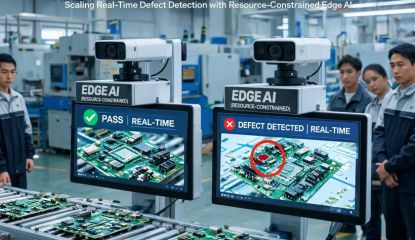
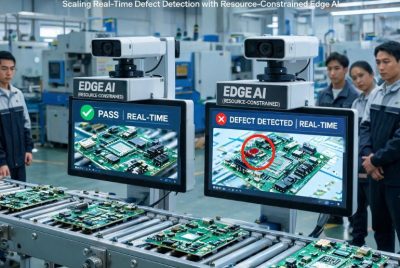
 The core objective of modern manufacturing is simple: achieve zero-defect production at scale. Yet, for decades, industrial quality control has been hamstrung by a structural paradox. Human inspection is well-known to be susceptible to fatigue.Moreover, there is the use of rigid pixel matching methods that are used by machine vision and fail to work effectively because of the challenges posed by real-world imperfections. In light of this, the current smart factories have begun to make use of Resource-Constrained Edge AI even within their production lines, allowing weaker processing power to conduct image analysis and find faults.
When deep learning and Convolutional Neural Networks (CNNs) emerged, they promised a revolution, demonstrating an elite capacity to automatically learn complex features and accurately classify faults without manual engineering. However, these massive neural networks introduced a massive infrastructure hurdle.
For years, the standard approach was to stream production line data to centralized cloud servers to perform inference. In a high-speed automotive or electronics assembly facility, this architecture quickly falls apart. High data transmission latency, massive bandwidth expenses, and severe operational vulnerability during network drops make cloud-reliant quality inspection entirely unviable for real-time line intervention. To stop a defective component from moving down the line, decisions must happen in milliseconds.
The industry’s answer is Edge AI, which brings machine learning models directly onto localized hardware on the shop floor. But standard factory floors are not climate-controlled cloud data centers; they are filled with compact, localized, and embedded systems. To deploy these advanced neural networks directly onto the factory floor without astronomical hardware budgets, industrial enterprises must embrace Resource-constrained Edge AI.
By running highly optimized machine learning architectures on embedded microcontrollers and local edge accelerators, manufacturers can instantly capture, process, and act upon structural anomalies right at the source. This comprehensive guide highlights the impact that Resource-constrained Edge AI has made in changing the face of quality control and enabling the rise of the autonomous smart factory through its quick ROI (return on investment).
Shift in Architecture: From Cloud-Dependence to Factory Floor Autonomy
To comprehend the importance of resource-constrained edge AI when it comes to the high throughput nature of smart factories, it is first necessary to understand the inherent failure of cloud-based visual inspections.

Consider a high-speed bottling or semiconductor production line where parts move past an inspection camera at a rate of 30 to 60 units per second. A standard high-resolution camera captures several gigabytes of visual data every minute. Streaming this massive, uncompressed data payload to a cloud data center introduces a multi-second latency bottleneck caused by network serialization, routing, and cloud queue processing.
By the time a cloud-hosted vision model processes an image and transmits an “anomaly detected” flag back to the facility, the defective component has already traveled hundreds of feet down the line, potentially embedded itself into a larger assembly, or caused a physical jam on the conveyor belt.
Furthermore, relying on external network pipelines exposes the manufacturing execution system (MES) to devastating operational risks. A momentary internet outage completely blinds the quality control system, forcing operators to either halt production entirely—costing thousands of dollars per minute—or run blindly, risking catastrophic batches of defective inventory.
By deploying Resource-constrained Edge AI, the entire mathematical inference pipeline is executed directly at the camera node or within an adjacent industrial PC. Because the sensor data does not need to travel across an external network, latency is slashed from seconds down to single-digit milliseconds.
This hyper-localized execution allows Edge AI units to interface directly with programmable logic controllers (PLCs) and robotic actuation arms. Once any form of anomaly is identified, the localized system creates an instant physical reaction, for instance, through the deployment of a pneumatic reject arm that discards the malformed part without affecting the rest of the production chain.
Additionally, the introduction of Edge AI reduces risks related to data privacy. Unlike in the past when raw video feeds from industries were continuously streamed across public channels, the Edge AI technology holds onto raw data in secured locations while sending just light data such as performance statistics.
Deep Dive: How Resource-Constrained Edge AI Operates within Hardware Limits
Deploying sophisticated, multi-layer neural networks onto localized hardware is a profound engineering challenge. State-of-the-art vision models typically boast tens of millions of parameters, demanding massive memory footprints and heavy floating-point computational power.
Conversely, real-world industrial environments require cost-effective, rugged, and low-power hardware. Factory floors have the use of small modules, embedded systems, and edge servers in the form of ARM Cortex-M processors, Google Coral boards, or NVIDIA Jetson chips.
To be able to integrate such complicated algorithms into local hardware systems, resource-constrained Edge AI techniques are implemented. The optimization processes reduce significantly the size of deep learning models, without compromising their accuracy.
1. Model Quantization
Standard deep learning architectures are trained using 32-bit floating-point precision (FP32) to represent numerical weights and activations. However, executing FP32 math requires significant memory bandwidth and computational cycles.
These weights and biases are then reduced through quantization either during post-training quantization or quantization-aware training (QAT) within the framework of Resource-constrained Edge AI to lower bit-width versions, including 8-bit integers (INT8) or 16-bit floating points (FP16).
This results in a significant reduction in model memory requirement, up to 75%, and speeds up processing times because INT8 operations can be computed quickly using inexpensive vector math processors within the chip. Recent benchmark comparisons between VAD models deployed at the edge have shown memory savings of up to 77% while maintaining comparable defect-detection accuracy.
2. Network Pruning
Not every neuron or synoptic weight within a massive deep learning network contributes meaningfully to the final output. Network pruning allows for the detection and removal of superfluous weights or whole convolutional channels whose deletion does not affect defect classification.
Removing this excess compute path makes REAIs extremely efficient. Pruning leads to a reduction in the number of floating point operations (FLOPS) per video frame needed for classification, enabling the network to work at full frame rates in constrained silicon environments.
3. Knowledge Distillation
Knowledge distillation is a highly effective machine learning optimization strategy where a large, highly accurate “teacher” model trains a lightweight, hyper-efficient “student” model.
During the training phase, the student network learns to replicate the precise behavior, decision boundaries, and feature extractions of the teacher model. In manufacturing contexts, this technique allows lightweight object detection networks like optimized variants of YOLOv8 to achieve state-of-the-art accuracy on complex industrial surfaces while remaining compact enough to run locally on low-cost edge accelerators without lag.
|
Optimization Technique |
Primary Mechanism | Hardware Benefit |
Impact on Defect Detection |
| Quantization | Converts FP32 weights to INT8 or FP16 precision | Reduces memory footprint by up to 77%; speeds up calculations (Stropeni et al., 2026). |
Maintains exceptional precision with minor trade-offs. |
|
Pruning |
Removes redundant neurons and inactive network channels | Lowers mathematical FLOPs; cuts power consumption. |
Streamlines execution to match ultra-high line speeds. |
|
Knowledge Distillation |
Trains an agile “student” network using a massive “teacher” model | Shrinks overall model file size significantly while retaining feature extraction capability. |
Delivers cloud-level accuracy within local hardware constraints. |
By combining these advanced minimization techniques, Resource-constrained Edge AI translates what was once a massive cloud infrastructure liability into an agile, self-contained software asset that requires mere milliwatts of power and tens of kilobytes of memory to run successfully on the shop floor.
Real-Time Defect Detection Across Key Manufacturing Verticals
The implementation of Resource-constrained Edge AI is quite unique in every sector, tackling highly sophisticated and unique quality control weaknesses that cannot be detected by traditional vision solutions.
Automotive Assembly and Weld Inspection
In automotive manufacturing, structural integrity is paramount. Robotized chassis welding lines move at a relentless pace. Standard automated inspection tools often miss micro-cracks, internal structural porosity, or subtle spatter anomalies hidden across dark metallic surfaces.
By embedding an optimized Edge AI model directly into the smart camera units mounted on robotic arms, the system can instantly evaluate the surface geometry of a freshly laid weld seam. Utilizing localized, high-speed convolutional inference, the Resource-constrained Edge AI setup analyzes the structural texture within milliseconds, immediately signaling the assembly robot to pause and rework the component if an anomaly is identified, preventing defective frames from moving downstream.
Electronics and Surface Mount Technology (SMT)
The production of modern printed circuit boards (PCBs) requires placing hundreds of micro-components onto incredibly dense surfaces. Subtle defects like microscopic solder bridging, missing resistors, or slightly misaligned integrated circuits can ruin an entire production batch.
Deploying Resource-constrained Edge AI directly within SMT pick-and-place systems enables ultra-high-resolution, frame-by-frame visual inspection. Because the optimized model runs locally, it can process dozens of micro-components every single second, identifying structural placement errors in real time before the board enters the reflow oven, saving expensive substrate materials from ruin.
Continuous Process Industries: Textiles, Paper, and Steel Rolling
Continuous manufacturing plants run long, unbroken webs of material through high-speed processing machinery. In steel rolling mills or high-speed textile weaving systems, a single surface tear, pinhole, or chemical discoloration can ruin thousands of meters of product if left unchecked.
Traditional sampling methods only catch these issues after production concludes. Through an interconnected network of nodes enabled by Resource-constrained Edge AI, manufacturing facilities are able to scan all parts of the moving belt continually.
Edge AI nodes will analyze images captured from the belt at very high frequencies and immediately classify any defective part, pinpointing its location with absolute precision. It becomes extremely easy to cut or fix the faulty part, thus minimizing wastage to almost nil.
Overcoming Edge Deployment Challenges: The Edge-to-Cloud Continuum
While the primary value of Resource-constrained Edge AI lies in its complete operational independence on the factory floor, a truly successful deployment requires a balanced relationship with centralized cloud infrastructure. This integration is known as the edge-to-cloud continuum.

The primary operational hurdle for any localized quality control network is managing model drift and adapting to novel, unseen defect variations. Industrial operations are dynamic; lighting conditions shift throughout the day, mechanical parts wear down, and raw material consistencies can change between supply batches.
The Edge AI algorithm that has been trained only on static historical data will be affected by declining accuracy due to the changes in the environment.
This problem is resolved using the closed loop data feedback structure in smart factories. The localized Resource-constrained Edge AI unit handles the immediate, high-speed work of real-time fault detection and local device interaction.
When the model encounters an ambiguous product or an anomaly with a low confidence score, it isolates that specific image packet. During off-peak hours, the local system transmits these edge-flagged edge cases up to the cloud analytics pipeline.
In the cloud, powerful data processing and machine learning models aggregate these rare anomalies from across multiple production facilities. Data scientists use this real-world information to retrain the massive “teacher” neural networks, expanding the system’s foundational knowledge.
Once updated, these models are run through optimization pipelines—applying quantization, pruning, and distillation—to generate a fresh, highly accurate, and compact model update. The enhanced package is now sent down to the Resource-constrained Edge AI nodes through over-the-air (OTA) upgrades, constantly refining the accuracy of the visual process without the need for on-site reengineering.
Value Proposition and ROI: Why Resource-Constrained Edge AI is Necessary for Business
A convincing argument from an operations management perspective would be that a new technology adoption has to be justified by its ROI potential. The implementation of Resource-constrained Edge AI has many benefits for business.
Direct Reduction in Scrap and Material Waste
Traditional quality control setups identify defects through post-production batch sampling. When one of the parts of the machine moves away from its alignment right at the beginning of the shift, a lot of faulty production may take place before such a problem is noticed, resulting in scrapped material.
With the help of Resource-constrained Edge AI, problems are detected almost immediately after their emergence, making it possible to prevent such problems and save on scrap materials.
Optimization of Total Cost of Ownership (TCO)
Deploying advanced machine vision across an entire enterprise often comes with massive cloud computing and storage expenses. Constantly streaming high-definition video feeds to external data networks runs up significant monthly bandwidth fees and cloud infrastructure costs.
Implementing Resource-constrained Edge AI radically alters this cost dynamic. With local processing of video streams on affordable edge accelerators, companies do not require paying expensive fees for cloud compute and huge bandwidth costs, reducing the overall cost of ownership of the system.
Maximizing Equipment Lifespan and OEE
When a structural defect or structural misalignment occurs on a fast-moving assembly line, it can easily lead to a physical pile-up, damaging expensive production equipment and causing hours of unexpected downtime.
The resource-constrained Edge AI guarantees detection of any physical imperfections in components, immediately halting the whole process to avoid any mechanical breakdown (Pappula, 2023). Such knowledge avoids costly damages on the machines involved and promotes efficiency.
Future Outlook: What’s next for Edge Computing Intelligence?
With the evolution of embedded computing technology, the potential of Resource-constrained Edge AI within the smart factory setting will increase exponentially. The industry is already moving beyond single-sensor visual inspection toward advanced multimodal edge fusion.
Future Resource-constrained Edge AI systems will not rely on visual video frames alone. Next-generation systems will simultaneously ingest and analyze synchronized streams of high-frequency vibration data, acoustic sensor arrays, and thermal imaging feeds directly at the edge node.
By analyzing these diverse data streams through optimized, lightweight multimodal architectures, the localized system can diagnose both visible surface defects and internal structural faults at the same time.
Furthermore, the integration of specialized neuromorphic hardware and ultra-low-power neuromorphic processing chips will allow Edge AI devices to perform on-device learning. It would be possible for the systems to be able to adapt to slight changes in lighting and material automatically, without requiring data to be transferred from another place.
In due course, as such independent technologies develop further, the concept of an autonomous, defect-free smart factory would cease to be just a revolutionary achievement but rather become a necessary standard in manufacturing industries worldwide.
Conclusion: Securing Competitive Advantage with Resource-Constrained Edge AI
The transition toward autonomous smart factories is fundamentally changing how industrial quality control operates. Relying on slow, high-bandwidth cloud networks for time-sensitive production line decisions is no longer a viable strategy for modern manufacturing.
Through the use of Resource-constrained Edge AI, companies will not only be able to avoid latency issues, ensure system uptime, but also save money on data transfer costs. This technique allows companies to perform rapid and accurate visual inspections using low-cost local hardware.
By optimizing complex deep learning models through quantization, pruning, and distillation techniques, organizations can benefit from cloud-level intelligence within the factory itself. As a result, companies will be able to reject physical defects instantly, reduce wastage and cut down their overall costs.
As margins tighten and global supply chain demands intensify, implementing Resource-constrained Edge AI is no longer just an innovative technological upgrade—it is a critical B2B strategy to secure operational efficiency, protect product quality, and maintain a decisive competitive advantage on the global market.
 Follow the Bisinfotech WhatsApp channel to stay updated on India’s new technology ecosystem