The release of the cover of Christopher Paolini’s latest novel must have delighted the book world. After all, the author is best known for Inheritance Cycle, a beloved name in the fantasy genre. His warrior-magician Eragon and dragon companion Saphira have grown with a younger generation of enthusiastic readers.
But on February 8, Paolini took to Twitter to express his surprise at the forthcoming sci-fi novel. fractal noiseThe book had received both 5-star and 1-star reviews on the book rating platform Goodreads, even though it had not yet been released.
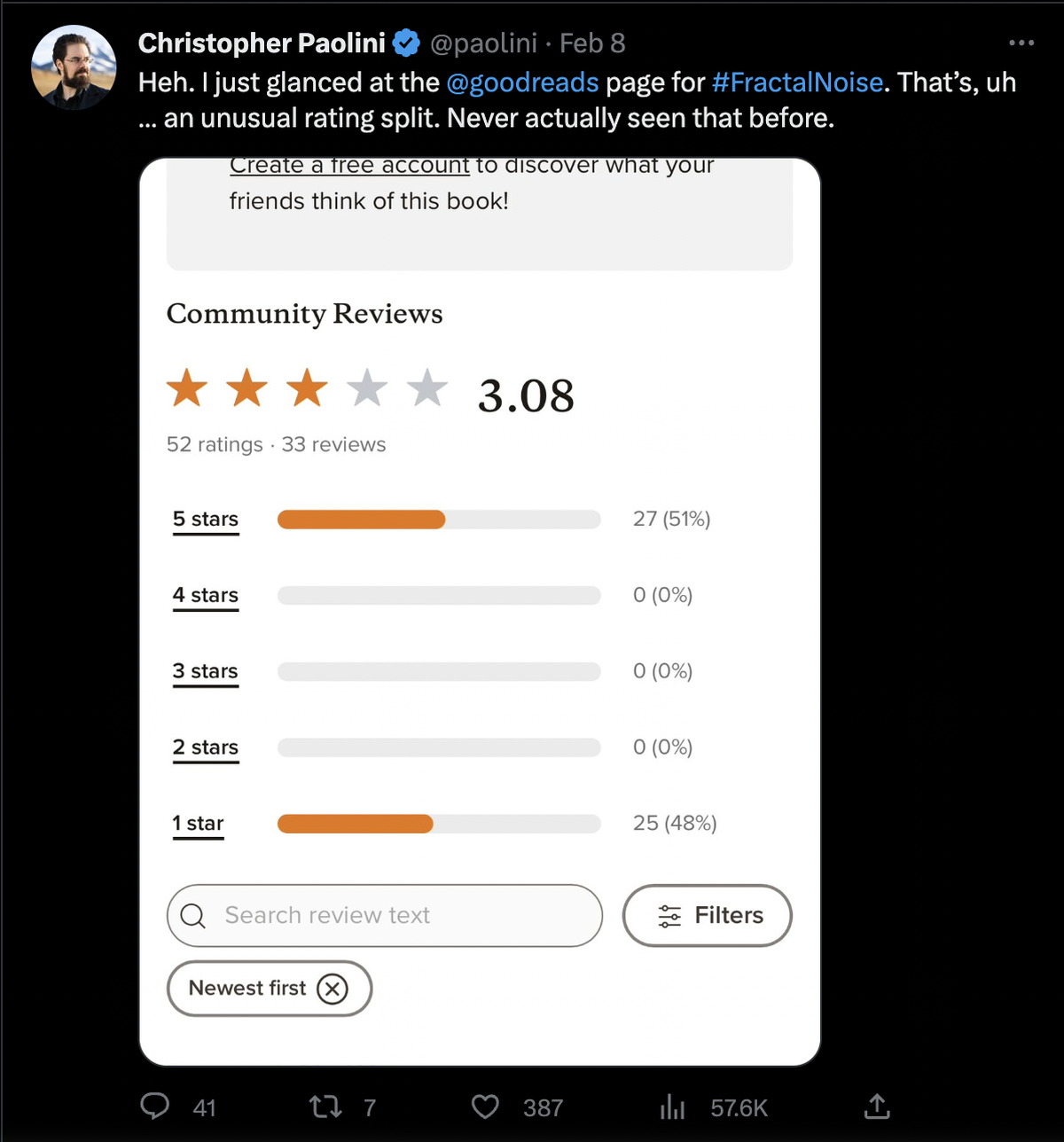
Screenshot showing both 5-star and 1-star book reviews on Goodreads | Photo by @paolini on Twitter
Many angry reviewers explained they were leaving 1-star reviews to protest the platform fractal noisecover. The image itself is nothing unusual. An astronaut approaching the looming red and black abyss. However, publisher Tor Books acknowledged that the stock images “may have been created by AI.”
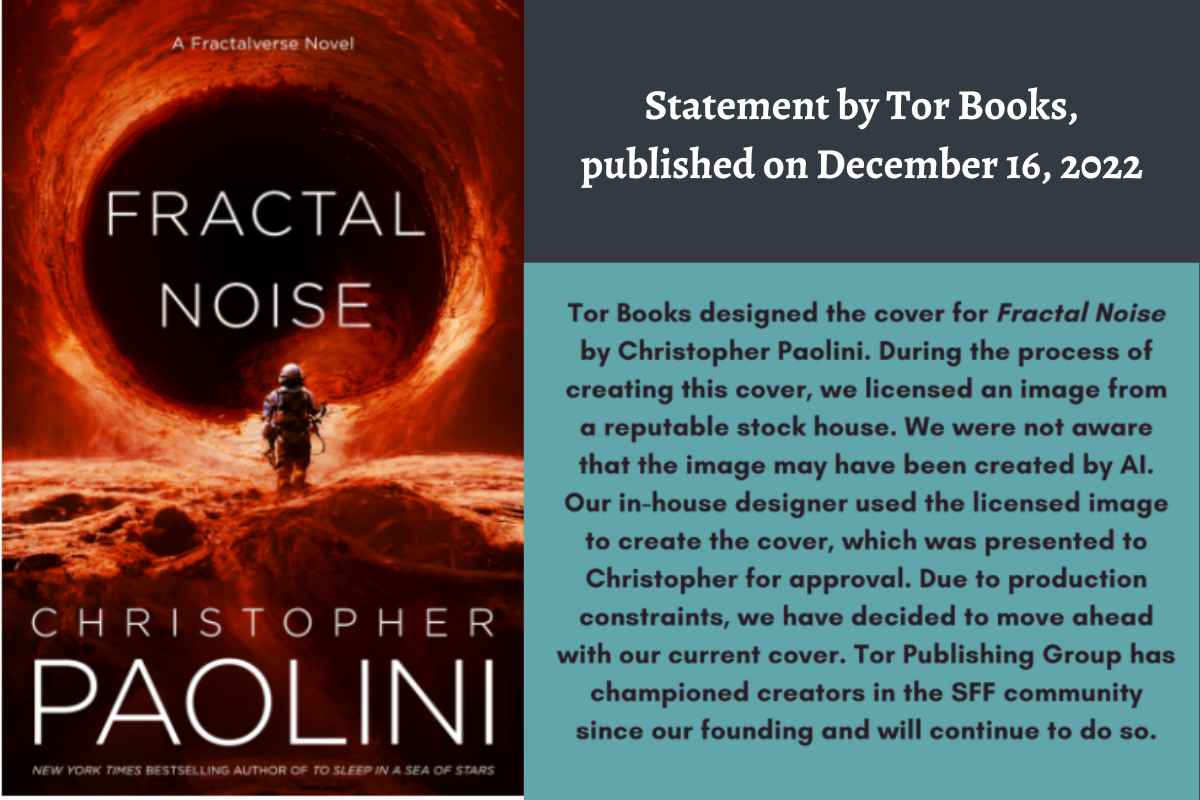
Fractal Noise Cover and Statement by Tor Books | Photo Credit: Cover image and statement separately taken from @torbooks on Twitter. Edit as a collage in Canva
Other users on Goodreads have left 5-star reviews simply to compete with 1-star reviews.Despite strong reaction, Tor announced it would go ahead with its controversial cover This is due to “manufacturing constraints”. Paolini also defended the move.
cover-up
Nearly 150 years ago, book covers in the Western world served primarily the purpose of decoration or protective packaging rather than the art of showing the content of a book. About 100 years ago, book covers actively referenced the stories they contained. The iconic cover of the 1925 edition great gatsbythe watery-eyed motif, the deep cobalt blue sky, and the city lights still conjure images of the story’s high-society drama and its sweltering aesthetics today.
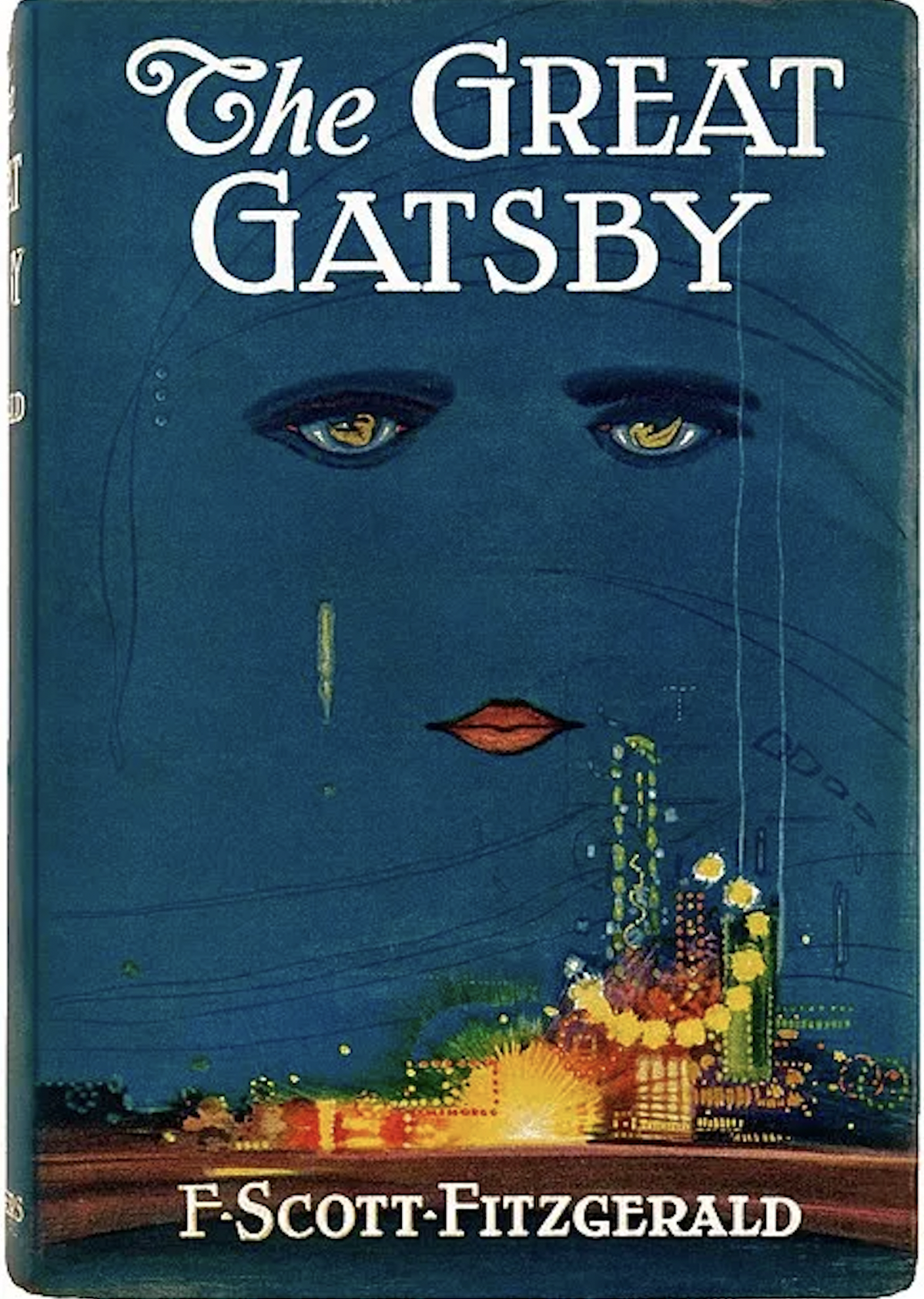
The Great Gatsby cover | Photo credit: Wikimedia Commons
These days, Canva templates and stock images can get you up and running in minutes. With the advent of text-to-image generators, it should come as no surprise that AI-generated art is the next step in the evolution of book covers.
How does the AI text-to-image generator work?
A text-to-image generator can be a game-changer for artists and designers, helping them save time and energy. So why would some artists take these companies to court? | Video credit: Sahana Venugopal
Sunandini Banerjee, Senior Graphic Designer, Editor and Translator, is known in the Indian publishing industry for her intricately layered, vibrant book covers that tell the stories of the many authors whose work she publishes with Seagull Books. I’m here.

A collage of book covers designed by Sunandini Banerjee | Photo credit: Sunandini Banerjee; edited as a collage in Canva
“You can see the temptation, or the ‘fun’ factor, in being able to give something a name or a title and almost magically ‘generate’ a cover. We also find that some self-publishing authors find it easier to ‘generate’ their own cover, and not have to worry about finding, explaining, and paying for a cover designer,” says AI. When asked about the cover she generated, she said in an email. Hinduism.
“But I don’t want the whole creative field, the whole wonderful act of creativity — reading, drawing, imagining, interpreting — to be wiped out. One aspect is the variety and vibrancy of the book’s cover, which is often the first point of entry into the content,” explained Banerjee.
Also read: Artists fight AI programs that copy their style
To test how easy it is to create an AI-generated book cover and see how it works in the Indian publishing industry, we asked Mr. Banerjee to generate an image from the text DALL-E. I sent you two book covers that I made using the generator. OpenAI — the same company that created ChatGPT.
After tweaking the image descriptions and generating some good images, I formatted the images on Canva and added the finishing touches like titles, author names, and typeface effects.
One was the cover of Bram Stoker’s vampire horror novel Dracula (1897), compared to the original cover of Penguin Books.
Another book cover was by Edward Said orientalism (1978) compared to Penguin Books original cover. Orientalism explores power relations between colonial states and the Middle East. It took less than 2 hours in total to make both covers. Experienced DALL-E users will probably be able to produce more sophisticated images in less time.
Banerjee was informed that these covers were made by AI and asked to rate them. Mr. Banerjee made a phone call. Dracula The cover is “plain and completely unremarkable”.
Paolini’s cover received similar praise from her.
for orientalism, she said the cover was “obviously terrible”, pointing out poor image quality, multiple objects preventing viewers from finding the main subject, and inappropriate typeface. She provided a version of the cover that she felt was far superior, which she used for comparison.
“Overall, there’s nothing eye-catching on the cover,” she concluded.
suit and stability
Aesthetics are not the only issue. Beautiful, professional AI-generated covers exist on Amazon, but copyright is another obstacle. Even if designers and publishers accept AI-generated art and tools, other media providers may not.
In January 2023, stock image provider Getty Images announced it would sue Stability AI, which created a text-to-image model called Stable Diffusion. Getty Images has accused an AI company of illegally using its photos to train models.
If a book cover is created using a text-to-image platform whose dataset contains copyrighted images, how much legal protection can such cover receive? Unknown. However, there are currently several self-published books on Amazon that list ChatGPT as the author, Midjourney as the illustrator, or both.
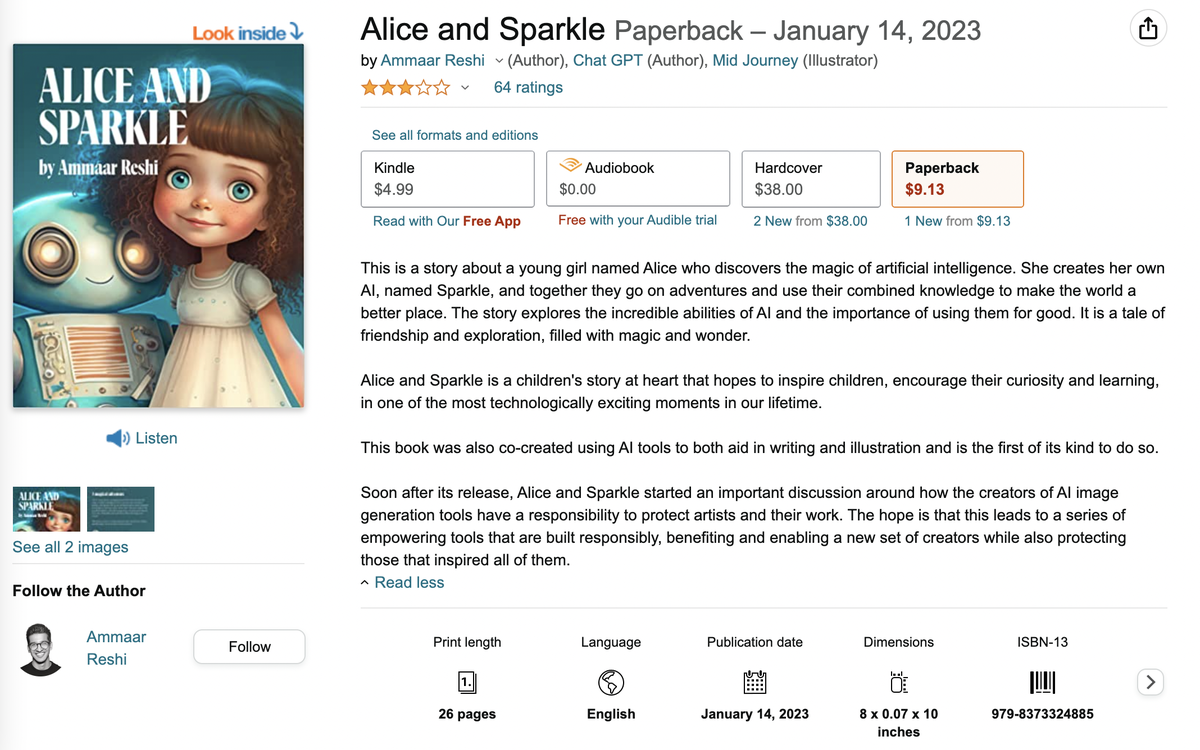
Amazon’s AI-generated picture book | Photo Credit: “Alice and Sparkle” by Ammaar Reshi; Screenshot from Amazon
The use of copyrighted material in AI training data is a serious concern, but treating a book cover the same as a painting by a contemporary artist, for example, may not be entirely accurate. Book designers Peter Mendelsund and David J. Alwerth noted that many book covers were not works of art, but rather “product packaging.”
“Marshall McLuhan said, ‘The ‘content’ of any medium is always another medium,’ but this claim is based on book covers that reuse pictures, photographs, and text from book reviews and other sources. This is especially true for ,” the designers wrote.of how the book looks (2020).
From that perspective, the idea of an AI-generated book cover image from another artist’s work isn’t entirely unheard of. But whether it will be welcomed by the Indian publishing industry, and more importantly by readers, is a big question.
Banerjee, for example, said he didn’t see publisher Seagull using AI in the bookbinding process because he enjoyed every part of the job.
Because major book publishers, such as the Big 5 and their publishers, have ethical obligations to the communities they serve, the use of AI-generated images is, for many readers, the equivalent of humans in the bookbinding field. It can be seen as betraying the artist or designer. However, rising costs may make AI-powered text-to-image conversion more profitable.
cover replacement, reader replacement
It is a misconception that a book designer must also be a professionally trained artist or painter. Banerjee said she could neither draw nor paint and could only work as a cover designer on a computer.
“As long as I run a program, I’m not against technology. It’s not the program that drives me. If I get stuck in a book or can’t ‘see’ an image, it helps me change my mind.” I welcome inspiration from all sources,” she said, noting that she has never researched AI technology. to a considerable extent.
She has never objected to her work being added to the AI Platform’s dataset to increase its pool of knowledge and help others.
“I just hope it doesn’t become industry practice,” Banerjee said. “It would take a lot of creativity out of the world and put a lot of creative workers out of work. If you change the cover designer, then you change the editor, and then the writer… how this is going to happen. Do you understand? Shall we change readers too?”
This is the second article in a series on artificial intelligence and publishing.