
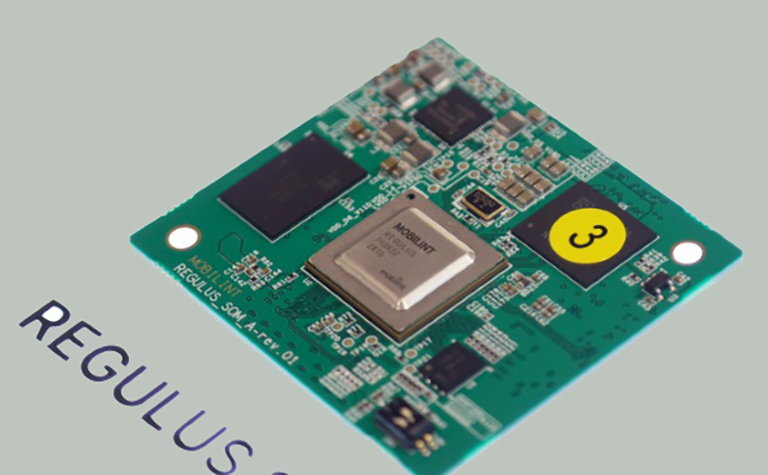
The Regulus SoM chip, an AI accelerator, is on display at the Consumer Electronics Show (CES) on January 9, 2025 in Las Vegas, Nevada. — © AFP/File Richard A. Brooks
New research from Tokyo University of Science shows how machine learning can quickly analyze complex electronic structural data that would normally require manual review by experts. This approach helps identify important changes in materials that are key to the development of next-generation electronics.
This study was conducted based on the following research questions.
Can machine learning automatically detect important changes in a material’s Fermi? Do you want to extract surfaces from complex and noisy data?
The Fermi surface is an abstract boundary in momentum space that separates occupied and unoccupied electron energy levels at absolute zero and separates filled and empty states. It acts as a constant energy surface at the Fermi level and is important for determining the electrical, thermal, and magnetic properties of metals.
The Fermi surface of a material is typically determined experimentally using techniques such as angle-resolved photoelectron spectroscopy (ARPES). However, interpretation of ARPES data requires specialized knowledge, and the measurements themselves are often susceptible to noise.
One of the limitations of traditional methods is that experiments generate large amounts of data, making the process of manually carefully reviewing every image time-consuming and inefficient.
AI method
The researchers used a technique called principal component analysis (PCA). This is a type of unsupervised machine learning that simplifies complex data while preserving the most important patterns.
The researchers started with computer simulations based on density functional theory to calculate the electronic structure of the material at various compositions. Based on these calculations, scientists generated an image of the Fermi surface.
The researchers also calculated spin polarization, an important property that explains the imbalance between electrons with different spin directions. Fermi surface images were converted to one-dimensional vectors and analyzed using PCA to identify similarities and differences between compositions.
Researchers have found that an AI-based method can successfully identify specific material compositions that result in significant changes in electronic structure. This detection was evident even when the data were unclear or noisy, similar to real experimental conditions.
Significance of the research
This study presents a practical method to reduce the need for expert manual analysis of Fermi surface images. This could help researchers screen large data sets more quickly and accelerate the discovery of materials for spintronics, topological electronics, and other advanced technologies.
The research paper is scientific report The title is “Anomaly Detection of Fermi Surface Morphology in Co2MnGaxGe1-x by Interpretable Machine Learning.”


