Quantum-classical hybrid approaches are increasingly attracting attention in the pursuit of more powerful artificial intelligence, and a team led by Stefan Balauca and Ada-Astrid Balauca from the University of Al. I. Cuza and Adrian Iftene are making significant progress in this field. They present novel recurrent and convolutional neural networks known as QRNN and QCNN as hybrid language models and report the first successful end-to-end training and evaluation of such models on real quantum hardware. This work overcomes a major hurdle in quantum machine learning and proves that even today's noisy intermediate-scale quantum (NISQ) devices can learn complex sequential patterns. By combining carefully designed quantum circuits with classical processing and employing a robust training strategy, researchers establish an important engineering foundation for natural language generation processing and validate the potential of quantum computing for advanced artificial intelligence.
The researchers investigated quantum convolutional neural networks (QCNN) and quantum recurrent neural networks (QRNN) implemented on IBM Quantum hardware. ibm_kingston Evaluate processor performance and understand the impact of hardware limitations. The connectivity of processors arranged in a heavy hex pattern determines how logical qubits in a quantum circuit are mapped to physical qubits in the hardware, posing significant constraints during implementation.
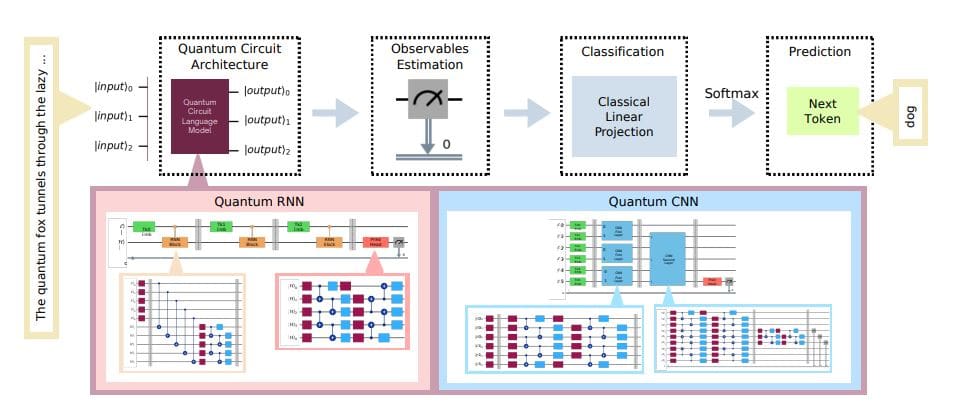
The team closely characterized the processor by measuring single-qubit and two-qubit gate error rates, which affect the accuracy of calculations. We then designed and implemented both QCNN and QRNN architectures and adapted them to the specific constraints of our environment. ibm_kingston processor. QCNN consists of an embedding layer, convolutional blocks for feature extraction, and a prediction layer, whereas QRNN is a recurrent model designed to process sequential data. The researchers carefully considered different embedding configurations, varying the number of qubits used to represent the input tokens, to optimize performance.
To visualize the mapping of logical qubits to physical hardware, the team created a detailed layout using color coding to represent connections between embedded registers and qubits. These layouts are designed to minimize the need for error-causing SWAP gates. This work highlights the importance of hardware-aware design, where quantum circuits are specifically tailored to the underlying hardware connections, and reveals important trade-offs between circuit size, number of qubits, and complexity of the mapping process.
Quantum language model trained on real hardware
Scientists have successfully trained and evaluated quantum recurrent neural networks (QRNNs) and quantum convolutional neural networks (QCNNs) for generative language modeling directly on noisy quantum hardware, achieving a breakthrough in quantum natural language processing. This work establishes a rigorous engineering foundation for generative quantum natural language processing and validates the feasibility of training complex sequence models on current quantum hardware. The team designed hardware-optimized circuits specifically adapted to the heavy hex topology of IBM quantum processors and combined these parametric circuits with lightweight classical projection layers.
The experiments included a multi-sample stochastic parallel simulation annealing (SPSA) strategy to efficiently estimate gradients through quantum noise, allowing end-to-end training of both quantum and classical components. The researchers introduced a synthetic dataset designed to isolate syntactic dependencies in a controlled environment, allowing detailed analysis of model functionality. Results demonstrate that observable-based readout allows successful learning of continuous patterns on NISQ devices despite the challenges posed by hardware noise and quantified architectural trade-offs between circuit depth, qubit count, and trainability.
In this study, we establish a performance baseline for generative quantum models and characterize their robustness to physical noise compared to classical simulations. Scientists have successfully trained hybrid sequence models on real quantum hardware for generative language modeling, confirming the practical feasibility of these architectures in the NISQ era, validating that hybrid quantum architectures can successfully learn sequential dependencies, and providing a concrete foundation for exploring the benefits of quantum in NLP as hardware fidelity increases.
Hybrid quantum model successfully generates the sequence
This work demonstrates the first successful training and evaluation of a hybrid quantum sequence model on real quantum hardware for generative tasks. Researchers employed both recurrent neural network (QRNN) and convolutional neural network (QCNN) architectures to establish a baseline for generative quantum natural language processing within the constraints of current noisy intermediate-scale quantum (NISQ) technology. Key to this achievement was a focus on developing scalable training workflows and hardware-aware circuit design that tailors quantum circuits to the physical topology of the processor.
Our experiments revealed an important trade-off between circuit depth and trainability. QRNNs offer qubit efficiency but become susceptible to noise accumulation as depth increases, and QCNNs offer shallow circuits at the expense of increased connectivity requirements. Importantly, the team demonstrated that estimator-based readout significantly outperforms traditional bitstream sampling in gradient-based training, providing the necessary smoothness for convergence on noisy devices, and validating the potential of hybrid quantum architectures to learn syntactic structures despite hardware imperfections, provided the training process is carefully optimized for device limitations.
The authors acknowledge that there are current limitations, such as limited vocabulary size and the possibility of shallow circuits acting as kernel methods, that prevent them from capturing complex semantic dependencies. Future research will focus on exploring spatially multiple attention mechanisms to address vocabulary bottlenecks and enhance parallelism through hierarchical quantum embeddings. The complete code and detailed experimental settings are publicly available to facilitate further investigation and reproducibility.