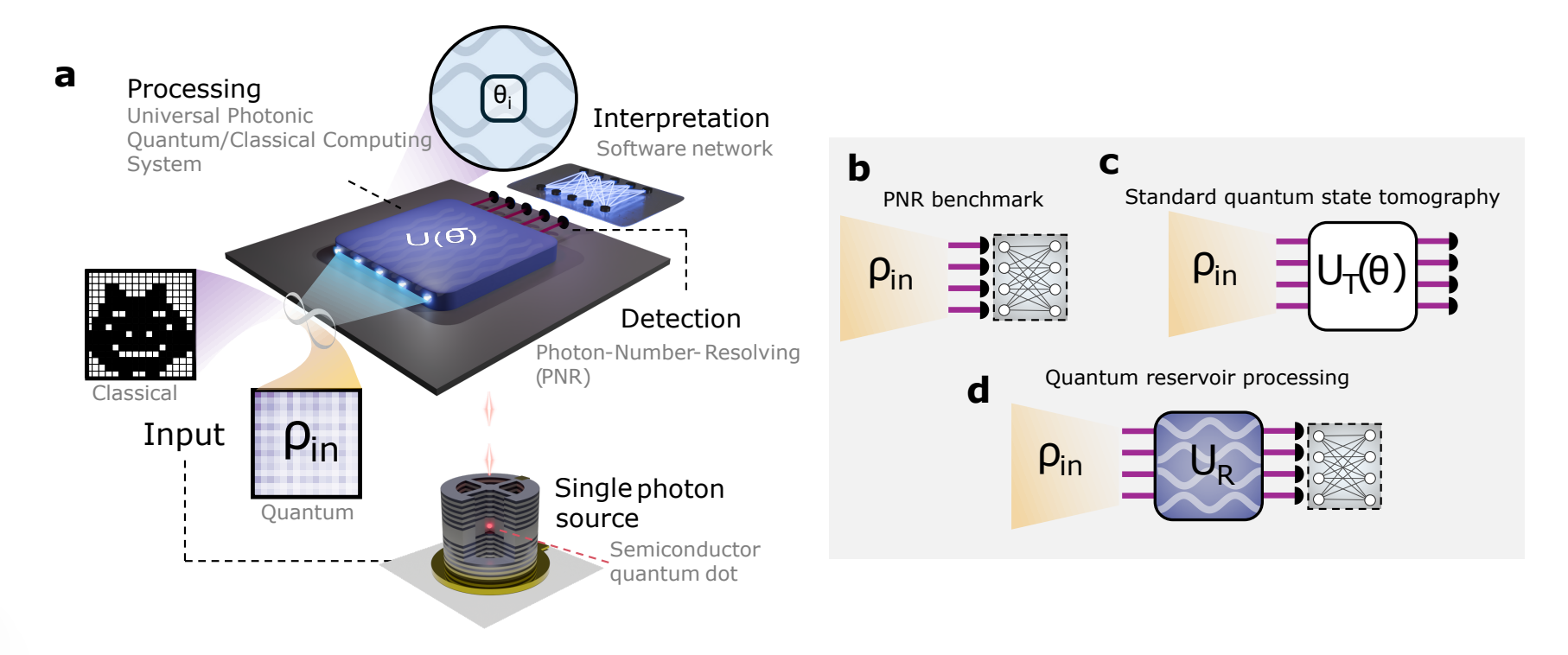
A joint research group consisting of quantum information scientists from Quandera, the Center for Theoretical Physics of the Polish Academy of Sciences, and the University of Warsaw has experimentally demonstrated a scalable physical quantum machine learning (QML) architecture. Supported by the European Union’s Horizon Europe Candensate In the Pathfinder project, the team utilized programmable silicon photonic quantum processing units (QPUs) excited by single-photon states to perform both classical machine learning classification and essential quantum information processing tasks.
Importantly, the introduction of the hardware introduces a practical method to overcome the exponential scaling bottleneck in quantum state characterization by successfully performing full quantum state tomography and multimode entanglement tracking using a single fixed metric.
[ Multimode Fock States ] ──► [ Programmable Silicon MZI Matrix (Belenos QPU) ]
                                                │
                                                ▼
[ Software Linear Readout Layer ] ◄── [ Photon-Number-Resolving (PNR) Detectors ]
Quantum reservoir processing using unitary photonic matrix
The experimental setup leverages the physical principles of quantum reservoir computing (QRC) and is specifically configured as a quantum reservoir processing (QRP) network. In the physical QML framework, complex nonlinear mathematical transformations are performed natively through quantum mechanics at the hardware level, rather than being mapped as digital computing code. The non-trainable “reservoir” consists of a universal Bell-Walmsley interferometer mesh fabricated on a compact silicon chip and features a dense network of integrated optical waveguides, mode couplers, and thermo-optically controlled thermal phase shifters.
To process information, single photon pulses generated on demand by semiconductor quantum dots embedded in micropillar cavities are routed through a 12-mode active demultiplexer and injected into Quandela’s 24-mode Belenos QPU chip as a non-classical multimode state. As photons propagate through a programmable Mach-Zehnder interferometer (MZI) array, they undergo complex transformations caused by quantum interference. The output states are mapped by a polarization-resolving photon number-resolving (PNR) detector combined with an electron correlator. This allows the system to bypass the binary limitations (0 or 1 photon) of standard threshold detectors and construct a 15-element feature vector from a multiphoton coincidence probability distribution.
                              [ Tomography Scaling Topologies ]
Standard State Tomography ──► Exponential measurement arrays executed across varying bases.
Photonic QRP Protocol     ──► Unitary cross-mode interference captured via a single, fixed basis.
Single-based quantum tomography and feature extraction metrics
The QRP platform was directly benchmarked against a standard PNR setup to perform quantum state tomography on a multimode two-photon mixed density matrix. Standard quantum tomography architectures require performing an exponential number of physical measurements across multiple different measurement bases to reconstruct complex quantum states. The QRP framework avoids this scaling trap by utilizing a single fixed random unitary transformation matrix to map multimode quantum correlations to traceable photon counting signatures.
To generate mixed target states, the initial two-photon state was processed through a single state preparation that works across specific modes. Mixability was then introduced by tracing and discarding the auxiliary modes, forcing a block-diagonal density-reduced matrix structure.
Empirical match counts collected from the hardware were fed into a classic multi-output ridge regression software layer that utilizes regularization to map linear relationships. The model reconstructs the initial matrix, enforces hermitity, and projects the negative component of the resulting spectrum onto a probability simplex to ensure semipositivity.
                                  [ Experimental Reconstruction Performance ]
Pure PNR Benchmark Baseline ──■■■■■■■■ Mean Fidelity = 0.747 (Fails to capture off-diagonal coherences)
Photonic QRP Hardware Core   ──■■■■■■■■■■ Mean Fidelity = 0.820 (Recovers full phase and state structures)
The hardware-executed QRP architecture achieved an average fidelity of 0.820 on the test dataset, clearly outperforming the baseline PNR benchmark (0.747). This benchmark could not systematically resolve off-diagonal phase coherence due to the lack of optical interference. The software extracted three fundamental quantum metrics from this reconstructed density matrix with high precision: purity, von Neumann entropy, and negativity (a rigorous measure of quantum entanglement).
Additionally, the team mapped the scaling properties of the circuit and proved that the required functional space dimension scales quadratically with the number of modes in the target state, establishing a sustainable blueprint for the characterization of three-mode (45 independent parameters) and larger multi-mode states.
Hardware-enabled regularization and perturbation relaxation loop
To extend the usefulness of this platform to classical data processing, the researchers mapped a nonlinear binary classification task resolving intertwined dual-spiral data points on Quandela’s legacy 12-mode Ascella processor. Real-world silicon hardware is inherently degraded by microscale manufacturing variations, thermal drift, and transition bugs, creating an operational disconnect between ideal digital simulations and physical hardware execution.
[ Classical Coordinates (x,y) ] ──► [ Dual-Rail QPU Encoding ] ──► [ Unitary Perturbation Loop ]
To fill this gap, the team designed a hardware-aware system. in silico Training framework. During the classical optimization cycle of the software readout layer, the ideal simulation reservoir matrix was intentionally injected with a random sample-specific unitary perturbation matrix containing local variations. This perturbation layer acts as a physical regularization code, training the software readout network to maintain feature elasticity when exposed to local hardware variations.
By running an optimization loop with a perturbation amplitude that directly matches the measured conversion error of the physical chip, the physical hardware experimentally achieved a classification accuracy of approximately 79.7%. This outperforms the same ideal classical simulation network processing coherent state inputs and average intensity counts, and presents a clear path to local error mitigation in modern optical networks.
The complete peer-reviewed proof, error mitigation log, and Hilbert spatial scaling calculations can be analyzed in the complete preprint research paper here. Additionally, high-level corporate research roadmaps and neuromorphic development goals can be tracked through the Quandela Science Blog here.
June 26, 2026