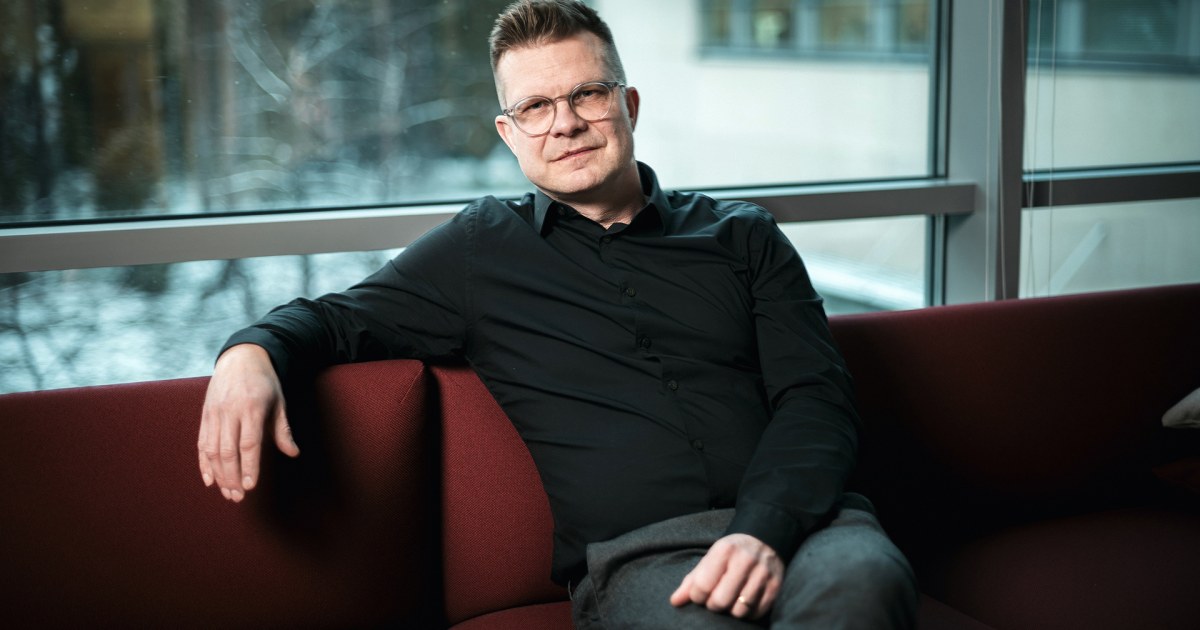
“We are developing very fast machine learning models for very demanding environments. In principle, nothing in financial markets should be predictable except on very short time scales at the millisecond level. This is where we focus.”
Research combines theory and practice
professor Juho Kannainen He currently leads a research group consisting of four postdoctoral researchers and two doctoral candidates.
“Everyone talks about artificial intelligence, but at its core it's machine learning, the algorithms and models that power this intelligence. Universities play an important role in the development of these methods,” said Kanniainen.
The group works closely together alexander iosifidisjoined the University of Tampere in spring 2025 as Professor of Machine Learning.
“It's great that Alexandros is here. The University of Tampere brings together world-class expertise in theoretical machine learning and applied data science to investigate the dynamics of financial markets. Alexandros' expertise lies at the core of machine learning, and my expertise is more on the applied machine learning side. Together, we can achieve results that neither of us could have achieved alone.”
Tampere researchers have been engaged in international collaborations for nearly a decade, helping to place local research at the forefront of this field worldwide.
Predict market movements in milliseconds
Professor Kanniainen's best-known research focuses on limit order book data: the flow of buy and sell orders, their modifications and fills, and the speed at which all this happens.
“Within the stock market, huge numbers of messages are sent in a matter of nanoseconds. Trading algorithms react to each other's actions in fractions of a second, creating a chain reaction. True predictability only emerges when you focus on short enough time scales.”
Kanaiainen illustrates the extreme nature of this phenomenon with an example from the United States.
“In 2010, a new cable was installed between Chicago and New York, reducing communication time between these cities by 4 milliseconds. The cost was $300 million. Our perspectives are different. We aim for predictability, not speed. ”
To achieve this, the Group has worked with international partners to develop many of the world's most accurate machine learning models for predicting limit order book data. These models can, for example, predict the direction of price movements just a few moments in advance, but this short time frame is enough to make a difference in an automated trading environment.
“Our research has social and practical implications. Our methodology helps reduce the risks associated with market making and improves market liquidity. Furthermore, the research results we are publishing will particularly benefit small and medium-sized trading firms that compete with large hedge funds.”
Investigating the spread of insider information through social networks
Another major research focus of Kanaiainen's group is how information spreads in the stock market through social networks. This group focuses specifically on connections between company insiders.
“Board members form surprisingly dense social networks, and previous research has found that insider information can actually be transmitted through these networks.”
Researchers have access to a very extensive Finnish dataset that allows them to track investor trades across all securities, even those that are not subject to insider trading regulations.
“The goal is to determine whether anomalous trading activity is occurring within the close social circles of these insiders before company announcements such as interim or annual earnings reports are released. We are developing new machine learning models to detect suspicious trading activity.”
The group's third established research direction continues to focus on financial mathematics, derivative pricing models, and traditional time series analysis.
From research to practice: Introducing artificial intelligence to financial markets
Professor Kanaiainen's research is not aimed at developing tools for individual investors.
“Our model is designed for professionals in market making, automated trading, regulatory oversight, risk management, etc. It does not directly benefit retail investors.”
Against this background, commercialization of research results is a natural next step. Mr. Kanniainen is currently participating in a large-scale Research to Business project funded by Business Finland, whose aim is to bring to market models developed through cutting-edge research.
Examples of application areas include:
“This is not about building a ChatGPT-style solution, but about building a very fast, purpose-built model that, if successfully deployed, can have a direct impact on enterprise performance,” says Kanniainen.
Career path takes an unexpected turn
Mr. Kanaiainen did not initially set out to specialize in academic research on financial market data.
“The driftwood analogy applies very well to my career path. I initially went to university to study systems theory, but I had no interest in working in a paper mill. I was fascinated by finance and approached the subject from a mathematical and methodological perspective.”
Kanaiainen wrote his doctoral thesis on financial mathematics. Over the years, his research interests have increasingly shifted towards machine learning and data-driven approaches.
Studying in Tampere provides students with world-class expertise
According to Kanaiainen, quantitative finance professionals rarely enter the profession by following the traditional economics path.
“In fact, very few people have a background in economics or finance. This field was once dominated by mathematicians and physicists, but is now increasingly attracting computer scientists and data scientists.”
Kanniainen encourages students to build a strong foundation in mathematics, statistics, programming, machine learning, and data science.
“Combining these skills with financial mathematics can go a long way. Many of our graduates are now working in quantitative finance teams in banks and investment firms in Finland and around the world.”