
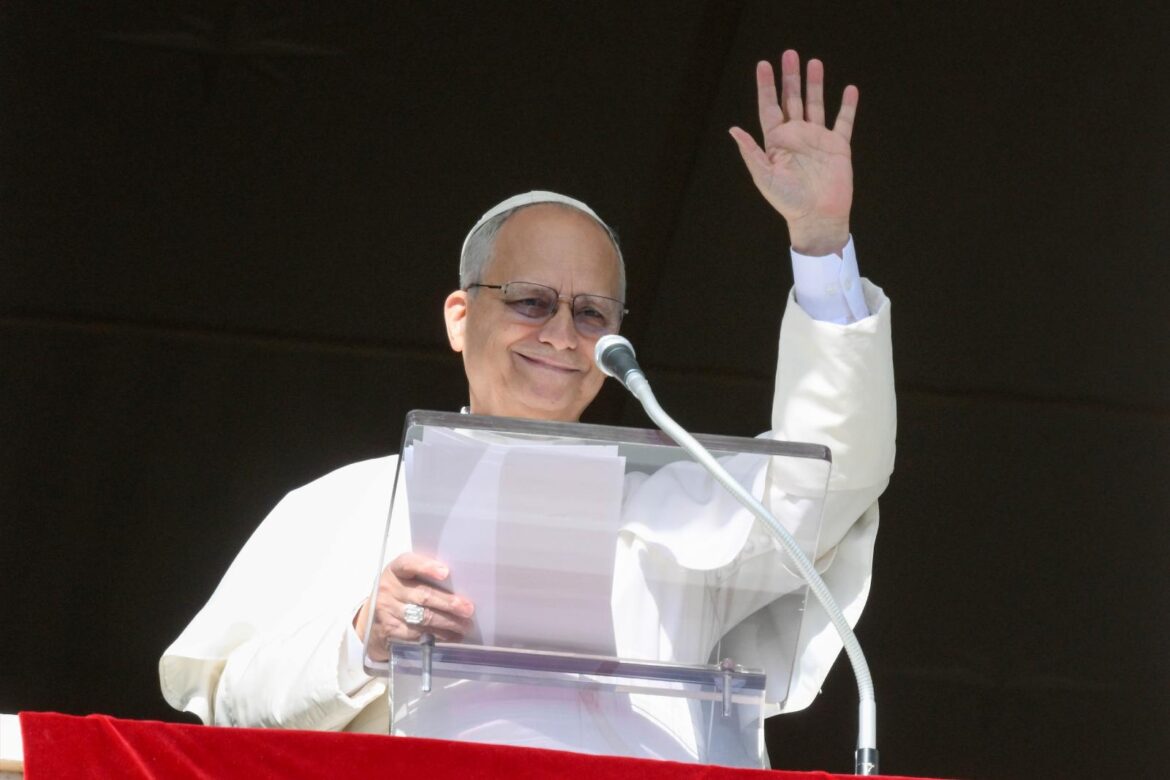
(OSV News) — Pope Leo XIV not only wrote his first message as pontiff on World Communication Day, January 24th. Pope Leo XIII wrote a program document on artificial intelligence in response to the challenges of the modern world, just as he faced the industrial revolution more than a century ago.
The 60th World Communication Day will be celebrated on May 17th, but the text, published on January 24th, the feast day of St. Francis de Sales, the patron saint of Catholic newspapers, issues a stark warning that AI and digital technologies are reshaping human communication, creativity and identity. And the greatest risks, the Pope said, are not technological, but deeply human.
Failure to protect digital technologies and educate people on how to use them “risks fundamentally changing some of the fundamental pillars of human civilization that we sometimes take for granted,” Pope Leo said.
“By simulating human voice and face, wisdom and knowledge, consciousness and responsibility, empathy and friendship, the systems known as artificial intelligence not only interfere with the information ecosystem, but also infiltrate the deepest level of communication, the relationships between humans.”
AI cannot replace human encounters
Therefore, the Pope said, the challenge is “not a technical one, but an anthropological one. Protecting our faces and voices ultimately means protecting ourselves.”
Pope Leo asked AI what technology cannot replace: the human face and the human voice, and emphasized the importance of these. “They are described as a unique expression of one’s identity and the basis of authentic human encounters,” the Pope said.
“They express the unrepeatable identity of a person and are constitutive of every encounter,” Pope Leo said, adding that “faces and voices are sacred” and are “given to us by God, who created us in his own image and likeness and calls us to life with the words he himself has spoken to us.”
The Word of God “first echoed through the centuries as the voice of a prophet, then in the fulness of time became flesh,” the Pope recalled.
God “has made the human face reflect His love so that humanity can live out its full humanity through love,” Pope Leo said. Therefore, “protecting the human face and voice” means “protecting this seal, which is an indelible reflection of God’s love. We are not a species composed of a predefined biochemical algorithm. Each of us has an irreplaceable and inimitable mission that manifests itself throughout life and manifests itself precisely in our communication with others.”
Pope Leo: “Don’t stop thinking”
In his message, Pope Leo challenged humanity, dependent on social media and driven by algorithms, to not abandon its thinking, and urged humanity to use technology to support rather than drive human life.
Algorithms “evaluate quick emotions and instead penalize human expressions that require more time, such as efforts to understand and reflect,” Pope warned.
They trap people in “bubbles of easy agreement and easy resentment,” which “decreases the capacity for listening and critical thinking and fosters social polarization.”
AI can provide support and assistance in managing communication tasks, but in the long run, the “avoidance of our own mental efforts” will erode “our cognitive, emotional and communicative capacities,” the Pope said, turning people into “mere passive consumers of thoughtless thoughts and anonymous products, without authorship or love, while masterpieces of human genius in the fields of music, art and literature become mere training grounds for machines.”
“Abandoning the creative process and handing over one’s mental faculties and imagination to machines” means “burying the talent we have received to grow as human beings in relation to God and others. It means hiding the face and silencing the voice,” Pope Leo emphasized.
Pope Leo’s past words on AI
This message was not the first time Leo has spoken out strongly about AI. In June, he sent a message to the Second Rome Conference on Artificial Intelligence in which he expressed “concerns for children and young people and the impact that the use of AI may have on their intellectual and neurological development.” Pope Leo emphasized on June 17 that our youth “must be helped, not hindered, in their journey towards maturity and true responsibility.”
In November, he wrote to the World Congress Builders AI Forum in Rome: “The last two days of discussion show that this effort is not limited to research institutes or investment portfolios. This must be a very ecclesiastical effort.”
But in his Jan. 24 message, he delivered a mission statement and a call to action: “Technologies that exploit our desire for relationships can have dire consequences not only for the destinies of individuals, but also damage the social, cultural, and political fabric of society.”
The challenge ahead for humanity is “not to stop digital transformation, but to guide it,” the Pope said. “It is to recognize the ambiguous nature of digital transformation. It is up to each of us to speak up in defense of humanity so that these tools are truly integrated as our allies.”
This partnership is possible, the Pope said, urging it to be built on three pillars: “responsibility, cooperation and education.”
With this, Pope Leo challenged the AI moguls and Silicon Valley.
“For those at the top of online platforms, this means ensuring that their business strategies are driven not only by criteria of profit maximization, but also by a far-sighted vision that considers the common good as much as each one looks out for the interests of their own children.”
encouragement to parents
In November, during the conference “Dignity of Children and Adolescents in the Age of Artificial Intelligence”, Pope Leo met Megan Garcia, an American mother who lost her son Sewell Setzer III in February 2024 after being driven to suicide by an AI chatbot.
Garcia filed one of the first of many lawsuits against AI companies after her son died in an ambulance after a chatbot encouraged him to commit suicide.
Character.AI announced in October that it would ban users under the age of 18 from its platform, a decision that went into effect on November 25th.
Garcia told Rome Report that he prayed during the conclave that the next pope would “recognize that the mission of the church is threatened by unregulated AI.”
Garcia and other parents may take heart from the Pope’s message on January 24th.
“Creators and developers of AI models are required to be transparent and socially responsible regarding the design principles and moderation systems underlying their algorithms and the models they develop, in order to promote informed consent on the part of users,” Pope wrote.
“Similar responsibilities are expected of national legislators and supranational regulatory authorities,” he stressed, citing their primary mission as ensuring “respect for human dignity.”
“Suitable regulation can prevent people from forming emotional bonds with chatbots, curb the spread of false, manipulative and misleading content, and protect the integrity of information against deceptive simulations,” Pope Leo said.
“We are all asked to work together.”
He told media and communications companies that “public trust is earned through accuracy and transparency, not through engagement at all costs.”
In his message, Pope Leo said, “Content generated or manipulated by AI must be clearly labeled and distinguished from content created by humans,” and appealed for the protection of authors’ rights and “sovereign ownership of journalists’ works.”
“Constructive and meaningful public services are not based on opacity, but on transparency of sources, stakeholder participation and high quality standards.”
And for this, the Pope urged, no one should be stripped of responsibility.
“We are all called to work together. No single sector can rise to the challenge of guiding the governance of digital innovation and AI alone.”
The pope said all stakeholders, “from the technology industry to legislators, from creative companies to academia, from artists and journalists to educators,” must be involved in “building and enabling a conscious and responsible digital citizenship.”
“As Catholics, we can and must contribute to helping people, especially young people, acquire critical thinking skills and grow as free spirits,” he urged.
“Just as the industrial revolution required basic literacy to enable people to cope with new things,” the digital revolution requires “digital literacy” alongside humanistic and cultural education to understand “how algorithms shape our perception of reality” and “how AI biases work.”
In his message on January 24, Pope Leo specifically took issue with Time magazine’s “Person of the Year” (who will be announced as “Architect of AI” in 2025).
“Behind this huge invisible force that engulfs us all is only a handful of companies, the ones whose founders were recently featured as founders of the People of 2025,” Pope Leo said.
“This raises serious concerns about the oligopolistic control of algorithms and artificial intelligence systems that can subtly shape behavior and even rewrite human history, including the history of the Church, often without people really being aware of it,” he warned.
In August, Pope Leo
Time magazine said he chose the name “to respond to the revolution that is AI.” The list includes “leaders,” “innovators,” “formers,” and the group “thinkers,” of which Pope Leo is listed.
If Leo XIV continues to rally the world’s Catholics against the alienating potential of AI, Time said, “Silicon Valley will face a formidable and unexpected spiritual counterforce.”
Pope Leo’s message for World Communications Day appears to be a promise that this “thinker” will not disappoint.
Paulina Guzik is the international editor of OSV News. X Follow her at @Guzik_Paulina.


