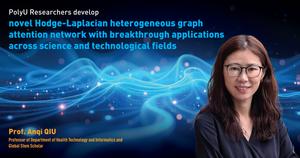
Graph neural networks (GNNs), an emerging technology in the field of artificial intelligence (AI), are deep learning models designed to process graph-structured data. Although GNNs are currently effective at capturing relationships between nodes and edges in data, higher-order complex connections are often overlooked. To address this challenge, a research team at the Hong Kong Polytechnic University (PolyU) has developed a new heterogeneous graph attention network that revolutionizes the modeling of complex relationships in graph-structured data. This innovation is poised to break the boundaries of AI applications in fields such as neuroscience, logistics, computer vision, and biology.
Simply put, traditional GNNs mainly consider pairwise relationships such as “A to B” and “B to C” connections, making it difficult to understand the group interactions between A, B, and C. Anqi QIU Professor, PolyU Faculty of Health Technology and Information Studies, Global STEM Scholar; and her research team have developed a new “Hodge-Laplacian heterogeneous graph attention network” (HL-HGAT) that can learn and analyze heterogeneous signals at different levels and capture complex relationships between different graph structures.
Mathematically, a k-simplex is a fundamental element of high-dimensional geometry that captures higher-order relationships between multiple nodes. 0- Simplex is a single node, 1- Simplex is an edge connecting two nodes, 2- Simplex is a triangle formed by three nodes, etc. The HL-HGAT model interprets graphs as simple composites and allows complex interactions between nodes, edges, triangles, and other multilevel structures to be captured simultaneously, greatly enhancing the model’s ability to understand complex data relationships.
The core of HL-HGAT is the Hodge Laplacian (HL) operator. It provides a mathematical framework for modeling and propagating signals over simple complexes. This allows networks to break through the limitations of pairwise relationships and build more accurate models for complex multilevel interactions within structured data. The major advance of HL-HGAT in the field of dynamic graphs lies in its ability to extend high-order topological representations into the time domain, combining efficient HL filtering, adaptive attention mechanisms, and heterogeneous signal decomposition to reveal complex time-varying motifs that cannot be captured by traditional static GNNs.
Professor Qiu said, “The HL-HGAT model has demonstrated wide effectiveness and versatility across diverse graph-based scenarios, from theoretical optimization problems to real-world biomedical applications. It has been comprehensively evaluated across a variety of graph applications, and the results demonstrate the model’s adaptability as an integrated framework capable of handling cross-disciplinary optimization, classification, regression, and multimodal learning tasks.”
The research team conducted comprehensive tests in multiple areas. In the logistics field, HL-HGAT has effectively solved the classic traveling salesman problem (how to plan the shortest delivery route), allowing logistics companies to save a lot of time and cost. In computer vision, HL-HGAT analyzes images by converting them into graph structures and outperforms traditional GNNs in CIFAR-10 image classification tasks by capturing image details with higher accuracy. In chemistry, HL-HGAT achieves superior accuracy in predicting molecular properties and accelerates new drug development
HL-HGAT has also shown high application value in neuroscience and medical diagnosis. The researchers applied it to functional magnetic resonance imaging data analysis to accurately predict intelligence and brain age, and also discovered abnormal default-mode “tripartite synapses” and limbic networks in patients with depression, subtle changes that cannot be detected using traditional methods. Additionally, HL-HGAT can identify early cortical thinning and disruption of neural connections in Alzheimer’s disease patients, allowing for more timely symptom detection.
This innovative HL-HGAT model not only achieves remarkable results in tackling complex graph-based tasks in scientific and industrial applications, but also represents a significant advancement in graph neural network technology. This research was published as a paper titled “HL-HGAT: Heterogeneous Graph Attention Network with Hodge-Laplacian Operator.” IEEE Transactions on Pattern Analysis and Machine Intelligence.
Disclaimer: AAAS and EurekAlert! We are not responsible for the accuracy of news releases posted on EurekAlert! Use of Information by Contributing Institutions or via the EurekAlert System.