
The Department of Defense is exploring AI-enhanced target recognition to help troops, vehicles, and ships destroy drones.
The C-UAS Close-In Kinetic Defeat Enhancement project focuses on Assisted Target Recognition (AiTR). It uses concepts such as AI, machine learning, and computer vision to create a system that can detect threats faster than human operators and distinguish them from non-threats, such as birds.
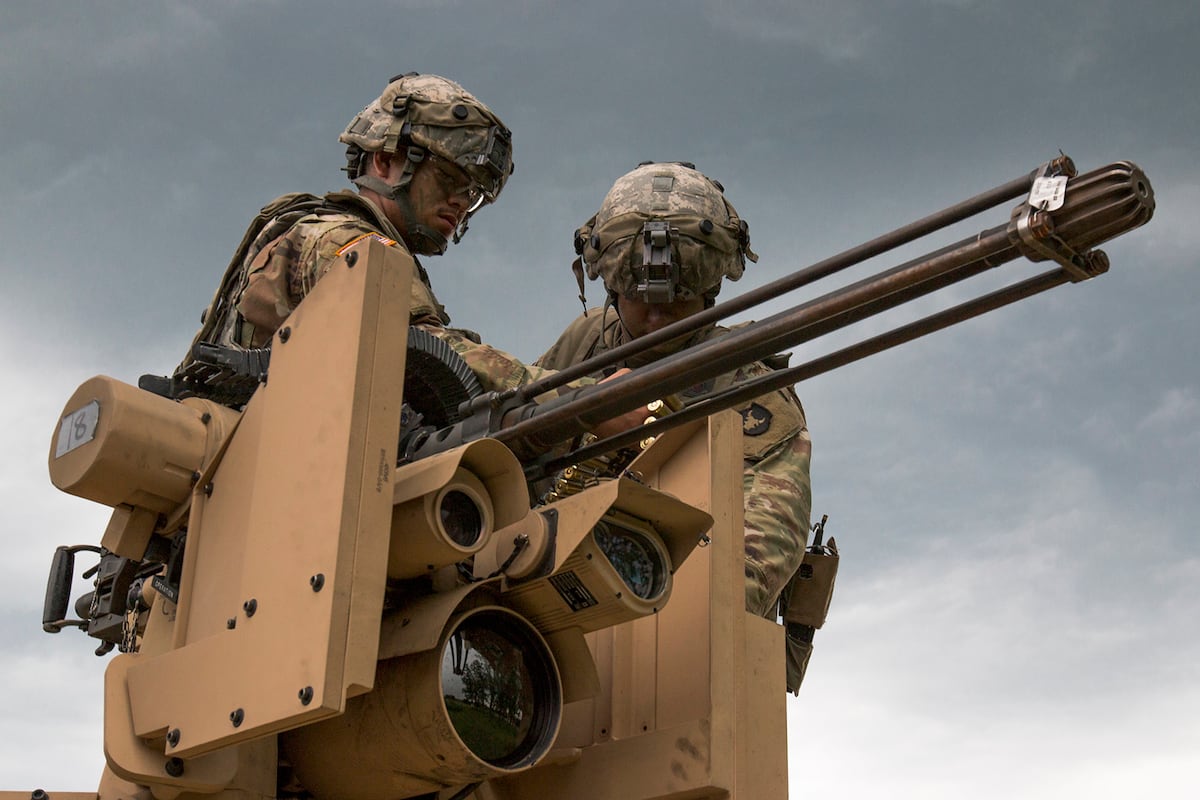
The first phase of the project targets remote weapon stations, specifically the ubiquitous Common Remotely Operated Weapon Station (CROWS) turrets installed on various military vehicles.
“The primary objective is to accelerate the combat schedule, initially focusing on unmanned aircraft systems (UAS) and then on other threats such as vehicles and human-sized targets,” the Defense Innovation Unit recruitment explained. The deadline is May 15th.
The prototype should “significantly improve” the ability of current remote weapon stations to detect, track and engage targets in groups 1 and 2, or targets weighing 55 pounds or less.
Detection must occur at a distance of at least 600 meters, and engagement must occur at a distance of at least 100 meters. According to the request, the system must be effective against drones traveling at speeds of at least 30 meters per second, or 67 miles per hour.
The second phase of the project aims to enhance C-UAS capabilities on “both mobile and fixed platforms, including terrestrial and marine environments,” the solicitation states.
Specifications include the ability to attack Group 1 drones (weighing less than 20 pounds) traveling at 7 meters per second, or 16 miles per hour, at a range of 50 to 200 meters. The document states that the weapon must be capable of hitting targets when it is lowered to -10 degrees or raised to 90 degrees from directly above.
To this end, contractors are required to provide prototypes that are “capable of being launched in land and sea environments, rather than simply in a laboratory setting during a pitch,” the solicitation says.
Most notable, however, is the third phase of the project, which will add target recognition support capabilities to small arms carried by dismounted troops.
“Preferred solutions include systems that can redirect or self-aiming standard munitions to increase the probability of hit against manually selected temporary targets, while integrating networked sensors and small arms control systems,” the DIU said.
The system must be able to engage drones moving at at least 7 meters per second, “must be able to adapt to detached conventional small arms, be scalable across calibers and configurations, and be able to maintain baseline performance of the weapon in the event of system degradation or failure,” the document states. “We need a prototype capable of semi-automatic live fire.”
The final stage of the project aims to improve sensor and weapon integration.
“Commercial wireless edge network architectures that bridge military systems and vice versa are essential at all stages of this effort to manage the transfer of data from sensors and weapons/fire control systems,” the DIU said.
The U.S. military is beginning to employ target awareness support. The Army is already testing small UAVs equipped with AiTR to help infantry squads control drones.
But the Pentagon also recognizes that AI and targeting are controversial.
DIU projects specify that humans must be involved in the loop. Solutions must adhere strictly to the Department of Defense AI Ethical Principles. Failure to do so will result in “immediate disqualification,” the DIU warned.
Michael Peck is a correspondent for Defense News and a columnist for the Center for European Policy Analysis. He holds a master’s degree in political science from Rutgers University. Find him at @Mipeck1 on X. His email is mikedefense1@gmail.com.


