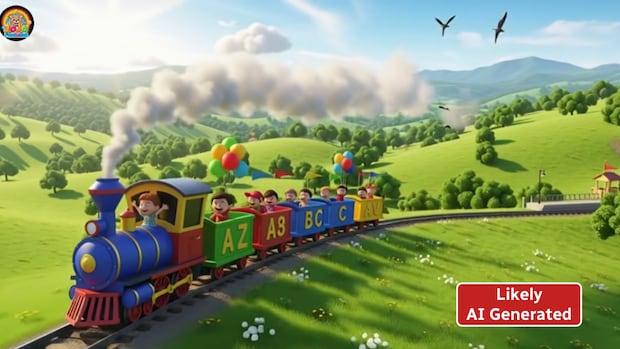
With its bright visuals and smoothly animated babies and colorful trains, you might think you’ve found a mediocre online video teaching kids their ABCs.
But this may actually be an example of meaningless content mass-generated by artificial intelligence, known as AI slop, circulating on YouTube, alarming child development experts and advocacy groups like Fair Play. This month, the group sent a letter to YouTube’s parent company, Google, expressing concerns about the decline in artificial intelligence and calling for changes to the way AI videos are displayed and distributed on the platform.
AI slop “distorts children’s sense of reality, overwhelms their learning processes, and hijacks their attention, negatively impacting children’s development,” the letter said.
What is baby slop?
While Italian Brainrot videos and other AI “slop content” have previously captivated older audiences, experts say Baby Slop is a more recent wave of AI-generated videos aimed directly at toddlers and preschoolers.
Kelly Ewart, an associate professor of education at Wilfrid Laurier University who studies AI literacy, said videos can include bright colors, repetitive sounds and familiar characters from popular movies and TV shows.
But such content “really doesn’t have any developmental or cognitive coherence or intent,” she says.

An education professor and children’s content creator explains the characteristics of the low-quality, hastily produced, generated AI video content that is proliferating online.
How do we know it’s AI?
If you look closely at a video, you can often find classic signs that suggest it was generated by AI.
Characters and objects may suddenly become different (a red car looks different in each scene) or behave strangely (a child on a scooter disappears into the ground, a stream of underwater bubbles flows downward instead of upward). The actual letters and numbers may be mixed with meaningless characters.
Expanding the description of a YouTube video may reveal that the video contains “altered or synthetic content,” but not all creators disclose this.
How is this harmful?
Because infants and preschoolers’ brains are still in the early stages of understanding the world and developing language skills, some AI videos are so confusing that children “can’t make any kind of meaning out of them,” Ewart suggested.
According to children’s content creator Carla Engelbrecht, these types of videos can model risky behavior. For example, someone who grabs a hot pot with their bare hands.
“I’ve seen content that models behavior that you don’t want your kids to have,” said the California-based creator who collaborated on the project. sesame streetNetflix and PBS Kids for 25 years.
Dr. Michelle Ponti, chair of the Canadian Pediatric Association’s Digital Health Task Force and lead author of the Screen Guidelines for Children Under 5, talks candidly about these videos.
“This is trash, and young children can’t learn from trash,” said the London, Ont.-based pediatrician.
“We know what fosters early learning: direct contact with a loving caregiver, real human back-and-forth interaction that can create connections and help children learn,” she said. “AI slop is just a collection of garbage.”

The UK has issued new screen time guidelines suggesting specific limits on how much time children should have, depending on their age. To learn more about that and how these guidelines compare to Canadian guidelines, CBC’s Stephen Quinn spoke with Dr. Peter Lin, medical columnist for The Early Edition.
Ponti recently co-signed a Fair Play letter asking Google and YouTube to make changes, including clearly labeling all AI-generated content and banning AI-generated content on YouTube Kids.
YouTube CEO Neil Mohan said in January that “low quality and repetitive” AI content was attracting the company’s attention.
A YouTube spokesperson said in a statement to CBC News this week that the company has “high standards” for YouTube Kids content and limits AI-generated content in the app to “a small number of high-quality channels.”
A spokesperson said creators on the main platform will be required to publish AI content that looks real and indicate whether they have used YouTube’s AI tools. The spokesperson also said that a labeling strategy for YouTube Kids is in the works.
CBC News attempted to contact multiple YouTube channels that create videos for preschoolers that appear to be AI-generated, but did not receive a response in time for publication.
Are there any guidelines for children’s videos?
With quality children’s programming like mr dress up, Mister Rogers’ Neighborhood and sesame street When language has a purpose, Ewart says, “purposeful repetition” provides “opportunities for children to develop their understanding.”

According to Engelbrecht, traditional television and online programs that incorporate child development typically follow principles of multimedia, design, and storytelling.
For example, to support literacy skills, spell out a word and then show its objects and say them on the screen to emphasize concepts for young brains. It shouldn’t be too fast-paced or too busy.
“If you want your attention to say, ‘The dog is in the yard,’ but instead you see a scene of a busy street with clouds and planes flying overhead,” these additional elements can be distracting and overwhelm the original intent, Engelbrecht said.
Can’t parents forbid it?
Calgary parent Sarah Lynby-Workland has been adjusting her family’s screen time after witnessing nearly seven-month-old Ben becoming engrossed in just a few seconds of infant sensory videos. She immediately stopped the video. She’s seen other parents show their kids online videos and have them do difficult tasks, like untangling or brushing their teeth.
AI video is so prevalent online that it may seem inevitable, like an “avalanche rushing towards us,” says Lembey-Workland.

She points out that while YouTube Kids accounts have parental controls and parents need to know what their kids are watching, it’s impossible to scrutinize them every second or monitor them every hour of the day.
“Compared to when we were kids, he’s changed so much.” [watching] Saturday morning cartoons. ”
Mr Ponti agreed that this was more than a matter of parental guidance, saying proper regulations were needed that “put child development at the forefront”.
Can AI be used effectively?
Engelbrecht has worked with AI tools for years, but recently dabbled in AI animation, which she says has influenced her work to help others. Improve AI literacy, Detect tilt and create better videos.
Since AI models are already tuned to reflect copyrighted content, Engelbrecht doesn’t think adding safety guidelines to children’s content is overkill.
“A direct ban on AI content. I think the toothpaste definitely came out of the tube,” she said. “But it is possible to talk about and enforce standards and quality of content.”
The current challenge, she says, is that platforms and algorithms emphasize fast-moving video and visual transitions, which is inconsistent with best practices in video production and child development.

But if you push generative AI to incorporate such principles, she says, “it’s actually going to do a pretty decent job.”
She believes AI can be used to create online children’s content that is a middle ground between fast food and Michelin-starred cuisine.
She also mentioned the studio behind the hugely popular online video series cocomelon Working with UCLA scholars to incorporate child development research into the content could also have “significant impact and impact.”