
PADUKAH — The Paducah City Commission discussed current and potential uses of AI in city government and passed first reading of the 2027 budget at Tuesday’s meeting.
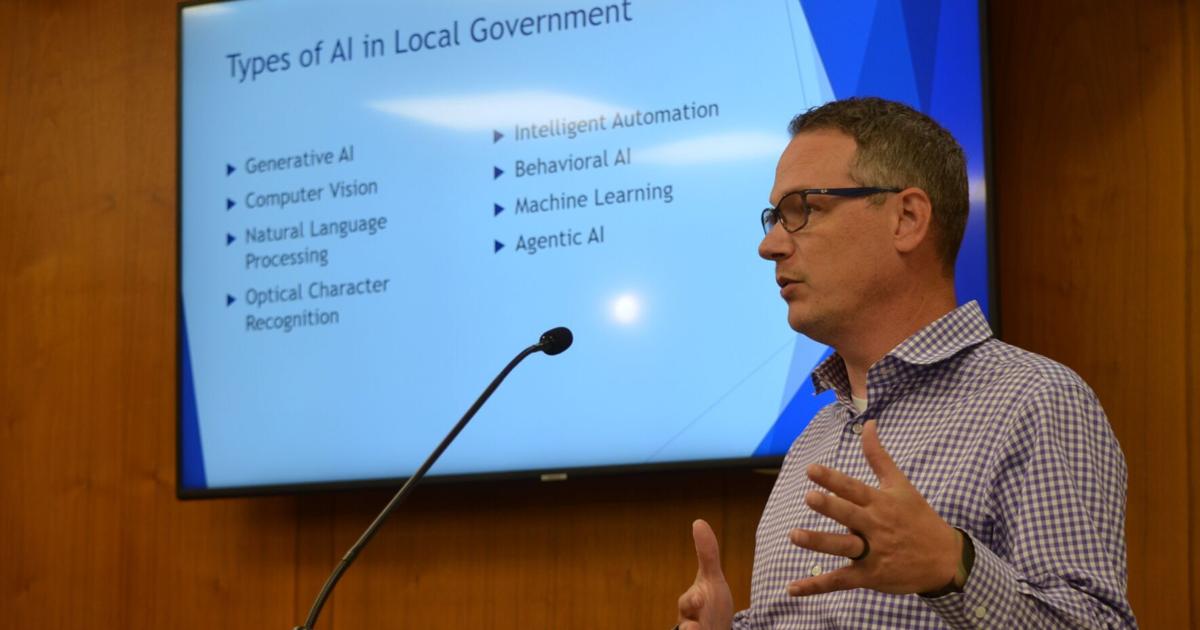
At the International Association of City Managers conference in early April, Eric Stuber, director of technology for the City of Paducah, presented information he learned about using AI in local government, along with city manager Daron Jordan. He began by distinguishing between different forms of artificial intelligence, including generative AI, computer vision, natural language processing, and behavioral AI.
“The biggest thing to understand is that AI is not a single thing, so when people say AI, they mean an abundance of things,” Stuber said. “It’s just an umbrella term that people use. It refers to a collection of individual technologies, techniques, and systems. What Daron and I learned at the ICMA conference are many of the different types of AI being used in government.”

Eric Stuber, director of technology for the city of Paducah, briefed the Paducah City Commission on Tuesday on the use of AI in local government, including potential new applications the city is pursuing.
Stuber then discussed the various uses of AI by governments that were discussed at the conference. This includes using cybersecurity to detect viruses, scanning building plans for code compliance, recording meeting minutes, performing financial audits, and more. Also discussed was using AI to perform Freedom of Information Act requests and redactions, and enabling Flock cameras, already used in Paducah to detect license plate numbers, to use facial recognition technology to detect missing people.
“The biggest lesson from that is to start small and have a purpose,” Stuber said. “Don’t deploy AI just because you want to deploy AI. Find a specific use case, make sure it’s small, implement it and build on its success. If you try to cram AI down people’s throats, it often fails. AI is change, and a lot of what happens when you implement software into technology is change management.”
Stuber said it is also important to require human review of all uses of AI and to properly disclose when AI is used for government purposes.
Stuber described the types of AI uses that the Paducah city government is already implementing. Urban applications include optical character recognition AI for document indexing and Flock cameras, behavioral and natural language processing AI for email security, and generative AI for meeting notes and presentations and policy reviews.
“There are departments that are using generative AI for policy reviews,” Stuber said. “If you want to look at a policy, whether it’s Copilot or Chat GPT, you can ask a generative AI, ‘Give me an overview of this policy,’ and it will read all the text and give you an overview of that policy. You can ask things like, ‘How would someone interpret this policy? How would a citizen interpret this policy? How would a member of my team interpret this policy?’


“AI is here. It’s coming like a house on fire,” said Mayor George Bray. “If we don’t adapt and adopt, we’re going to be left behind. Sometimes the government adopts things a little later than the private sector, but I think we need to be as far ahead as possible and provide as much data as possible to the public as efficiently as possible.”
He said the city’s next steps are to adopt an AI policy, form an AI working group, and evaluate areas for specific use cases.
Commissioner Reynaldo Henderson asked Stuber about areas where the city could start considering new uses of AI. Stuber cited the example of the city of Reno, Nevada, which implemented AI utilities on its website to help citizens more easily navigate and find information.
Mayor George Bray supported promoting its use, saying it would be “very helpful” and allow people to scrutinize large amounts of information more easily. He suggested that using AI to provide meeting notes could be helpful.
“AI is here. It’s coming like a house on fire,” Bray said. “If we don’t adapt and adopt, we’re going to be left behind. Sometimes the government adopts things a little later than the private sector, but I think we need to be as far ahead as possible and provide as much data as possible to the public as efficiently as possible.”
Henderson said the city needs to work to ensure it maintains a personal, human touch alongside advances in technology.

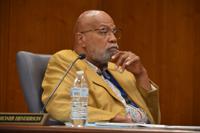
Commissioner Reynaldo Henderson said, “I think this is great, but the other challenge we have is making sure that AI doesn’t replace the human touch, but that it can talk to a real person when needed or desired.”
“I think this is great, but I think the other challenge we have is making sure that AI doesn’t replace the human touch so that we can talk to someone, a real human, when we need or want to,” Henderson said. “I understand if it’s after hours, but during the day if you want to talk to (city clerk) Lindsay (Parish), you can talk to Lindsay.”
The committee also held the first reading of the 2027 budget ordinance. The annual operating budget estimates General Fund receipts at $49,713,352, expenditures at $51,882,954, and utilized reserves at $2,169,602. Total revenues were estimated at $95,622,341, total expenditures were estimated at $116,428,475, and total reserves utilized were estimated at $21,078,342.


