To bring AI agent development under one roof, Oracle today updated AI Agent Studio for Fusion Applications.
AI Agent Builder combines no-code, low-code, and pro-code tools to serve line-of-business users building simple task-based agents. We also support developers who can build more complex agents using Git-based workflows and coding tools like Claude Code, and have access to sandboxes and other familiar testing tools.
Oracle also released Fusion Agentic Applications. It’s a native runtime app that lets you manage Oracle and third-party AI agents and AI automation within Fusion cloud apps across CX, HR, ERP, and supply chain.
Constellation Research analyst Holger Mueller said the new tools and apps build on Oracle’s previous “agent swarm” orchestration, which deploys multiple lightweight agents together to perform more complex tasks. Fusion AI apps update traditional apps for the AI era.
“You don’t have to use the Fusion app to add agents,” says Mueller. “As you build new apps that use agents for what they’re good at, there are other things humans still need to do.”
Many cloud companies in the CX space, such as Pegasystems, Adobe, and Genesys, are working to limit LLM calls by combining deterministic and probabilistic workflows or by setting limits, such as monthly caps, on the cost of AI agents.
Muller added that compared to this time last year, companies are no longer relying on LLMs to make everything tangible happen. Rather, you want to apply AI only where it makes logical and economic sense in your workflow.
“Either the agent gives you the sales numbers back or they don’t,” Moller said. “There’s nothing probabilistic about it.”
Fusion Apps are not strictly AI harnesses. These are business applications with outcomes in mind, such as improving collections, optimizing workforces, and modifying service calls. But they leverage some of the same features, such as security and governance rules within the Fusion environment, said Kaushal Kurapati, head of agent platform at Oracle.
”[It’s a] “It combines AI-assisted inference with LLM, but with deterministic runtime execution, so you get the flexibility and power of LLM and the predictability, reliability, consistency, and speed you need to run enterprise workflows,” said Kurapati.
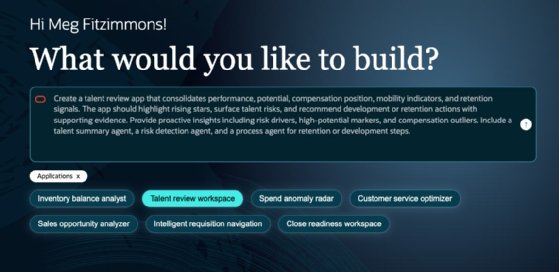
Studio merge development mode
AI Agent Studio for Fusion Applications integrates plain language coding tools with a procode environment that includes app lifecycle management, local validation, debugging, and CI/CD workflows.
That way, line-of-business users who know where their workflow bottlenecks are can work with developers to solve them with new apps, Kurapati said. Non-developers can create or describe agents, and developers can intervene as needed to apply corporate testing and deployment methods.
Professional developers can also build AI agents, AI skills, and Fusion Agentic applications with popular AI coding tools such as OpenAI Codex and Anthropic Claude Code, which integrate with AI Agent Studio.
“If business users are comfortable with natural language interfaces, they can actually build them,” Kurapati said. “They can [also] You quickly create a prototype, show it to a developer, and say, “Hey, why don’t we enhance this with all the safety measures, guardrails, test use cases, everything, and build the same thing in Codex?”
Don Fluckinger is a seasoned B2B technology journalist with over 30 years of experience specializing in enterprise IT, digital experience, and content management. As a senior news writer for Informa TechTarget, I provide award-winning analysis that helps IT and business leaders leverage complex technology to improve customer and employee experiences. Any tips? Please email him.