
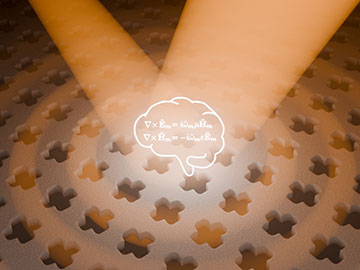
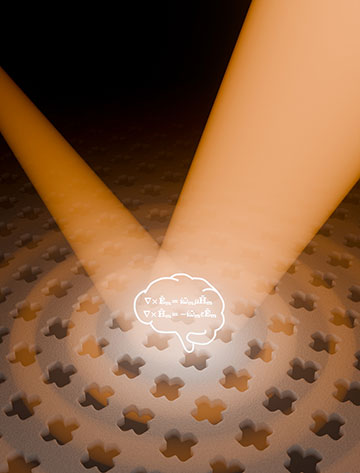
An artistic expression of a new optical development process that accelerates device design by supplementing machine learning with equations that represent real physical processes. [Image: Chalmers University of Technology, Viktor Lilja]
Scientists in Sweden combined machine learning and physical calculations to design photonics components faster than using either approach alone (Laser Photonics Rev., doi: 10.1002/lpor.202502769). They demonstrated a new method that relies on accurately reproducing light scattering in the design of both photonic crystal slabs and devices made from free-form metasurfaces.
Design using neural networks
Researchers traditionally design advanced optical devices using computer simulations based on Maxwell’s electromagnetic equations. They do it by simulating the output of an initial random or obvious design, and then work backwards using the difference between the simulated and desired outputs to fine-tune the design in hopes of improving it. By repeating this process many times, the end result is a high-performance device.
Because many simulation steps take a long time to perform, many groups are instead using neural networks for optical design. The idea here is to train the network to effectively learn the physics behind the behavior of the device in question. The network is fed many different designs at input, and the neuron weights are fine-tuned after each round to match its output (parameters that define the optical performance of the device) to the expected result in each case.
Such networks can typically calculate the output of a particular design much more quickly than traditional simulation. In principle, each step in the “reverse design” process is much shorter, so it can also save a lot of time when generating new designs. However, design performance is limited by the accuracy of the neural network. This accuracy can be improved by increasing the number of parameters in the network or adding additional rounds to the training process, but this requires significant computational power to generate additional data samples, and the one-off design can be more time-consuming overall than traditional simulation.
Back to physics
Rather than using a neural network to directly compute the scattering matrix, the researchers trained the network to generate a set of parameters that describe the subnormal modes.
In a new study, Philippe Tassan and his colleagues at Chalmers University of Technology have shown how pure machine learning can be improved by bringing physics back into the design process. These define the performance of the device through what is known as the scattering matrix. The scattering matrix relates the amplitudes of the incoming and outgoing electromagnetic modes, revealing how much light is transmitted, reflected, or absorbed. More specifically, we decompose the scattering matrix into “quasi-normal modes” and define the damped resonant frequency of a physical system that loses energy.
Rather than using a neural network to directly compute the scattering matrix, the researchers trained the network to generate a set of parameters that describe the subnormal modes. These values were then incorporated into the algorithm to calculate the scattering matrix. In doing so, they hoped to reduce the amount of data needed to train the network, which they named QNM-Net, while ensuring that the system’s output design conserved energy and followed the principle of causality.
Testing the scheme
They tested their plan by designing a photonic crystal slab consisting of a sheet of lossless dielectric material patterned with an array of micrometer-sized holes. They started by training QNM-Net using 8,000 data samples (each consisting of a random slab design and its associated scattering spectrum) and then tested the system’s accuracy using an additional 2,000 samples. They compared these results with those of three standard fully connected neural networks (without physical algorithms) and found that QNM-Net could achieve a given spectral accuracy with only one-tenth of the data needed to train its traditional counterpart.
The researchers then used the trained QNM-Net to perform inverse designs of five different photonic crystal slabs. They were able to do this in less than a second per design, and found that in each case, computer simulations of the device’s output closely matched the output sought at the beginning of the exercise.
Tassin et al. also used QNM-Net to simulate the behavior of more complex devices in the form of free-form all-dielectric metasurfaces. Here they succeeded in reducing the amount of training data required to achieve a given loss by about a third compared to the best standard neural networks, but in some cases failed to reproduce simulated scattering resonances. The design space was so large that even the tens of thousands of datasets used for training were not enough to maintain high accuracy, they said.
They point out that they are not the first group to integrate physical calculations with machine learning for the design of optical components. The researchers say that QNM-Net’s accuracy and training requirements are similar to previous physically reinforced neural networks, but argue that the method has the potential to be used to design a wider range of photonic devices and has a more solid theoretical basis. Devices that QNM-Net could design could include lightweight, high-performance lenses for cameras and glasses, as well as photonic crystals for transmitting data between quantum computers.


