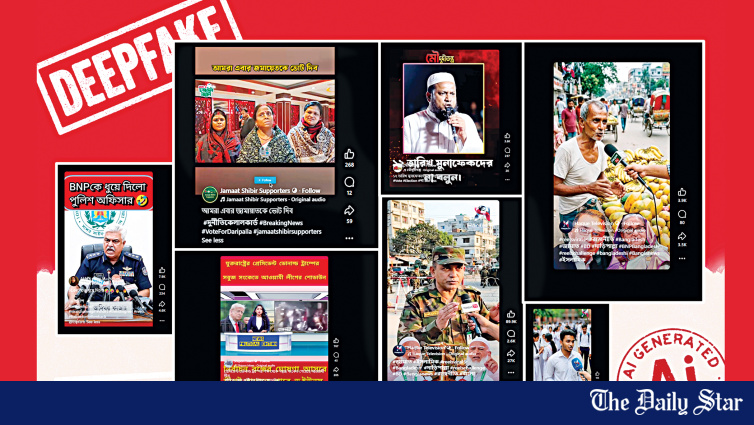
On January 11, Facebook Reel featured a police officer attending a staged press conference who confidently predicted that Bangladesh’s Jamaat-e-Islami would win 200 seats in the next election. The video also uses derogatory language accusing the Bangladesh Nationalist Party (BNP) of systematic extortion.
Just a few days ago, another reel featured an alleged Islamic preacher who heavily criticized the Jamaat for deviating from the principles of Islam as practiced in Madinah. In the third short clip, a person purporting to be a news presenter claims that the US will spare no effort to ensure the return of the Awami League to power.
However, if you look closely, it is clear that there are inconsistencies in facial movements such as blinking and lips.‑Synchronization looks unnatural, lighting and textures don’t match‘They often don’t match and there is distortion in the background. And the audio doesn’t match the speaker’s mouth movements.
In reality, both videos are fakes created using deepfake and cheapfake artificial intelligence (AI) tools. Social media is full of such content. As the February 12 election approaches, AI-generated disinformation and misinformation is increasingly flooding Facebook, a Daily Star investigation has found.
This newspaper documented and analyzed 97 AIs between December 14, 2025 and January 14, 2026.‑The content generated on Facebook, mostly videos, comes from 19 pages and profiles (see methodology online).
This content promoted political agendas across political parties, often through manipulation and disinformation, attacking opponents or boosting one’s own faction. Together, these pieces of content generated 1.6 million engagements within the first 24 hours of posting, highlighting the sheer number of users exposed to the content and raising questions about its potential influence with voters.
Analysis of comments revealed that many viewers believed the content to be true.
Data also shows that these AI content trends are accelerating as Election Day approaches. Between the first and last week of data collection, incidents where such content spread more than tripled from 9 to 33, a 267% increase within this limited dataset.
Experts say AI content can serve as a strategic tool to sway public opinion, but its risk must be judged by whether it crosses a “harm threshold” of inciting violence or suppressing voters.
Experts noted that social media platforms have the technical capacity to detect organized fraud and stressed that platforms need to effectively apply content moderation tools and policies to combat disinformation, especially during election periods.
attacker, target, story
More than half of the content spread by these actors was classified as manipulative content, followed by disinformation (39.18%). remaining 9 pieces The percentage was categorized as hate speech, religious provocation, character assassination, and sexual and gender-based violence.
Of those, 50 deepfakes and cheapfakes came from pages or profiles that appeared to support Jamaat. The BNP-affiliated page provided 30 pieces of content, while the pro-Awami League (AL) page posted 17 similar items in a month.
However, none of these pages or profiles monitored for this study are official handles of political parties.
Their political affiliation was determined by reviewing the 30 most recent posts from each page or profile at the start of the monitoring period in mid-December last year.
The categorization was based on narrative coherence, such as sustained promotion of particular political parties, repeated opposition to particular actors, nature of intervention in ongoing political debates, and visual and symbolic cues.
According to the analysis, the BNP was the most frequently targeted political actor, with 27 posts against the party, all from pro-Jamaat groups. Jamaat followed suit, facing 26 posts. Of these, 24 came from pro-BNP stakeholders, representing 80 percent of all pro-BNP content analyzed.
This pattern shows that online political activity between the two parties, currently the most likely candidates in Bangladesh’s post-Awami League political landscape, is mainly focused on attacking each other on social media, even as on-ground campaigning also intensifies.
Most of the pro-Jama’at Posts targeting the BNP centered on allegations of extortion and corruption. For example, a video posted by a page called Haque Television on January 13 depicted a fruit vendor claiming that the BNP was planning to steal votes in the same way as the Awami League. He concluded with a call to resist “terrorists and extortionists.”
Beyond efforts to delegitimize the BNP, many posts from Jamaat-aligned pages and profiles targeted the general public by promoting pro-Jamaat discourse aimed at shaping public opinion. These included false endorsements by AI-generated characters, fabricated achievements, and portrayals of Jamaat as morally correct and superior to the BNP.
In contrast, pages and profiles affiliated with Awami League target the transitional government to replace Awami League, individuals leading the new government, and actors involved in overthrowing the AL government. These targets included student coordinators, caretaker government advisers, and National Civic Party (NCP) leaders.
Pro-AL organizations also attacked prominent female politicians such as Tasnim Jarrah, DUCSU leader Fatima Zuma, and Tahrima Jannat Surovi, who spearheaded the July uprising. These posts often suggested moral laxity and sexual corruption, and led to the inclusion of female leaders, sometimes alongside male leaders, in fabricated or compromising scenarios.
manufacturing agreement
Most of the manipulated content aligned with the BNP sought to discredit the Jamaat’s Islamic credentials, criticizing its role in the 1971 Liberation War, hinting at a secret alliance with India, and highlighting alleged violations of Islamic principles that drove people away from the Jamaat.
In one reel, an AI figure mentions that the BNP has nominated four people from the Bangladeshi party Jamiat Ulama-e-Islami, portrays the party as a truly pro-Islamic party, and urges viewers to vote for the BNP.
However, the most-shared Jamaat-aligned AI videos were designed to demonstrate broad support for the party by showing support for diverse social groups, including alleged Hindus, rickshaw drivers, and other working-class people.
One video shows a Bangla-speaking man standing in a desert environment and claiming that as an immigrant he has “seen it all” and will vote for the Jamaat in the next election.
Two further videos explicitly equate voting for and supporting the Jamaat and its student wing, Islami Chhatra Shibir, with supporting Islam itself. One person urged viewers to “vote for Islam,” while another framed Sybil’s recent victory in the student council election as a victory for Islam.
Overall, 50 of the 97 pieces of AI content analyzed appeared to be manipulative. Jamaat-aligned pages and profiles accounted for the largest share of these posts (34 posts), followed by BNP-affiliated actors with 14 posts and Awami League-affiliated sources with two posts.
For this study, manipulation was defined as content that seeks to generate fear, prejudice, or false dualisms by relying on innuendo or rhetorical frameworks without providing verifiable or falsifiable evidence.
voters are attracted to it
The comments section shows that many users have fallen into this manipulation trap by assuming the content to be true, while others have flagged the content as being created by AI.
For example, an AI-generated video that received 2,700 comments depicts a person who appears to be a Hindu saying that Hindus will now vote for the Jamaat. One user commented on the post: “Alhamdulillah baaro.”
The majority of comments under the same post appear to be positive, but many appear to be coming from bots.
Some users were quick to denounce the scam to warn others. Md Reazul Hassan, a verified user, commented, “AI video.”
This pattern of positive comments and denouncing deception is evident across AI-generated content from other pages and profiles.
However, engagement (1.6 million for these 97 pieces of content) is unevenly distributed across stakeholders, with Jamaat-aligned profiles and pages dominating in both volume and reach, potentially impacting many stakeholders.
For example, Uttorbongo Television in partnership with Jamaat had over 1.06 million engagements on just 14 videos, which is about 64 percent of the total engagement across all posts. Other Jamaat-related pages include Akhi’s Story, Haque Television, and Jamaat Shibir Supporters.
Together, these four pages accounted for 44.33 percent of the 97 posts analysed, but about 78.37 percent of the total engagement, revealing the dominance of pro-Jamaat actors in generating engagement.
Similar to Jamaat-aligned pages where one or two pages accounted for a disproportionately large portion of total engagement, we observed the same pattern for BNP-aligned entities. Of the total engagement attracted by pro-BNP AI content analyzed, 97% came from the Next Insight Network.
In contrast, pages related to Awami League had limited reach. 11,800 engagements were generated from 17 posts from 10 profiles and pages. Although 17.53% of the AI content analyzed in this study was generated by AL-aligned pages, they accounted for less than 1% of the engagement, suggesting a weak circulation network.
The most prominent pro-AL actor was Shipon Islam, who distributed six pieces of AI content and accounted for 59.15 percent of the total engagement generated by actors participating in Awami League.
A recent study by fact-checking organization Dismislab identified him as the third largest spreader of disinformation in 2025, and responsible for 62 such pieces of content.
Shipon Islam (AL affiliate), Engr. Jahirul Islam Tom (BNP affiliate) and Next Insight Network (BNP affiliate) did not respond to multiple text messages.
In response, Utorbongo TV and Haq TV (affiliated with Jamaat) denied any political ties and claimed that their videos were aimed at conveying “truth” to society.
Both pages avoided direct questions about the credibility of the content or whether the AI-generated videos were misleading the public with disinformation.
Miraj Ahmed Chaudhry, managing director of Digitally Right, said the impact of synthetic media depends entirely on the digital literacy of individual voters, and that public awareness is far more effective than police enforcement when it comes to preventing deception.
“While some people may easily spot AI, others may be seriously misled by the ‘realism’ of the persona presented. This problem cannot be tackled by the police. We need widespread awareness so voters understand that what they see online is not necessarily reality,” he told the Daily Star.
Asked about social media platforms’ role in preventing manipulative AI content and disinformation, he said: “While platforms have the technical ability to detect coordinated fraud and bot-driven engagement, their will to effectively enforce these policies is questionable. We need more transparency from platforms acting as watchdogs, sharing exactly why content is being moderated or removed and based on whose direction.”
[Authors are interns at The Daily Star. See online for a more detailed version and full methodology]
Additional reporting and research: Nourin Sultana Toma, Mir Rownak, Tarek Hossain