
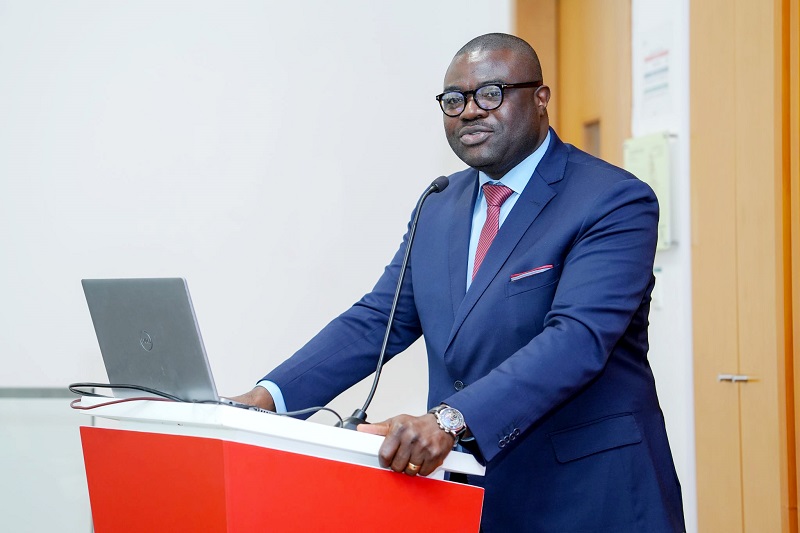
Professor Damilola Olawi (SAN), international law expert and president of the Association of University Lecturers in Environmental Law in the Middle East and North Africa (ASSELLMU), called for the ethical and responsible use of artificial intelligence (AI).
He said this is to maximize its potential for achieving sustainable innovation in line with Goal 9 of the United Nations Sustainable Development Goals (SDG 9).
The Nigerian Senior Advocate, who is also the Chair of the United Nations Working Group on Business and Human Rights, made the remarks during the High-Level Plenary Session of the 7th Middle East and North Africa (MENA) University Environmental Law and Policy Scholars Conference held at Sorbonne University, Abu Dhabi, in Abu Dhabi, United Arab Emirates.
The theme is “Environmental Law in the Digital Age.”
Established in 2018, the conference is the largest annual gathering on environmental law and policy in the MENA region, bringing together academics, governments, businesses and international organizations to discuss innovative approaches to environmental law teaching, research and international collaboration across MENA universities.
This year’s conference attracted high-level speakers, including the president of Sorbonne University Abu Dhabi; Professor Nathalie Marcial Braz, HE Professor. His Highness Dr. Sheikh Abdul Aziz bin Ali Al Nuaimi. His Excellency Arthur Matri, founder of Green Shake Academy. Dr. Richard John O’Brien Perry, Ambassador of Switzerland to the United Arab Emirates and Bahrain; Professor Patricia Mbote SC, Advisor to the Environment Agency, Abu Dhabi, United Arab Emirates; Professor Ignacio Tirado, Director, United Nations Environmental Program Law Division; In attendance were the Executive Director of the United Nations Institute for International Private Law (UNIDROIT), Professor Ord Solveig Epstein, the Rector of the Sorbonne University, representatives of Abu Dhabi, United Arab Emirates, the United Nations Development Program (UNDP), the African Union, and other senior officials.
The conference aimed to provide a platform to foster learning and collaboration to strengthen the education and practice of environmental law in the region, with a particular focus on the role of innovative technologies and digital tools, including artificial intelligence, in promoting sustainable development.
Emphasis was placed on the concept of “twin transitions,” which explores the possibilities of addressing the ecological crisis while simultaneously promoting the spread of digital infrastructure throughout society.
Highlighting the important role of AI in education, research, enforcement and monitoring of environmental law, Mr. Olawi noted that AI must be used ethically and responsibly to improve trust and strengthen environmental decision-making and enforcement in this digital age.
According to him, “Despite AI’s innovative and important contributions to environmental monitoring, research, and education, the exploitative and unethical use of AI and other digital tools is becoming one of the greatest threats to innovation and critical scholarship.”
“Therefore, in this digital age, articulating the guiding principles and ethical codes that underpin the education and practice of environmental law and the sustainable use of AI will help chart a timely and consistent path forward.
“Now more than ever, interdisciplinary and innovative research is needed to uncover integrated solutions and twin transition approaches that address the global ecological crisis and at the same time accelerate the uptake of resilient, climate-smart digital infrastructure in our societies.”
Professor Olawi stressed the need for capacity building to enhance the long-term benefits and use of AI and other digital technologies around the world, while calling on higher education institutions to develop interdisciplinary courses and programs that blend sustainability and technology.
Mr. Olawi noted the importance of instilling a “technopreneurial mindset” in students, stressing the importance of educating the next generation about the ethical use of AI and how it can enhance environmental monitoring and how decision-making can unleash youth-led entrepreneurship and innovation that accelerates sustainable and prosperous economies.
The conference concluded with a closing ceremony highlighting future directions for advancing technology-driven environmental law education.
The highlight of the closing ceremony was the official unveiling and handing over of the conference flag to Al Faisal University in Riyadh, Saudi Arabia, as the host university for the 8th conference in 2027.
The 8th MENA Environmental Law Conference, held at Al Faisal University, aimed to build on the important dialogue established at this year’s event.


