

It started with fried chicken.
At APEC 2025 in South Korea, NVIDIA CEO Jensen Hwang met with top executives from Samsung and Hyundai. Behind the laughter and camera flashes, big things were happening. More than 250,000 graphics processing units (GPUs) deployed to expand South Korea’s AI infrastructure
On the surface, it looked like a new chapter of progress and innovation in East Asia. But behind that moment was an environmental cost that the world hasn’t paid enough attention to.
That’s why the System Shift Podcast is back. In this new episode, Greenpeace East Asia looks at the real-world implications behind NVIDIA’s record-breaking valuation and asks the question: Who is paying the price for the AI boom?
 © CNBC Used courtesy of CNBC. “wp element caption” class=”caption”>NVIDIA CEO Jensen Hwang shares soju, bonds and toasts with Lee Jae-young (Samsung Electronics) and Jung Eui-sung (Hyundai Motor Group) in Seoul in October 2025.
©CNBC
What powers AI and its hidden costs?
For many years, South Korea’s SK Hynix and Samsung, and Taiwan’s TSMC have supported NVIDIA’s rise. Together, the two companies have built the backbone of the global AI industry, producing the chips that power data centers and supercomputers everywhere. These companies have turned East Asia into the world’s efficient, ambitious, and unstoppable electronics factories.
But this success hides an unpleasant truth. It has high environmental costs.
As the demand for AI chips increases, so does the demand for power. The semiconductor industry could soon consume a huge share of local electricity, according to Greenpeace East Asia’s 2024 report ‘Chipping Point’. 20% of Taiwan’s total electricity consumption and 30-40% of industrial applications in Korea by 2030 . But fossil fuels remain 50% In both locations.
To meet this growing demand, governments are turning back to fossil fuels and even nuclear power.
live on the front lines
In Yongin, South Korea, six new LNG power plants have been approved to meet AI’s energy needs. The decision has already sparked legal action, with 450 residents and civil society suing the government over climate and health risks. On the other side of the region, Taiwan, which once boasted of being a nuclear-free homeland, is now reconsidering a referendum on nuclear power plants. Even Mr. Huang, who was born in Taiwan, once referred to nuclear power plants as “nuclear power plants.” “Good option for the island.”
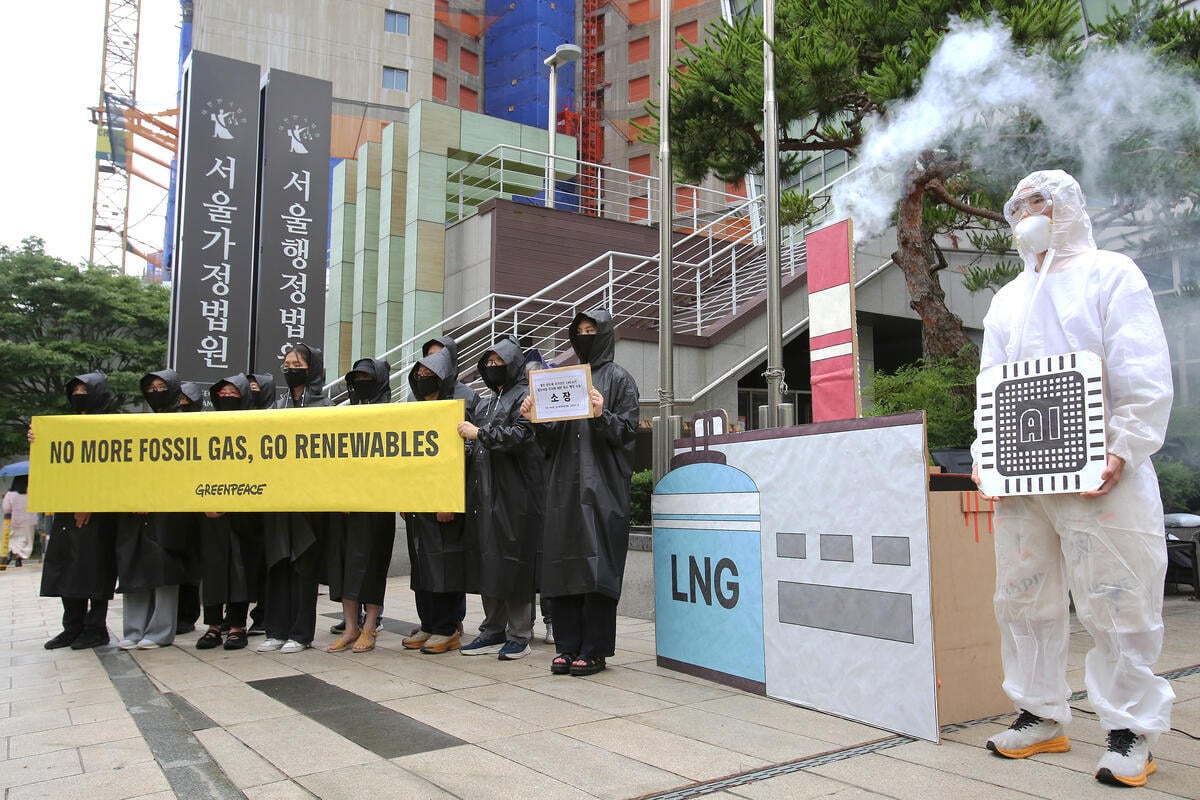
© Greenpeace / Park Yeo-sung
The dangers of fossil fuel expansion are not abstract. To meet the rapidly increasing power demand from the AI industry, Taiwan is proposing the expansion of multiple gas power plants. However, this raises public health concerns. September 2025, Gas leak explosion at Kodatsu Power Plant An ignition test in Kaohsiung City caused dissatisfaction and concern among local residents. A Greenpeace Taiwan study found that people who live near power plants and petrochemical production facilities are generally in areas with higher exposure to air pollution. They identified 191 facilities across Taiwan’s 13 prefectures and cities and claimed that the high-risk zones cover nearly 40 percent of the population, including 1.15 million children and 1.59 million elderly people.
Those at the forefront of AI industry development are paying the price for the world’s digital transformation.
silence of power
Meanwhile, NVIDIA is currently developing the world’s first 5 trillion dollar companyhas not yet set emissions reduction targets from its suppliers. According to Greenpeace East Asia, 80% of total carbon dioxide emissions It is sourced from supply chains, many of which are based in East Asia. However, Greenpeace East Asia’s latest rankings show that there are still no clear commitments or actions to help suppliers transition to renewable energy or improve the situation in the region.
This silence speaks volumes. It is treated by “partners” in Asia not as developing equals but as stepping stones to global AI dominance.
Greenpeace activists across the region are witnessing the human side of this injustice. They see communities living near new power plants, children facing potential exposure to polluted air, and families fighting for the right to clean energy. These stories are not heard enough.
You can listen to the latest episode system shift In our podcast, we talk about what happens when advances in AI collide with sustainability, and how we can build a digital future that doesn’t destroy our real future.
True innovation is not measured by speed or market value. It is measured by our care for people, the planet and future generations.
Please join us Clean AI, Clean Future By signing the petition below.
Avex Li is a Digital Communications Strategist at Greenpeace East Asia.
/Open to the public. This material from the original organization/author may be of a contemporary nature and has been edited for clarity, style, and length. Mirage.News does not take any institutional position or position, and all views, positions, and conclusions expressed herein are solely those of the authors. Read the full text here.


