
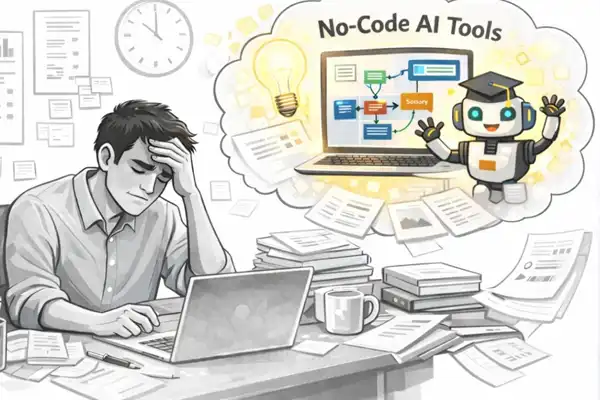
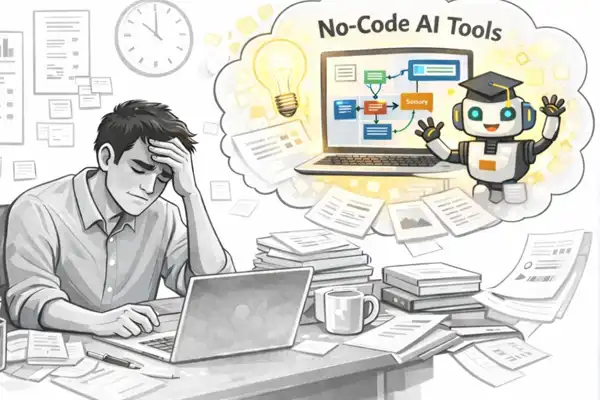
No-code AI tools reduce workload and increase productivity in academic and professional environments.
Artificial intelligence (AI) and machine learning (ML) are increasingly shaping daily activities in education, research, and organizational management. From data analysis and automation to academic documentation and research support, AI tools are gradually becoming part of regular academic workflows. However, traditional AI development often requires programming expertise, complex software setup, and large amounts of computational resources, creating barriers for students, educators, and non-technical users.
In academic environments, excessive amounts of time are often spent on repetitive tasks such as writing reports, mapping course outcomes, literature reviews, workflow management, and organizational documentation. Although AI can greatly streamline these activities, many users are hesitant to adopt it due to misconceptions that it requires advanced coding skills, complex setup, or expensive infrastructure. As a result, manual processes still dominate daily academic and professional work. No-code artificial intelligence tools are emerging to fill this gap, allowing users to leverage AI through visual interfaces, workflow builders, and prompt-based interactions without any programming knowledge. These tools include beginner-friendly AI training platforms, agent-based automation systems, academic assistants, and research support tools for literature review and knowledge organization.
We review below a carefully selected set of no-code AI tools tailored to real-world academic and professional needs. These cover four main areas: beginner AI model training using Google Teachable Machine, task automation with AI agents, academic documentation support, and research writing assistance.
Google Teachable Machine: No-code AI for fast learning
For many beginners, the main challenge with AI and ML is not understanding the concepts, but knowing how to get started. Students are often asked to build simple AI models, such as image or gesture classification systems, without any coding experience. Traditional ML workflows involve programming, library installation, and error handling, which often create obstacles rather than learning opportunities.
In such student-centric scenarios, the main requirements are to quickly train a model, test its predictions, and understand the basic ideas of classification within a limited amount of time. This challenge can be effectively addressed using Google Teachable Machine, a browser-based no-code platform designed for rapid experimentation. This platform allows students to solve three types of problems: image classification, audio classification, and pose classification. By collecting sample data through a webcam or microphone, assigning it to different classes, and training the model with one click, students can build functional AI models within minutes. This approach allows learners to focus on conceptual understanding and practical application rather than technical complexity.
Task automation with AI agents: Reduce your daily workload
In academic and professional environments, much time is spent on repetitive, rule-based tasks rather than meaningful analysis and creative work. Tasks such as managing emails, updating spreadsheets, sending reminders, generating reports, and processing form submissions are performed manually and repeatedly, increasing workloads and increasing the potential for human error.
Common real-world scenarios include students and faculty working on multiple digital platforms simultaneously. Submitting assignments, tracking progress, notifications, and regular reporting require constant attention, even for tasks that don’t require human intelligence. Here, AI agents provide practical support by automating daily tasks. An AI agent is a system that monitors input, applies predefined logic, and automatically performs actions. When implemented using a no-code platform, these agents can be created without any programming knowledge and run continuously in the background.
The main features of the no-code AI agent are:
- Monitor events such as emails, form submissions, and file uploads
- Apply rule-based or AI-driven logic
- Perform actions such as updating documents, sending notifications, and triggering workflows.
- Reduce manual effort and execution delays
- Improved consistency and time efficiency
- Common no-code AI agent tools include:
- n8n
- Zapier
- Make.com
- flowwise
- Relevance AI
No-code AI for research writing and literature reviews
Writing a research paper is one of the most difficult tasks in academia, especially for students and early-stage researchers. Often, the main challenge is not generating ideas, but managing large volumes of research papers. Tasks such as searching the literature, identifying key findings, comparing methodologies, and summarizing results require significant time and effort, especially for those new to systematic review practices.
Common scenarios include students writing the review section of a project or research paper. Having to manually read dozens of papers makes it difficult to identify reliable sources, understand previous contributions, and support arguments with evidence. As a result, reviews are often shallow or have incomplete references.
No-code AI research assistants address this challenge by simplifying literature discovery and analysis. These tools allow users to search and analyze academic papers using natural language queries and automatically extract structured information such as methodology, datasets, findings, and limitations. This allows you to more quickly compare studies and easily identify research gaps while maintaining academic integrity.
Popular no-code research creation tools include:
Overall, no-code AI research assistants act as productivity enhancers rather than content generators. By spending less time researching the literature and gathering evidence, researchers can spend more time interpreting, arguing, and contributing. This makes them valuable support tools in modern research writing workflows.
Reduce AI-generated content and increase uniqueness
In academic writing, maintaining originality is an important requirement for students and researchers. AI-assisted tools can help you structure and draft your content, but the output can appear machine-generated or overly generic. As a result, plagiarism and AI detection systems may flag such content, creating uncertainty during transmission. To address this issue, it is important to refine the AI-assisted text and verify its originality before final submission.
AI-generated content can be reduced by refining and rewriting the text while preserving the original meaning, logic, and academic tone. Content refinement tools help you reorganize your writing, improve readability, and remove AI-like repetitive patterns without generating new research material.
Commonly used tools for filtering content include:
- Quillbot
- AI humanizer
- Paraphraser.io
- grammatically
After you refine your content, you should verify its originality using plagiarism and AI detection tools. These tools can help you identify similarities, AI-generated patterns, and sections that need further revision or proper citation.
Commonly used tools for plagiarism and AI detection include:
Extending beyond core tools: the AI ecosystem
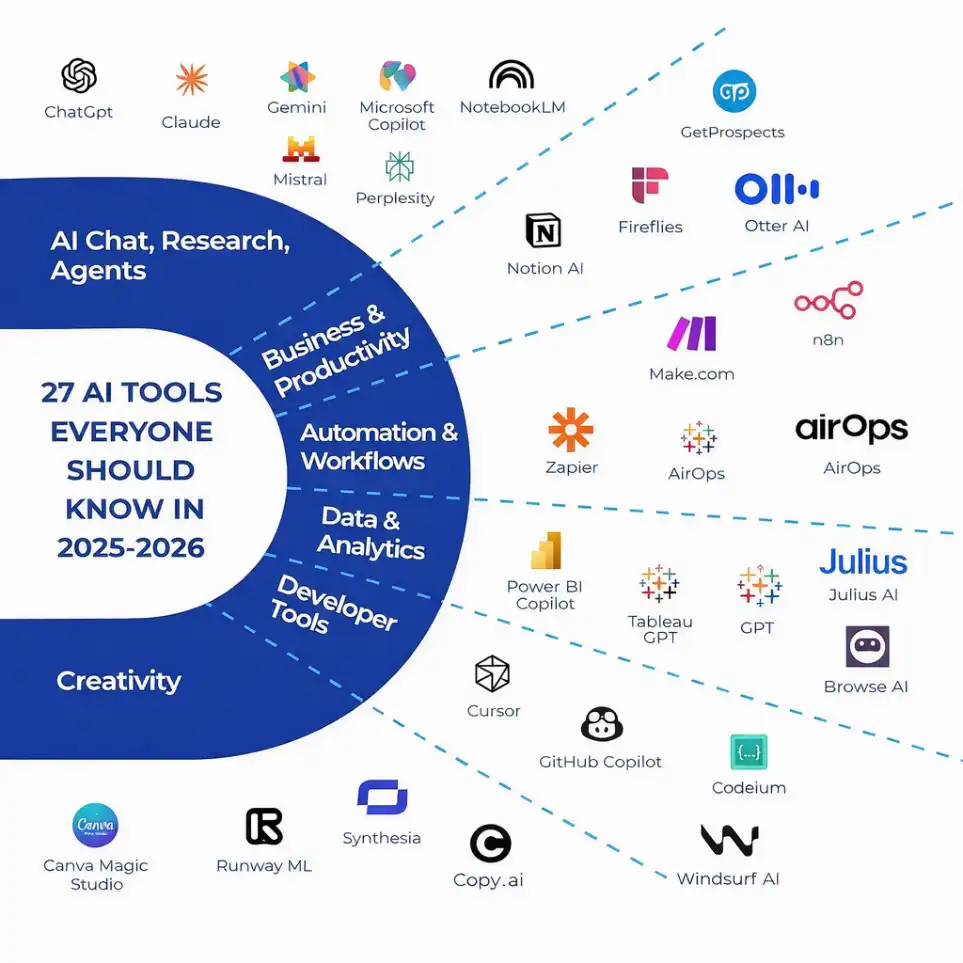
Figure 1 shows the broad ecosystem of AI tools that can be explored for a variety of academic and professional tasks. It shows how AI is being used in areas such as research support, automation, productivity, analytics, and creative work. Rather than focusing on a single tool, this image encourages you to be aware of the available context and explore tools that suit your workflow and requirements. This overview is intended to support informed decision-making when deploying AI in real-world scenarios.
The increasing integration of artificial intelligence into academic and professional workflows reflects a shift towards more efficient and accessible ways of working. No-code AI tools play a key role in this transition by enabling students, educators, and professionals to apply AI without technical complexity. These tools support tasks such as model training, automation, research writing, academic writing, and content refinement without replacing human judgment. When used responsibly, no-code AI tools reduce repetitive workloads, increase productivity, and allow users to focus on analysis, creativity, and informed decision-making, making them valuable companions in modern academic and professional environments.


