A new report says the majority of recent college graduates feel unprepared for the workforce and would like to see generative AI taught in university classes.
Moore Studio/Digital Vision Vector/Getty Images
A majority of college grads believe generative artificial intelligence tools should be incorporated into college courses, but more than half say they don't feel prepared for the workforce, according to a new survey from education technology company Cengage Group.
A survey released today found that 70 percent of graduates think basic generative AI training should be built into courses, and 55 percent said their degree programs did not prepare them to use new technology tools in the workplace.
The percentage of respondents expressing concern about generative AI varied by age, with 61% of Gen Z graduates (i.e. those under 27) saying they feel unprepared, compared to 48% of Millennials (ages 28-43), 60% of Gen Xers and 50% of Baby Boomers.
To conduct the study, Cengage surveyed 974 graduates of two- and four-year institutions (including nontraditional adult learners) and those who had received a skills certification in the past year.
“There's a lot of anxiety around, 'What does this mean for me in terms of my job prospects, and am I prepared?'” Cengage CEO Michael Hansen said, adding that he thinks early reservations about AI are fading as expectations for the technology become more realistic. “The education system, as it always does, is playing a little bit of catch-up, saying, 'AI is important, but we haven't built the curriculum we need yet.'”
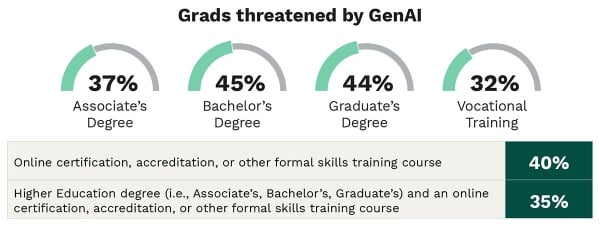
A new report from the Cengage Group finds that recent college graduates are, overall, concerned about keeping up with advances in generative artificial intelligence.
Graduates’ lack of AI knowledge coincides with an overall decline in optimism about the job market, with more than a third (39%) of graduates saying they feel threatened by generative AI that will completely replace them or their job.
“That's exactly what I've seen and heard,” said Chris, a senior fellow at the UPCEA online and professional education association. Inside Higher Education“Students are looking to the future — not just their next class, but their careers and what HR departments and startup owners are looking for in them. And the ability to leverage rapidly evolving technology is what makes all the difference.”
Employers report a skills gap in their workers' ability to use generative AI. Nearly half of 1,000 employers surveyed expect their hires to lack generative AI skills. Nearly two-thirds (62%) believe both future and current hires should have basic knowledge of generative AI tools, and more than half (58%) say they are more likely to interview and hire candidates with AI experience.
Although universities are gradually incorporating generative AI into a wide range of systems, from financial aid to dining services, many professors remain wary of the technology and unsure how to use it: A June survey by higher-education consulting firm Ithaka S+R found that while two in five faculty members are familiar with AI, only 14% are confident they could use it in their classes.
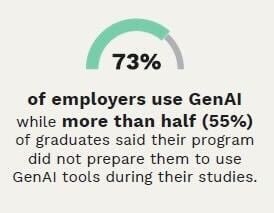
While many employers are adapting to generative AI, universities are not keeping up.
“Higher education institutions have made great strides to better meet the skills employers need, but to do so they need visibility into the skills employers are looking for,” said Tiffany Hsieh, innovation program director at JFFLabs, a subset of Jobs for the Future. “Cross-sector collaboration between educators and employers will be key to helping higher education institutions become more agile and responsive to the skills needed in an AI-enabled world.”
Schroeder encouraged universities to require students to take either an introductory course in generative AI, where they complete a project they can use in their portfolio, or a capstone course in the final year to give them up-to-date skills.
“It's so pervasive in the business world that few people realize it or are in denial. [can’t ignore it]”But the point I'm making here is this is unstoppable. This is so efficient and so powerful that it will not be denied in commerce, business and industry.”
The survey also found that graduates' perceptions of the value of higher education are improving: Nearly three-quarters (73%) of graduates say higher education is worth the cost, up from 52% in 2023 and 68% in 2022.
Hansen believes the spike in perceived value can be attributed in part to efforts by universities to teach students more technology skills.
“I think there’s an indirect connection to technology, where people are saying, ‘I live in a somewhat precarious environment, and education is going to give me the skills I need to be competitive,’” he said. “The U.S. education system has rightly received a lot of criticism. [from students] “People who say, 'it's too expensive,' don't see the value. Universities respond by focusing on value and saying, 'If we're going to spend tens of thousands of dollars on an education, it's going to help us get a better job.'”