
Monday Live | May 2026 | Back to Basics, Part 2
There’s a question the smart building industry has avoided for years. Instead of “What can AI do to buildings?” ask, “What needs to happen to buildings before AI can do anything useful to them?”
This shift in framework is at the heart of this month’s theme on Monday Live. The old basics of connecting systems and organizing data aren’t going away. But new fundamental principles are emerging with them, and ignoring them means hitting a wall the moment AI enters the scene.
old basics and new basics
For more than 30 years, the industry has focused on connecting systems and organizing data. That work is not done, but the goalposts have moved. The new basics are:
- A connectivity system that is not only technically open but also truly interoperable
- Data is structured by default and freed from proprietary architectures
- AI assistance is built into your workflow from the start
- Governance and security are built in, not added on
- Focusing on results is broad enough to avoid solving the wrong problem
Key insights from this week’s discussions: The industry has spent years turning to connected systems and data without a clear destination. Now that we can see the support, governance, and real outcomes of AI on the other side, the value proposition for getting one and two right has completely changed.
Five pillars of New Basic
1. Connected systems
Being connected is no longer enough. What matters is the quality and architecture of the connection, as well as the duration of the connection.
BACnet is the most obvious example of this change. This protocol is being seen in a new light, not as a surviving legacy standard, but as an important bridge to what comes next. BACnet includes relational data, topology, and context in the point list. That’s the beginning of the knowledge graph. The Semantic Interoperability Working Group within the BACnet Committee is actively developing exactly this capability.
The benchmark for IoT solutions deployed in buildings today is whether they approach the depth, metadata, scalability, and longevity that BACnet provides. Most don’t come close.
2. Default data
The data should not require additional licenses or custom extracts to access, and should be an automatic output of all systems. This means moving away from walled gardens and proprietary formats to standards like knowledge graphs and RDF.
When data is structured as a knowledge graph, it becomes self-describing and interpretable not only to humans but also to AI agents. ASHRAE has approved knowledge graphs as a way to represent BACnet data, and ASHRAE 223P provides a semantic tagging standard that gives data context. The path from functioning building automation systems to AI-accessible data structures is not a research project, but a well-defined trajectory.
The C4SB Semantic Buildings project tests how different open source semantic models can be integrated into truly useful knowledge.
3.AI support
Technologists and engineers are already using AI on a daily basis, finding use cases that product managers never anticipated. The problem is that these efforts continue to run into walled gardens, proprietary data architectures, and systems designed to feed only themselves.
A killer app is not just one app. This is a feature that allows any user to create their own solution using the data they need. Excel wasn’t a killer app. What made this transformative was that anyone could now access their data and do whatever they wanted with it. The same logic applies today, augmented by AI. When building data is freely structured and accessible, it enables thousands of applications built by people who know what they need.
Interoperable Building Box is developed as an open environment for owners and developers to run applications against live multisystem data without a proprietary platform in the middle.
4. Governance and security
As buildings become more connected and data rich, governance and security will move from being an IT issue to a core operational requirement. This means knowing who has access to what data, how that data is being used, and ensuring that automated decisions are aligned with business rules and compliance standards.
BACnet SC, a cybersecurity enhancement introduced in 2019, is now moving into live deployment at large sites. The adoption curve in this industry takes approximately 10 years from introduction to mainstream. BACnet SC is on schedule. A controlled and safe environment is not a hope for the future. Arriving.
5. Results-oriented
The industry has been focused on energy conservation for decades. That’s because it was easy to measure, with meters, before and after numbers, and an easy-to-read ROI. Energy efficiency has never been enough to justify full investment in the underlying infrastructure.
Buildings must perform the purposes for which they were designed as efficiently as possible, including keeping occupants comfortable, productive, and critical processes running. Energy savings are a byproduct of a properly managed building, not its purpose.
Before implementing Salesforce, no one asked for a rigorous return on investment calculation. The value was intuitive because the operational problem being solved was visible. The first AI-native apps for buildings are starting to have the same response.
Challenges to legacy and the path forward
A more difficult question is: What happens to systems that were installed 10, 15, or 20 years ago? PAE Living Building in Portland is doing just that. Although the building is five years old, it is built to look like a 100-year-old building, and its systems were designed 20 years ago, making it an honest agency of the installed base that the industry needs to address.
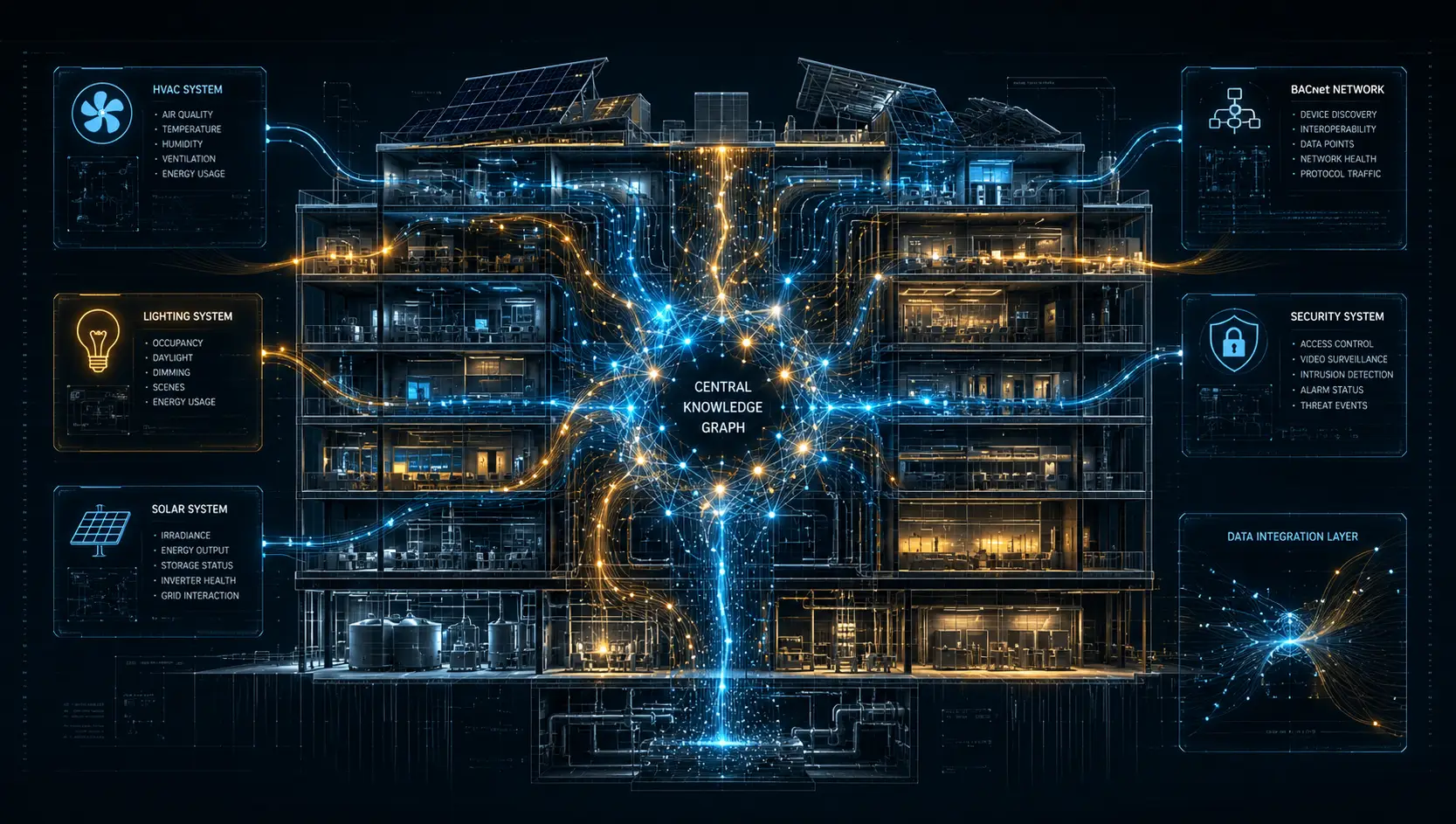
The silos being integrated include BIM and design documentation, lighting, battery storage, building automation systems, solar panels, water heating, electrical panels, and systems modeled for future integration (indoor air quality, cameras, access control, fire and life safety, operable windows connected to HVAC). If direct integration is not available, submetering obtains the minimum execution time.
The answer to legacy buildings is a semantic layer on top of existing infrastructure, not wholesale replacement. By using the relational data already embedded in BACnet Point Lists in conjunction with BIM documents and as-built drawings, you can surface and structure building data without demolishing anything. The C4SB Managed BACnet project addresses these deployment challenges in cloud-native environments. The Asset Leadership Standard establishes which smart assets should communicate with whom.
Once data is stored in a knowledge graph and accessible through standard tools, a building’s operational logic can change in days rather than years. The engineering firm that owns the PAE building has already created its own applications for the exposed multisystem data. Legacy assets are no longer liabilities. Finally, we can break the cycle of waste and replacement.
Just because it’s open doesn’t mean it’s available.
Even if a system is technically open, with published specifications and readable APIs, it may not be available in practice. The data needed to understand that is sparse. Relationships between points are not exposed. Metadata is not sent with the value.
BACnet is much more than the word “open,” and that label is largely unfair. It provides rich relational data, metadata depth, scalability over decades, and a direct path to the knowledge graph. The Data Modeling Working Group is where that evolution is being shaped.
True openness in 2026 means auto-discoverable, context-rich, and accessible to anyone with appropriate permissions, not just the vendor who installed the system.
From the janitor’s closet to the enterprise tier
The construction business has historically been parochial. No matter how wide your circle is, the conversation tends to be small. Energy savings became the key value proposition not because it was the most compelling result, but because it was the easiest to quantify.
Enterprise technology has become a trillion-dollar business across all sectors, without having to do difficult payback calculations. The value of accounting automation, CRM, and ERP was intuitive because all management could see the operational problems being solved.
Buildings are approaching the same inflection point. AI may make the value of well-structured building data legible to those ultimately managing capital allocation. The infrastructure work being done today, including unlocking data, building knowledge graphs, and connecting silos, is laying the fuse. AI is striking matches. The application continues.
C4SB Town Hall: First Rehearsal, Real Clarity
The first C4SB Thursday Town Hall was held last week. Twelve to thirteen working group leaders took turns presenting, each explaining where their group stood and what would happen next. The recording and written summary will be made available on the C4SB website in advance of the next town hall. June 5th.
Digital Building Profile initiatives have also been announced, increasing the catalog of all types of systems that can be connected within a building. Every time the list appears complete, five or six more systems emerge. The goal is a shared reference inventory that grows as practitioners reflect on the complexities of the real world.
what this actually means
The buildings that function in the AI era are not the ones with the most sensors. These are the ones that hold the most accessible, well-structured, and secure data. It requires:
- Obtain data from existing systems using submetering where direct integration is not possible
- Represent data in a knowledge graph using ASHRAE 223P for semantic context
- Make results accessible to developers, technicians, and owners creating their own applications
- Manage access and security from the ground up, not as an afterthought
The conversation is shifting from “What can technology do to my building?” “What should my building look like?” The answer is now clear. Connected, data-rich, AI-enabled, secure, and focused on real results.
That’s the new basic. Work starts today.
join the conversation
Monday Live takes place every Monday from 3pm to 4pm ET. This is an open session.
The views expressed in Monday Live sessions are personal and do not represent the views of any company or organization. Contributor profiles can be found at mondaylive.org/members.


