
Researchers from Google DeepMind, BIFOLD, and the Technical University of Berlin in Berlin have introduced a new machine learning method that can more efficiently represent global atomic interactions in chemical systems. In the future, this could enable more accurate simulations of chemical and materials science processes, accelerating the development of new drugs, more efficient batteries, and more sustainable materials. The study, titled “Machine Learning Global Atomic Representations with Euclidean Fast Attendant,” was published in Nature Machine Intelligence in March 2026.
For example, to understand exactly how a drug works, scientists need to calculate precisely how the atoms in the molecule move and interact. Such simulations form the basis of modern drug development, as well as the design of new materials and more efficient catalysts. However, many computational methods reach their limits due to their complexity when dealing with large molecules containing hundreds or thousands of atoms. Modeling atomic systems is difficult because each atom experiences forces simultaneously from many other atoms, including not only its immediate neighbors but also atoms further away. The result is a highly complex multibody system, where even small changes in one location can affect the behavior of the entire system.
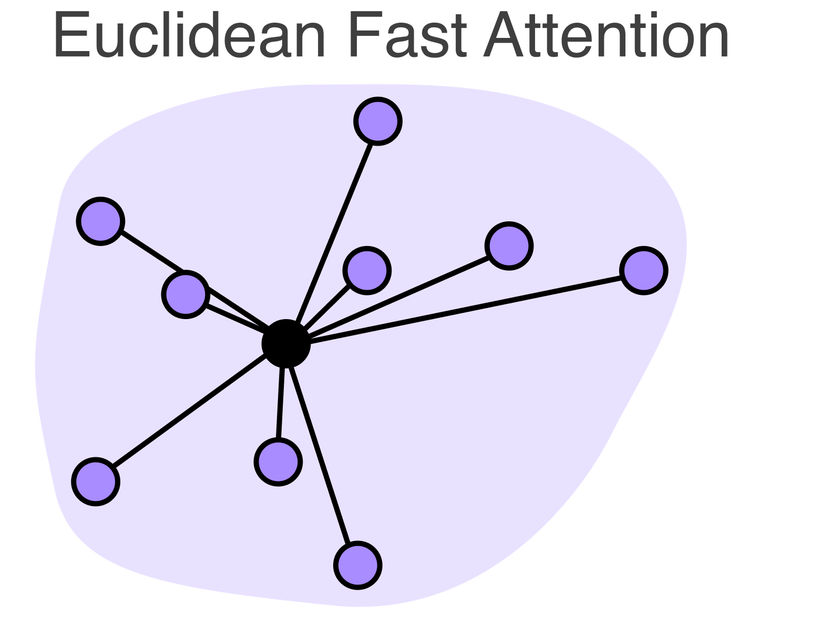
A new representation of these interactions is called Euclidean Fast Attention (EFA).
A central concept in modern machine learning known as self-attention plays a central role in this process. This concept allows the model to evaluate the importance of each piece of information in relation to all other pieces of information and to understand long-term relationships. However, as the number of atoms increases, the number of interactions involved increases approximately by the square of the number of atoms. Therefore, using self-attention for accurate modeling of physical systems is computationally very expensive and limits the size of atomic structures that can be simulated.
This is exactly where the research team’s new method comes into play. Scientists have developed a new linear scaling representation of these interactions called Euclidean Fast Attention (EFA). It is specifically designed for data in Euclidean space, where the rules of classical geometry apply. For example, atoms in molecules or materials whose relative position and orientation are important for accurate predictions. An important aspect of this approach is that spatial information can be efficiently represented without compromising important physical symmetries. The researchers showed in experiments that EFA can effectively capture a variety of long-range effects and describe chemical interactions where traditional machine learning force fields can produce erroneous results. This allows us to reliably capture interactions over long distances while requiring relatively little computation.
“Our approach enables an important new step towards more quantum-mechanically accurate modeling of many-body systems using new deep learning techniques,” said Professor Klaus-Robert Müller, co-director of BIFOLD and professor at the Technical University of Berlin.
This work therefore addresses a key question in many-body modeling in chemistry and physics: how can global structural information be incorporated into atomic models without sacrificing the computational efficiency needed for large systems? The method is specifically designed to efficiently handle large molecules, so it may be applicable in the future to particularly demanding systems, such as large or complex materials. The authors believe that EFA is a promising approach to make machine learning methods more robust and efficient in difficult chemical and materials science simulations.


