
People are tired of AI. They’re tired of predictions that AI will take their jobs, and they’re tired of the inability of the supposedly smartest economists to explain what’s going on. So the timing is perfect for a new theory that ties all the clues together into an elegant explanation. AI isn’t eliminating jobs, but it is reducing wages. No wonder workers are revolting.
A new study from Apollo Global Management shows that the earliest measurable harm from this technology will not be job losses, but reductions in pay. The findings come amid one of the most divisive debates in economics right now, one in which even those building AI systems can’t agree on what their data shows.
Economists change their minds
Thorsten Slok, Apollo’s chief economist, has spent much of 2026 arguing that the macroeconomic impact of AI on the labor market is essentially invisible. He wrote in April that “AI is everywhere except in incoming macroeconomic data,” but that he couldn’t see it in data on employment, productivity, or inflation.
At the same time, the influential analyst known for his Daily Spark blog and Chart of the Day from his previous days at Deutsche Bank is predicting an “industrial renaissance” and that AI will lead to a boom in small and medium-sized business entrepreneurship. As recently as May 29th, he published a spark entitled “Zero Evidence of AI-Related Job Loss,” arguing that AI is creating more jobs than it is destroying. Since April, he has similarly brought up the Jevons paradox, helping to popularize the idea that efficiency increases overall demand rather than shrinking the workforce. None other than Anthropic CEO Dario Amodei started using the term shortly after retracting his predictions about the massive job-destroying impact of his company’s technology.
In mid-July, Slok complained about the lack of clarity from the field of economics about the impact of AI, saying that “experts cannot agree” on what is actually happening in the corporate sector regarding AI and jobs. On July 30, Slok and co-author Sania Edlich published a paper that appears to connect all the contrasting theories. Rather than relying on the theoretical “exposure” scores that have dominated AI labor research for years, the researchers used observed usage data from Anthropic’s Economic Index (actual Claude interaction logs) to measure what workers are doing with AI, rather than what they could theoretically do. What they found was “wage compression” rather than job losses.
“Analysis of actual Claude usage data shows that wage growth rates for workers in AI-exposed occupations have slowed, but employment levels in these occupations have not changed, suggesting that companies are capturing AI productivity gains through wage compression rather than headcount reduction,” Throck wrote. This could explain the backlash, even outright resistance, to the adoption of AI in the broader economy. Workers seem to know that these machines will make them even poorer.
No matter what economists conclude, that’s how workers feel.
Another June 2026 survey of 1,005 U.S. employed workers by Software Finder captured this ground-level anxiety without relying on any academic model. Half of workers say they actively resist new AI tools, some of the findings are in some tension with Slok’s paper. While Apollo’s data shows that exposure to AI, with or without adoption, compresses wages, Software Finder’s snapshot shows that current adopters outnumber resisters, a gap that is likely explained by who tends to hire (managers, higher-income workers with more job security) rather than evidence that adoption itself protects wages.
For example, Software Finder reports that workers who resist AI earn about 20% less on average than those who embrace AI: $65,645 vs. $81,526. 45% cited fear of fungibility as a reason for pulling back, and only 16% believe their organization is deploying AI for real business value, rather than hype or competitive pressures. According to Slok’s research, the two effects could coexist: resisters could be penalized in wages even as wages offered for work exposed to AI decline. AI may just be a wage-eating machine.
There’s also a lot of AI shaming going on. 13% admitted to faking their use of AI (appearing to be using the tool while performing tasks manually). Additionally, only 6% believe managers accurately understand how often employees actually use the tools their organization has in place.
luckBy their own accounts, this resistance can escalate beyond quiet avoidance to deliberate sabotage. An April 2026 survey of 2,400 knowledge workers (including 1,200 executives) in the US, UK, and Europe by Writer and Workplace Intelligence found that 29% of employees admitted to actively sabotaging their company’s AI strategy, and this number jumped to 44% for Gen Z employees. This sabotage takes concrete forms. For example, they may enter sensitive company information into unapproved public AI tools, use unapproved “shadow AI” systems, refuse to engage with company-mandated tools altogether, and even falsify performance reviews or intentionally produce low-quality work to make the AI appear inefficient. Of the workers who admitted to sabotage, 30% cited fear of losing their job to AI as a primary motivation. This is the same fear that drives the Software Finder resisters.
What the data shows
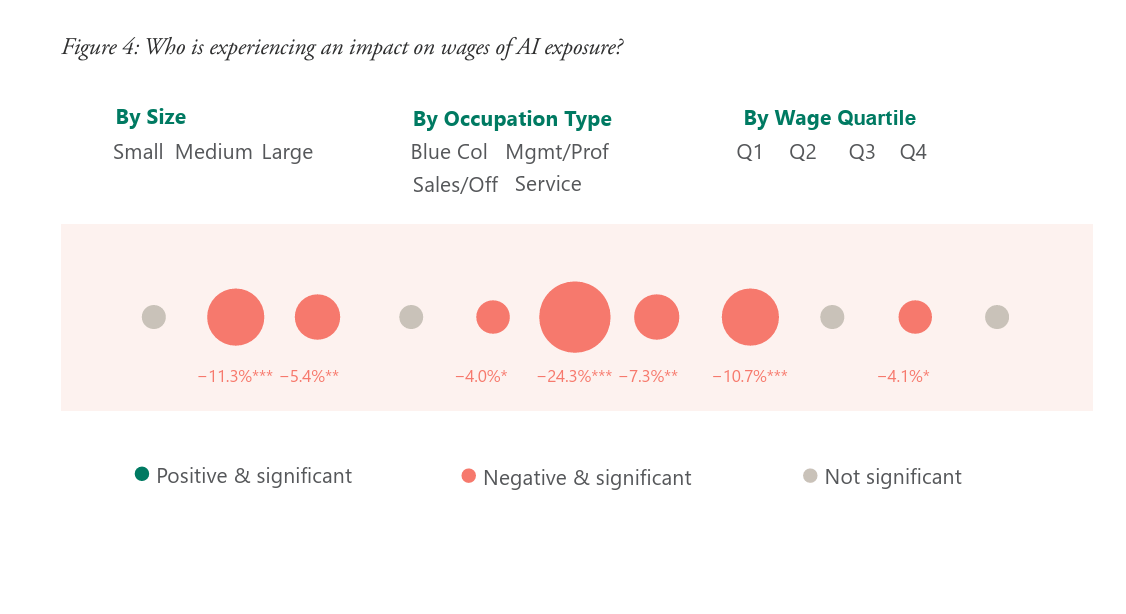
Using a difference-in-differences model across 321 occupations matched to Bureau of Labor Statistics data from 2015 to 2025, the Apollo paper found that real wage growth for workers in occupations with high exposure to AI slowed by 6.7 percentage points after 2023 compared to workers with less exposure, with no statistically significant employment effect. This is the crux of the discussion. Productivity gains are real, but they affect employers, not employees. What does this match? luck Reported in March: AI is shrinking jobs, which means companies can allocate more work to their employees.
The pain is concentrated at the bottom of the income ladder.
- Bottom quartile of wages: 10.7% reduction compared to less exposed occupations
- 2nd quartile: 5.4% decrease. 3rd quartile: 4.0% decrease
- Top quartile: No statistically significant impact – higher income earners appear to be better positioned to absorb or benefit from AI adoption
- Services: 24.3% decrease, although the authors caution that this is based on a small subsample
- Managers and professionals: down 4.1%. Blue-collar workers: no significant impact
Approximately 5.8 million U.S. workers (about 3.7% of the workforce) currently work in these stressful occupations, resulting in a conservative annual labor income loss of $28 billion, and the authors project that this number will continue to grow.
Anthropic’s economists say otherwise.
Further complicating matters, the data underlying Srock’s paper itself comes from Anthropic, whose head of economics expressed his own views in a lengthy essay on X in late July. Based on 18 months of internal research, he concluded that the U.S. labor market “has not yet been measurably hit by AI,” noting that the unemployment rate is 4.2% (the level the Federal Reserve considers full employment) and that the number of job openings is roughly in line with the number of unemployed people and the number of prime-age jobs, which is near the highest level in decades.
However, McCrory and Slok are not necessarily contradictory to each other. They are using overlapping data to answer different questions. It is entirely possible that the labor market will simultaneously exhibit flat unemployment and a quiet decline in relative wages. This is precisely the distinction that often gets lost in discussions where “there is no jobs crisis” and “workers are being squeezed” are treated as if they were both untrue.
This confusion is not unique to Anthropic. A comprehensive literature review cited by Reuters in July found that “most datasets find little evidence of economy-wide job losses or wage declines,” and so far attributed the impact of AI to “task redistribution and productivity gains within firms, rather than mass migration.” This conclusion, along with Mr. Slok’s findings on wage compression, is disturbing.
A silent and invisible threat
AI’s wage-compressing effect, if Slok’s data holds up, will fit into a much older pattern rather than break away from it. Throughout the 20th and 21st centuries, successive waves of technology, including mechanized agriculture, industrial automation, computing, and offshoring-enabled supply chains, have placed downward pressure on wages in the occupations they have affected, even as they have repeatedly lowered production costs and thereby expanded overall economic output.
Infamously, textile mechanization drove down wages for handloom weavers long before it created high-wage factory jobs elsewhere, sparking the Luddite movement often remembered in the AI era. More than 100 years later, the use of industrial robots in manufacturing in the 1980s and 1990s coincided with decades of stagnation in real wages for blue-collar workers, even as productivity rose steadily. This is the beginning of the “Rust Belt”.
of financial timesJoel Sass recently argued that the profits from new technologies have not flowed automatically to the workers who produce them since around 1970, because workers’ share of GDP has declined relative to capital’s share. An analysis of data from the United States, Japan, and most of Europe found that the same is true this time. He argued that “to the extent that advances in AI constitute technological change that is biased towards capital, the wage-productivity gap will widen further.”
What emerges from all of this is a story of labor that resists the pretty story that both sides want to tell. That’s not the scenario of mass layoffs that Mr. Amodei has been warning about, nor is it the completely obvious scenario suggested by Mr. McCrory’s unemployment data. It is quieter and more corrosive. It’s a mechanism that shows up on pay stubs rather than pink slips, and is so obscure that a rational economist looking at the adjacent data could come to the opposite conclusion.
This ambiguity may be precisely why worker unrest is so pervasive yet so difficult to substantiate in aggregate numbers. It’s also why he remains clear about the dangers of this mistake, even though Throck’s own paper acknowledges its limitations (the exposure measurement relied solely on Anthropic data and could only match 321 of the BLS’s roughly 800 occupations). “The key policy question is not whether AI will further reshape the labor market,” but broadly, how quickly and whether workers get the support they need when it does. ”