Customer expectations across Africa are changing faster than most organizations can track. A single inconsistent interaction can cause viral disease. Omnichannel journeys now take place via apps, brick-and-mortar stores, chatbots, and voice assistants, sometimes all within the same transaction.
Traditional mystery shopping has struggled to keep up due to its human nuance and depth of context. Manual audits are expensive, slow to scale, and have limited coverage. By the time the report reaches the decision maker’s desk, the pattern has already changed.
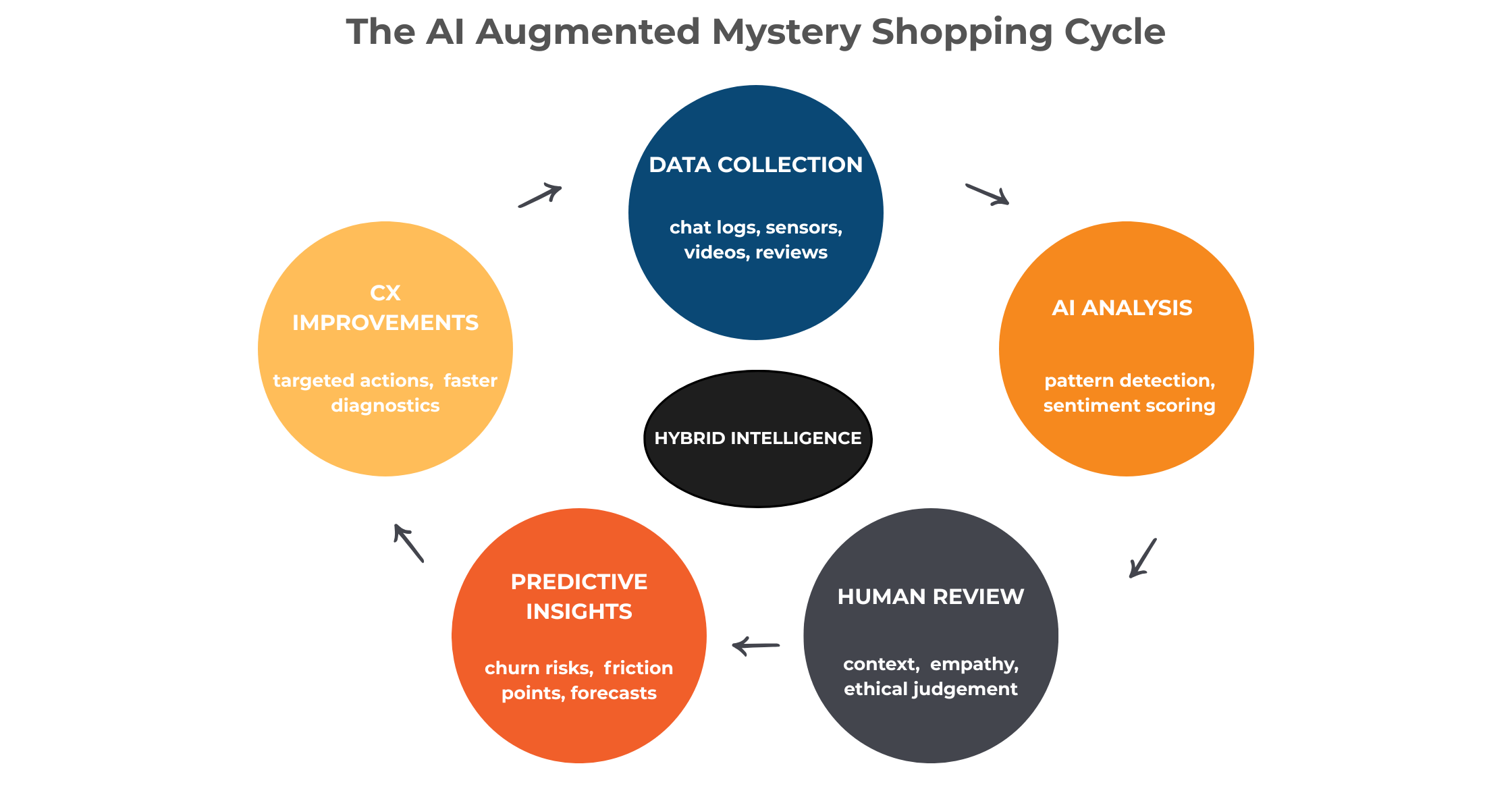
But something is changing. Machine learning and artificial intelligence are beginning to power mystery shopping in meaningful ways, transforming it from periodic snapshots into continuous predictive intelligence capabilities. Organizations no longer need to wait for quarterly reviews. We can now analyze thousands of interactions from chat logs, in-store sensors, customer reviews, and transaction data in near real-time to detect emerging issues, predict complaints, and take action before problems worsen.
Are we nearing the end of human-driven evaluation, or the beginning of something far more powerful? The honest answer is probably neither. What we are seeing is a renegotiation of what humans and machines each do best in the evaluation process, and that distinction is critical to how organizations choose investments.
For customer experience (CX) leaders, the question is no longer whether AI belongs in CX measurement. How to effectively integrate it to generate faster, more accurate, and more actionable insights.
From regular audits to continuous intelligence
Traditional mystery shopping offers something truly invaluable, including a subtle reading of body language, cultural context, and empathy during moments of service recovery. These are clearly human abilities. However, in today’s data-rich environment, human observers alone cannot process large amounts of data at the speeds businesses now demand.
Consider the RetailWave experience. A national chain of more than 200 specialty electronics stores augmented traditional mystery shopping with AI to combat inconsistent data, slow feedback, and high costs. In a pilot across 20 stores, AI analyzed shopper reports (text, images, and audio) in real time, flagging issues like cluttered displays or spikes in negative sentiment to take immediate action.
This is where machine learning comes into play. It is powerful at scale, analyzing vast datasets for sentiment patterns, service mismatches, and behavioral signals that predict churn and loyalty. Flag anomalies across channels in real-time, identify recurring points of friction in the omnichannel journey, and generate predictive diagnostics that enable your team to act rather than react. Retailers reduce lost sales by detecting patterns early. Telcos and fintechs surface service gaps before they become reputational damage.
This evolution is powered by a combination of advances in natural language processing, computer vision applied to in-store video, and unified data platforms that combine disparate signals into one coherent picture. This new model allows AI to handle routine pattern recognition while freeing up human auditors for deeper interpretation and contextual judgment.
Can algorithms replace mystery shoppers?
The honest answer is “partly and intentionally.”
Algorithms provide real strength. They offer unparalleled scale, evaluating thousands of interactions where human auditors would only be able to evaluate a few dozen. They provide consistency and remove the variability and unconscious bias that inevitably creep into human evaluations. It also brings predictive power to detect early warning signs of risk, long before they surface as complaints or customer churn. Industry forecasts reflect this momentum, with the mystery shopping services sector expected to grow at a CAGR of approximately 5% from 2026, driven in no small part by AI integration for real-time analysis, richer reporting, and increased accuracy.
But the limits are real. I don’t feel the algorithm. They can’t read the human context behind an irritated customer’s petty tone. They can detect deterioration in sentiment from chat recordings without realizing that the customer just received difficult news and needs a little more grace than usual. Over-reliance on algorithmic evaluation risks reducing CX measurement to a technical exercise, removing the very empathy that defines great service.
The future of mystery shopping is not a replacement. It’s convergence.
Hybrid intelligence: where humans and machines meet
Organizations leading the field in 2026 are adopting a hybrid model that leverages the strengths of humans and machines. AI handles data-intensive tasks such as anomaly detection, real-time auditing, and sentiment tracking across thousands of touchpoints. Human evaluators provide oversight, ethical judgment, and interpretive intelligence that algorithms cannot yet reproduce.
The results are tangible: reducing costs through scalable analytics, increasing consistency across geographically dispersed operations, and moving from reactive CX management to proactive intervention. The best hybrid approaches don’t just layer AI on top of existing processes. They are redesigning workflows so that machine-generated insights feed directly into human decision-making, with clear governance and accountability at each step.

ethical aspects
Progress here comes with complexity. Continuous surveillance raises legitimate concerns about data privacy and the ethics of surveillance. Algorithmic bias poses a real risk, especially when the training dataset doesn’t fully reflect the diversity of your customer base. And opacity in AI decision-making undermines trust both internally and with customers.
Best practices therefore require diverse and representative datasets, regular audits of algorithm outputs, human oversight of resulting decisions, and clear governance frameworks. Organizations that prioritize accountability and accountability do more than just reduce risk; They build trust, which in itself is a competitive advantage.
Opportunities unique to Africa
Africa’s CX landscape is unusually well-positioned to lead in AI-enhanced mystery shopping. Lightening legacy infrastructure across retail, communications and fintech means businesses can adopt hybrid models without first dismantling their predecessors, allowing them to leapfrog mature markets still burdened by outdated systems.
What appears to be a limitation can actually be a strength if you look closely. Language diversity, informal economies, and irregular data availability are exactly the conditions that drive innovation in context-aware machine learning. Build customized models to analyze multilingual interactions, interpret mobile-first behavior in e-commerce and mobile money, and understand service dynamics in informal sector markets. The adoption of AI is growing across the continent, for example with the introduction of chatbots in South Africa and Nigeria, as well as supportive government initiatives in several markets, and an ecosystem is being built to enable this.
African companies also have an undervalued competitive advantage: deep knowledge of the most important local issues. Inconsistent quality of service in high-growth informal markets, rapid urbanization driving new omnichannel demands, and the unique dynamics of mobile-first consumer behavior are all issues that context-aware AI systems can address in ways that general-purpose, globally designed tools cannot.
the window is open
As machine learning reshapes the way CX is measured and managed, organizations face real choices. You can continue using manual methods, which are time-consuming and costly, or you can intentionally invest in hybrid approaches that balance speed, scale, and human judgment, which algorithms cannot fully replace.
Organizations that lead are those that treat AI not as a substitute for empathy, but as an amplifier of it. The goal is not a smarter algorithm. This provides a more responsive, fairer, and more future-proof customer experience.
The starting point is an honest audit of your current CX assessment gap. What are the costs of delays? Where can early predictive signals change outcomes? From there, intentionally invest in hybrid capabilities like the right people, platforms, and governance frameworks. The window is open, especially across African markets. Those who act clearly now will be leaders later.
At IOA, we actively track these trends across advanced analytics, social listening, and market intelligence to help leaders stay ahead of what’s next in customer experience across the continent.