image:
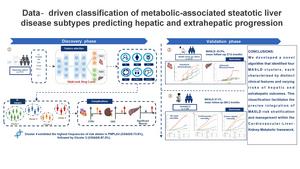
Leveraging a multi-task deep LASSO model, a new MASLD clustering system was developed to define different subtypes with unique clinical profiles and different risks of hepatic and extrahepatic complications. This classification facilitates accurate integration of MASLD risk stratification and management within a cardiovascular, hepatic, renal, and metabolic framework.
view more
Credit: Yan Bi and Tianwei Gu of Nanjing Drum Tower Hospital, Yinghuan Shi of Nanjing University
Metabolic-associated fatty liver disease (MASLD) is a clinically heterogeneous condition with highly variable outcomes, affecting more than 30% of people worldwide. The disease is traditionally staged by histological progression, from simple steatosis to metabolic dysfunction-associated steatohepatitis (MASH) and ultimately to fibrosis or cirrhosis. Besides liver-related outcomes, MASLD significantly increases the risk of extrahepatic complications such as cardiovascular disease (CVD), type 2 diabetes mellitus (T2DM), and chronic kidney disease (CKD). Currently, individualized management strategies are lacking, highlighting the urgent need for prognostic stratification systems that integrate both hepatic and extrahepatic risks to guide clinical decision-making. A groundbreaking study led by Professor Yan Bi of Nanjing University School of Medicine Drum Tower Hospital has developed a new algorithm that enables accurate MASLD subtyping for personalized intervention. This study was published online on January 28, 2026. Chinese medical journal.
In this study, we analyzed 1,111 people who underwent liver biopsy and developed a multitask deep LASSO algorithm for feature selection. Six key clinical indicators were identified in this model: age, BMI, HbA1c, TyG, TC/HDL, and GGT/PLT. Cluster analysis using these variables initially established four stable MASLD subtypes. To assess the generalizability of this classification, we replicated the cluster analysis in two large independent cohorts: a health examination cohort of 6,172 adults (MASLD prevalence: 43.9%, mean follow-up: 27.6 months) and a NHANES-III cohort of 7,406 participants (MASLD prevalence: 37.3%, mean follow-up: 280.2 months). The four cluster structure remained consistent across both validation cohorts.
Cluster 1 low CVD risk subgroups (41%):
Highest body fat percentage
minimum level of visceral fat
Cluster 2 high fibrosis risk subgroup (26%):
Significant lipid profile disturbance
severe liver damage
Cluster 3 high cardiovascular–Renal risk subgroup (19%):
minimum muscle mass
Overt chronic systemic inflammation
Cluster 4 high cardiovascular–liver–Renal risk subgroup (14%):
severe insulin resistance
Poor blood sugar control (>98% diabetes)
severe liver damage
High visceral fat percentage
PNPLA3 risk allele has the highest frequency (>70%)
To further investigate the influence of genetic variation on fibrosis, we conducted an analysis to examine the association between SNP genotype and phenotype in some individuals. Cluster 4 (cardiovascular, hepatic, and renal high-risk subgroups) had the highest frequency of risk alleles for PNPLA3, TM6SF2, and MBOAT7, followed by cluster 2 (fibrosis high-risk subgroups). PNPLA3 rs738409 C > G mutation carriers showed a significant 3.2-fold increase in fibrosis among those with the PNPLA3 CG genotype and a 2.7-fold increase among those with the PNPLA3 GG genotype.
This classification facilitates accurate integration of MASLD risk stratification and management within a cardiovascular, hepatic, renal, and metabolic framework. Professor Bi highlighted: Our subtyping allows for targeted interventions, for example prioritizing fibrosis screening for cluster 2 and implementing aggressive cardiorenal protection for clusters 3-4. Algorithm-based stratification systems represent a paradigm shift toward precision hepatology.
reference
DOI: https://doi.org/10.1097/CM9.0000000000003984
Yang B from Nanjing Gulou Hospital
Vice director and academic instructor of the Department of Endocrinology, Gulou Hospital, School of Medicine, Nanjing University.
Member of China Diabetes Association and candidate for president of Jiangsu Provincial Diabetes Association.
Sponsors major programs of the National Natural Science Foundation and its own exploration programs.
Focusing on clinical and basic research in diabetes and obesity, he has published 106 SCI papers as first or corresponding author in Cell Metabolism, Diabetes Care, Nature Communications, Journal of Hepatology, and other journals.
Tianwei Gu from Nanjing Gulou Hospital
Associate Chief Physician, Associate Professor
Focus on fatty liver disease associated with diabetes and metabolic dysfunction.
Published 16 SCI papers as first or corresponding author.
Sponsored three projects from the National Natural Science Foundation.
Yinghuan Shi of Nanjing University
Professor, School of Computer Science and Technology, Nanjing University
Focus on machine learning, pattern recognition, computer vision, and medical image analysis.
Sponsored by the National Natural Science Foundation of China Outstanding Young Scholars Fund, China National Key Research and Development Program, and Science and Technology Innovation 2030 Key Projects.
journal
Chinese medical journal
Research method
observational study
Research theme
people
Article title
Data-based classification of metabolic-related fatty liver disease subtypes predicting hepatic and extrahepatic progression
Article publication date
January 28, 2026
Disclaimer: AAAS and EurekAlert! We are not responsible for the accuracy of news releases posted on EurekAlert! Use of Information by Contributing Institutions or via the EurekAlert System.