

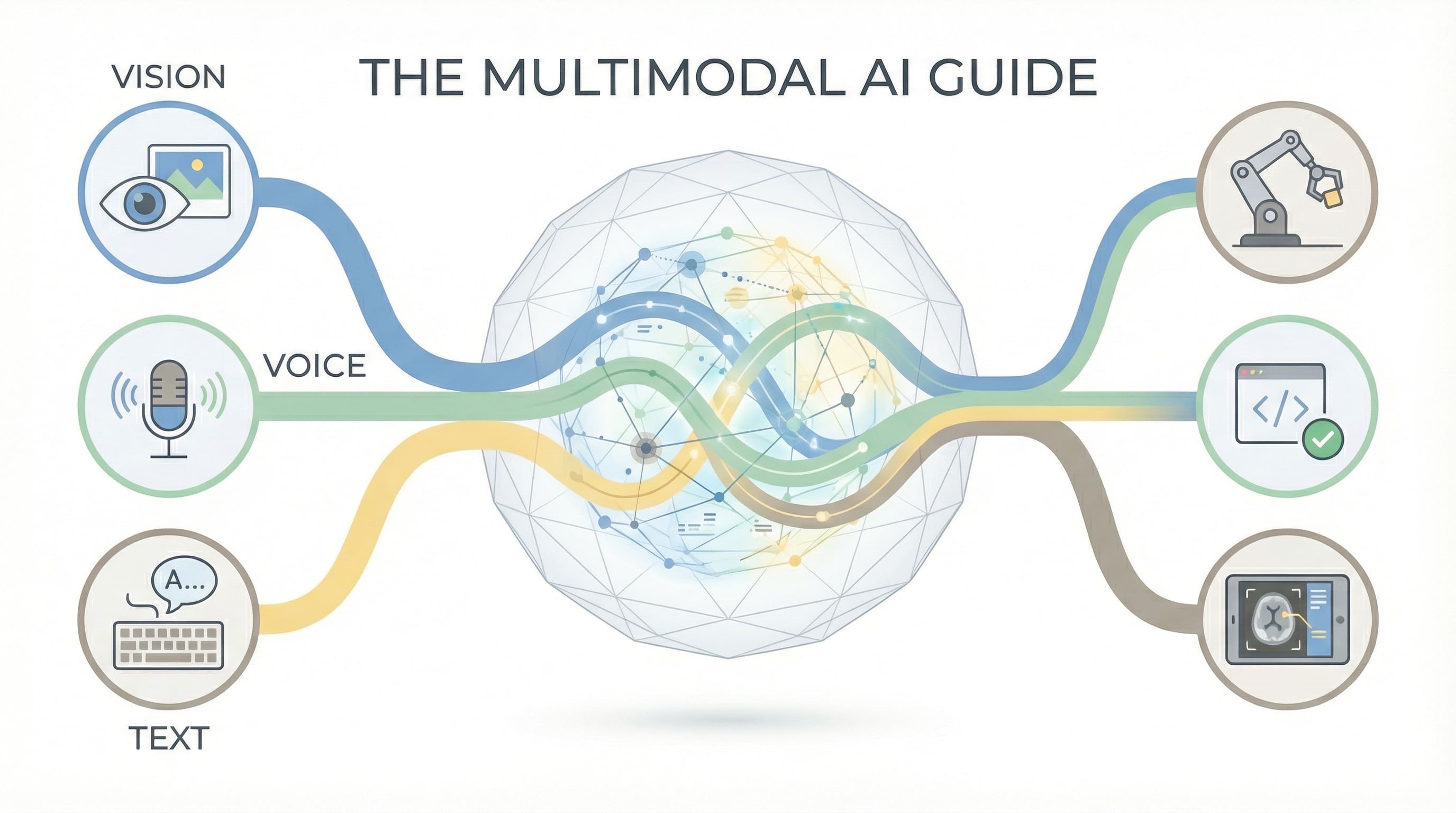
Image by author
# introduction
For decades, artificial intelligence (AI) meant text. I typed in my question and received an answer via text. Even as the language model improves, the interface remains the same: a text box waiting for a carefully crafted prompt.
That is changing. Today’s most capable AI systems do more than just read. See images, hear audio, process video, and understand structured data. This is not incremental progress. It’s a fundamental shift in the way we interact with and build AI applications.
Welcome to multimodal AI.
The real impact is not just that the model can handle more data types. That means your entire workflow is broken. Tasks that once required multiple conversion steps, such as image to text description, audio to transcript, and diagram to description, are now done directly. Because AI understands information in its native format, it eliminates the translation layer that has defined human-computer interaction for decades.
# Defining multimodal artificial intelligence: From single-sense intelligence to multi-sense intelligence
Multimodal AI refers to systems that can process and generate multiple types of data (modalities) simultaneously. This includes not only text, but also images, audio, video, and even domain-specific formats such as 3D spatial data, structured databases, molecular structures, and musical scores.
The breakthrough wasn’t just about making the model bigger. It was about learning to represent different kinds of data in a shared “understanding space” that they could interact with. An image and its caption are not separate things that just happen to be related. They are different representations of the same underlying concept, mapped to a common representation.
This creates capabilities that cannot be achieved with a single modality system. Text-only AI can explain pictures by describing them in words. Multimodal AI looks at your photo and understands the context you didn’t mention, such as lighting, facial emotion, and spatial relationships between objects. It’s not just about handling multiple inputs. It integrates their entire understanding.
It is important to distinguish between “true multimodal” models and “multimodal systems.” Some models handle everything together in one integrated architecture. GPT-4 Vision (GPT-4V) See and understand at the same time. Some connect special models. The vision model analyzes the image and passes the results to the language model for inference. Either approach will work. The former offers tighter integration, while the latter offers greater flexibility and specialization.
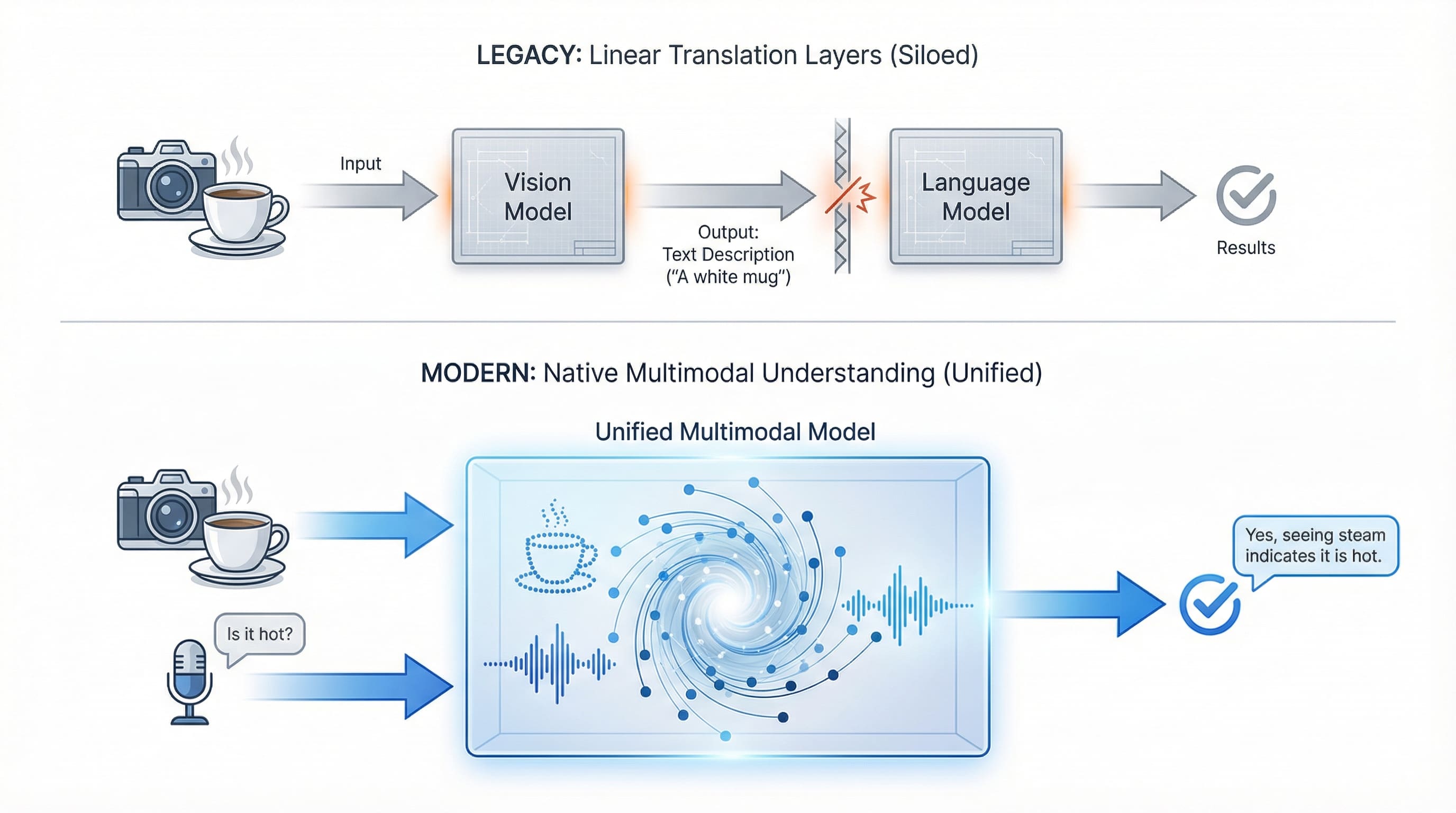
While legacy systems require specialized model-to-model transformations, modern multimodal AI processes vision and audio simultaneously in a unified architecture. |Image by author
# Understanding the Foundation Trio: Vision, Speech, and Text Model
The three modalities are mature enough for use in widespread production environments, and each brings different capabilities and different engineering constraints to AI systems.
// promote visual understanding
Vision AI has evolved from basic image classification to true visual understanding. GPT-4V and Claude Analyze charts, debug code from screenshots, and understand complex visual context. gemini Natively integrate vision across your interfaces. Open source alternatives — LLaVA, Kwen-VLand CogVLM — Now comparable to commercial options for many tasks while running on consumer hardware.
This is where the workflow changes become apparent. Instead of explaining what you see in a screenshot or manually transcribing chart data, just show it. AI sees it directly. What used to take 5 minutes for a detailed explanation now takes 5 seconds to upload.
However, engineering reality has its limitations. It is generally not possible to stream raw 60fps video to a large-scale language model (LLM). Too slow and expensive. Use of production system frame samplingextract keyframes (perhaps one every 2 seconds), or deploy a lightweight “change detection” model to send frames only when the visual scene changes.
Visual perception is not just about recognizing objects. It’s spatial reasoning. Understand that the cup is not floating, but is on the table. It’s about reading tacit information. That means recognizing that a cluttered desk suggests stress, or that a trend in a graph contradicts the accompanying text. Vision AI excels at document analysis, visual debugging, image generation, and any task where “show, don’t tell” applies.
// Evolving voice and audio interaction
Voice AI is more than just transcription. whisper We changed the field by providing high-quality speech recognition for free and locally. Reliably handles accents, background noise, and multilingual voices. However, voice AI now includes text-to-speech (TTS), such as: eleven lab, barkor footjobalong with emotion detection and speaker identification.
Voice eliminates another conversion bottleneck. That is, speak naturally instead of typing what you were going to say. The AI listens to your tone, picks up on your hesitations, and reacts to what you wanted to say, not just the words you managed to type.
Frontier’s challenge is not the quality of transcription. It’s latency and turn-taking. In a real-time conversation, waiting three seconds for a response feels unnatural. Engineers will solve this Voice activity detection (VAD)an algorithm that detects the exact millisecond the user starts speaking and instantly triggers the model, as well as “barge-in” support that allows the user to interrupt the AI mid-response.
The difference between transcription and comprehension is important. Whisper converts speech to text with incredible accuracy. However, new speech models pick up on tone, detect sarcasm, identify hesitation, and understand context that text alone misses. There’s a difference between a customer being dissatisfied and saying, “Okay,” and being satisfied and saying, “It’s okay.” Voice AI captures that difference.
// Composition by text integration
Text integration acts as the glue that holds everything together. Language models provide inference, composition, and generative capabilities not found in other modalities. Visual models can identify objects in images. LLM explains its importance. Audio models can transcribe audio. LLM extracts insights from conversations.
Ability comes from combinations. When you show an AI a medical scan while explaining your symptoms, it integrates understanding across modalities. This is more than parallelism. It is true multisensory reasoning, where each modality informs the interpretation of the other modalities.
# Exploring new frontiers beyond the basics
While today’s applications are predominantly visual, audio, and text, multimodal situations are rapidly expanding.
3D and spatial understanding Move AI beyond flat images and into physical space. Models that capture depth, three-dimensional relationships, and spatial reasoning enable robotics, augmented reality (AR), virtual reality (VR) applications, and architectural tools. These systems understand that a chair viewed from different angles is the same object.
structured data As a modality, it represents a subtle but important evolution. The new system natively understands tables, databases, and graphs, rather than converting spreadsheets to LLM text. They know that columns represent categories, that relationships between tables are meaningful, and that time series data has temporal patterns. This allows AI to query databases directly, analyze financial statements without prompting, and infer structured information without lossy conversion to text.
When AI understands native formats, entirely new capabilities emerge. A financial analyst can point to a spreadsheet and ask, “Why did revenue decrease in the third quarter?” AI reads the table structure, finds and explains anomalies. Architects can input 3D models and get spatial feedback without first converting everything to 2D drawings.
Domain-specific modalities Target your area of expertise. alpha fold’s ability to understand protein structures has enabled AI-driven drug discovery. A model for understanding musical notation enables compositional tools. Systems that process sensor data and time-series information bring AI to the Internet of Things (IoT) and industrial surveillance.
# Implementing real-world applications
Multimodal AI has moved from research papers to production systems solving real problems.
- Content analysis: Video platforms use vision to detect scenes, audio to transcribe dialogue, and text models to summarize content. Medical imaging systems combine visual analysis of scans with a description of the patient’s medical history and symptoms to aid in diagnosis.
- accessibility tools: Real-time sign language translation combines vision (seeing gestures) and language models (generating text or speech). Image description services help visually impaired users understand visual content.
- creative workflow: Designers verbally explain design decisions while sketching interfaces that the AI translates into code. Content creators use audio to explain concepts, and AI generates visuals to match.
- developer tools: The debug assistant looks at your screen, reads the error message, and verbally explains the solution. Code review tools analyze both code structure and associated diagrams and documentation.
This change is reflected in the way people work. Rather than context switching between tools, just show and ask. Friction disappears. The multimodal approach ensures that each information type remains in its native format.
Challenges in production environments are often about latency, not functionality. Voice-to-Voice systems need to process voice-to-text-to-inference-to-text-to-speech in less than 500 milliseconds to feel natural, and require streaming architectures that process data in chunks.
# Navigating the new multimodal infrastructure
A new infrastructure layer is forming around multimodal development.
- model provider: OpenAI, Anthropic, and Google lead commercial services. Open source projects like the LLaVA family and Qwen-VL democratize access.
- Framework support: rung chain Added multimodal chains to handle mixed media workflows. llama index Extend search augmentation generation (RAG) patterns to images and audio.
- specialized provider: Eleven Lab has a monopoly on speech synthesis, but in the middle of a journey and Stability AI Generation of lead images.
- integration protocol: of Model Context Protocol (MCP) Standardizing the way AI systems connect to multimodal data sources.
Infrastructure is democratizing multimodal AI. What was required for research teams a few years ago can now be done with framework code. What used to cost thousands of dollars in API fees can now be run locally on consumer hardware.
# Summary of key points
Multimodal AI represents more than technical capabilities. The way humans and computers interact is changing. Graphical user interfaces (GUIs) are being replaced by multimodal interfaces that can be viewed, communicated, drawn, and spoken naturally.
This enables new interaction patterns such as: visual grounding. Instead of typing, “What is that red object in the corner?”, users draw a circle on the screen and ask, “What is that?” The AI takes both image coordinates and text and fixes language to visual pixels.
The future of AI is not about choosing between visual, audio, and text. We’re building a system that naturally understands all three, just like humans do.
Vinod Chugani He is an AI and data science educator who bridges the gap between emerging AI technologies and practical applications for working professionals. His areas of focus include agent AI, machine learning applications, and automated workflows. Vinod has supported data professionals through skill development and career transition through his work as a technical mentor and instructor. He incorporates analytical expertise from quantitative finance into a practical teaching approach. His content highlights actionable strategies and frameworks that professionals can apply right away.


