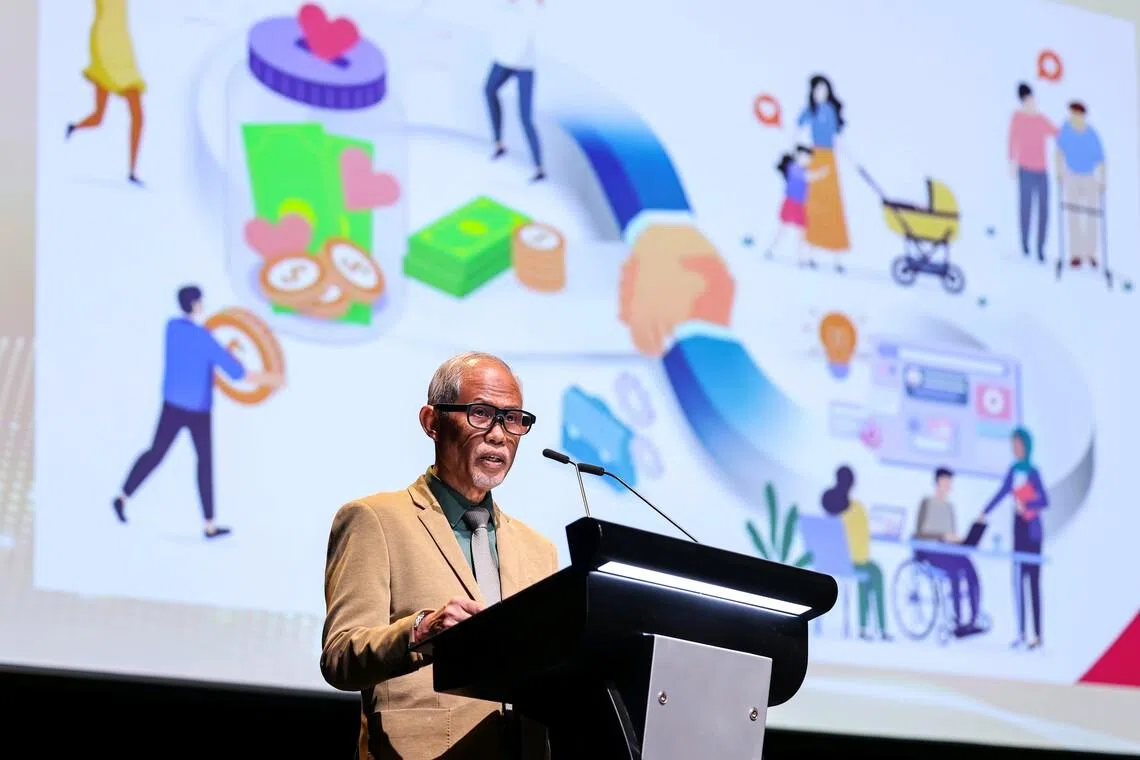
Singapore – The social services sector is riding the wave of artificial intelligence, with the Ministry of Social and Family Development (MSF) setting aside $15 million over three years to experiment with new technology.
Masagos Zulkifli, Minister of Social and Family Development, said on July 2 that one of his ministry’s goals is to use data to identify people at risk and reach families early, before challenges become more serious.
Some social workers are already using tools like CaseCentral, a case management system, with plans to use AI to provide insights about clients and their families and automate workflows.
On July 2, MSF announced a partnership with two local technology companies, NCS and ST Engineering, to further develop these technology solutions.
The partnership aims to enhance support for clients and families, provide professionals with tools to improve workflow, and leverage technology in residential and social service centers to improve safety and operations.
The parties signed the agreement at MSF’s first partner meeting held at the Star Theater in Buona Vista. Nearly 1,000 representatives from social services, academia and the business sector gathered to discuss innovation and collaboration.
Masagos said AI technology is already being used in social services across the world and in Singapore.
There are AI glasses that transcribe spoken words into captions for the hearing impaired, and AI-powered exoskeletons allow people with disabilities to live more independently.
He added that some therapists at early intervention centers overseas are using AI to track children’s developmental milestones.
Nevertheless, the minister acknowledged that some people may view the impact of emerging technologies with skepticism or fear that they will displace social care professionals.
“AI is not a silver bullet and cannot replace care professionals,” he says. “But if we use AI well, we can reach further, respond faster, and support families more effectively than ever before.”
Over 100 social service agencies have started using Scribe. Scribe is an AI-powered tool that transcribes and summarizes conversations in multiple languages and dialects, including Cantonese and Singlish, into case notes.
By using the tool, Care Corner Singapore’s social workers have been able to reduce the time they spend documenting cases by at least 50 per cent, said the company’s chief executive officer Christian Chao.
“Staff members say this tool allows them to fully focus on the session, instead of splitting their attention between listening and getting all the gist. And afterwards, it gives them the emotional space to actually reflect on the case instead of rushing through paperwork,” Chao said.
Weave, a tool developed by Care Corner, also uses AI to support social workers in case planning, including flagging blind spots in assessments to create more comprehensive case plans.
“Many social workers say their caseloads are so relentless that they sometimes work on autopilot,” Chao said, adding that the tool creates space for workers to think more rigorously.

Care Corner Singapore chief executive Christian Chao hopes AI will help social workers prioritize concerns in increasingly complex cases.
Photo: Care Corner Singapore
New ideas are also born from scratch.
For the past three years, AWWA has held an annual innovation drive for its staff to develop technology solutions, and winning teams receive support to scale up their ideas, said JR Karthikeyan, CEO.
For example, its staff created an AI facial recognition system that can identify adults with disabilities in AWWA homes with more than 90% accuracy.
This addressed the pressing issue that many customers may not be able to verbally identify themselves and staff may make mistakes in dispensing medications due to misidentification.

AWWA Chief Executive Officer JR Karthikeyan said the staff has been organizing annual innovation activities for the past three years to develop technology solutions.
Photo: Liu Ying
Another AI solution proposed by nurse educator Arthur Lee and staff nurse Lukman Rifki aims to structure and digitize standard operating procedure (SOP) documents used in AWWA’s adult disability services.
The two of us have SOPs. Evolving guidelines have made information increasingly extensive, making it difficult for staff to find the information they need.
Their proposal includes an AI chatbot that would allow staff to more easily find relevant information from these SOPs. It may also be easier to provide guidance to staff whose native language is not English.

Staff nurse Lukman Rifki (left) and nurse educator Arthur Lee proposed the idea of using AI to structure and digitize standard operating procedures for AWWA’s Adult Disability Services.
Photo: millet
Leaders in the social services sector have identified pain points that they hope technology and AI can help solve.
These include helping social workers prioritize concerns in increasingly complex cases and gathering information from different agencies to provide social workers with a complete picture of their clients, Chao said.
Fariz Fahmy, CEO of Allkin Singapore, said MSF’s goal of identifying risks early through data could enable social work to become more preventative rather than primarily crisis-driven.
Many social problems accumulate due to the accumulation of stressors, such as financial burden, stress of caregiving, and conflict between family members. He said aid can now reach people faster before these problems turn into crises.
Allaying fears that AI will threaten social services jobs, leaders in the field say it cannot. Inheriting the core of social work.
Data cannot replace the judgment of social care professionals, Faries said, adding: “We need to remember that data alone does not tell the whole story of a person’s life.”
Similarly, Chao emphasized that AI does not build trust with families or make professional judgments about risks.
“All of this remains intact in our social workers’ practice,” he said.