


Photo by Arian Darvishi on Unsplash
MLOps (Machine Learning Operations) are a collection of techniques and tools for deploying models in production. Over the last few years, the success of DevOps in minimizing the time between software releases and minimizing the gaps has been essential in the life of any company.
Developers with a history of success came to the machine learning field to apply the DevOps principles that created MLOps. By combining CI/CD principles with machine learning models, the data world can integrate models and deliver them in a timely manner within production. MLOps introduces new principles of continuous training (CT) and continuous monitoring, making production even more suitable for any machine learning model.
As MLOps have come a long way, some best practices should be followed for an optimal workflow. What are your practices? Let’s get into it.
Before continuing, this article assumes the reader already has basic knowledge of MLOps, machine learning, and programming. With that in mind, let’s continue with best practices.
1. Establish a clear project structure
MLOps are easier to evaluate due to the clear structure of the company’s use cases. There is no exact MLOps pipeline and tool that covers all points, so the project should have a clear structure. A well-organized project structure makes navigating, maintaining, and scaling future projects more manageable.
Project structure means you need to understand it end-to-end, from business issues to production and monitoring.Several Tips for improving your project structure include:
– Organize code and data based on environment and function. Also, keep your code and data naming conventions neat to avoid accidents,
– Track changes using version control such as GIT and DVC.
– have a consistent style of documentation,
– Communicate with your team about what to do and what to change.
Establishing a clear project structure can be tedious, but it will definitely help our project in the long run.
2. Know your tool stack
MLOps are not just concepts, they are also tools. There are many tools to choose from for all MLOps activities. However, the choice depends on the project and company requirements.
For example, if your company’s compliance requires data analysis to be done in a tool created by your home company, you should comply. Therefore, it is essential to know the tool stack you use in your MLOps pipeline when developing your feature.
To help you understand the tools you need for your project, MLOps stack template By Valohai you can refer to.
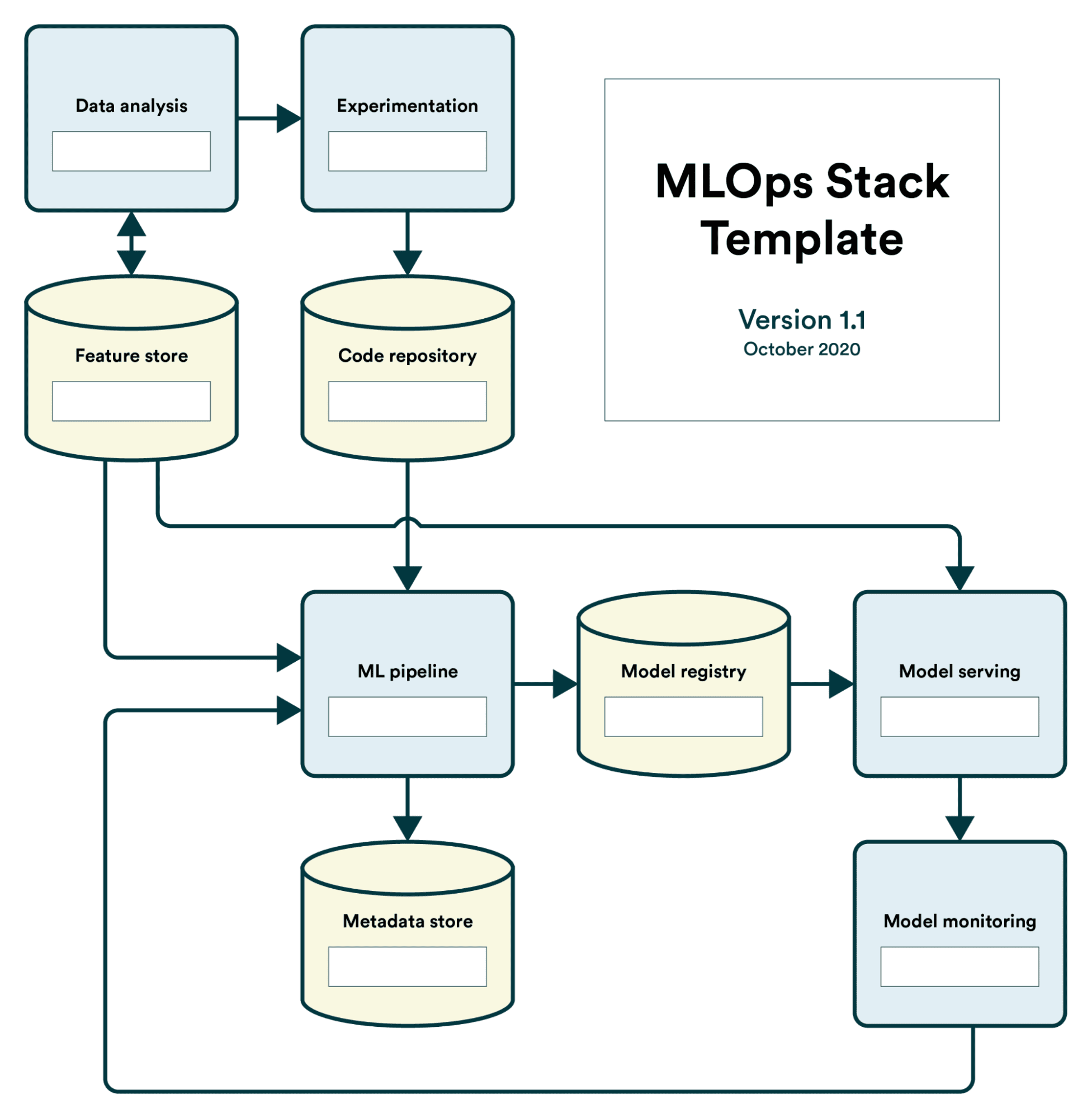
Image by Valohai
Also, try to limit yourself to about 3-5 tools. The more tools you use, the more complicated it becomes.
3. Track expenses
The goal of using MLOps in your pipeline is to minimize technical debt. This is a great goal because we don’t want our project to be complicated by technical debt. However, don’t make your financial costs high just because you want to minimize technical debt.
Many of the tools used for MLOps were either subscription-based or pay-as-you-go, depending on the tool itself. Rather than developing from scratch or using an open source base, many paid tools offer services that allow the user to integrate his MLOps with a better experience.
But you have to remember that sometimes you have to pay for the service. We may also use the service sparsely. This also happens to me in my early adopters of MLOps. We don’t want money to dilute the value provided by MLOps, so don’t forget to track your expenses properly.
Cloud services such as AWS, calculators, and alarms can help remind you of your spending. If not, try tracking them down using various tools. Even simple Excel is already working.
4. Have all the criteria
Not only do you have a simple structural project, Standard for all parts of the MLOps pipelineMinimizing technical debt means that everything works right. The drawback is often the need for standards within the team.
Imagine if the naming of tools, variables, scripts, data, etc. was random and inconsistent between one teammate and the other. It makes the process even longer and introduces technical debt as the developer has to understand what happens.
Standardization can be applied not only to naming conventions, but to anything related to MLOps pipelines. Data analysis process, usage environment, pipeline structure, deployment process, etc. MLOps work well when all the standards are in place.
5. Evaluate MLOps Maturity Regularly
How MLOps are ready is a question I have to ask often. We want to take full advantage of MLOps, which only exist if your maturity level is already there. Unfortunately, it’s not something that can be achieved in a day or a month.
It takes a little while, but that’s why we don’t wait for a full pipeline when we start implementing MLOps. Instead, start with what you can handle first and continue to assess your MLOps readiness.
As a reference, I use Microsoft Azure’s MLOps Maturity Pyramid to assess readiness. There are 5 levels and each level provides value to the ecosystem.
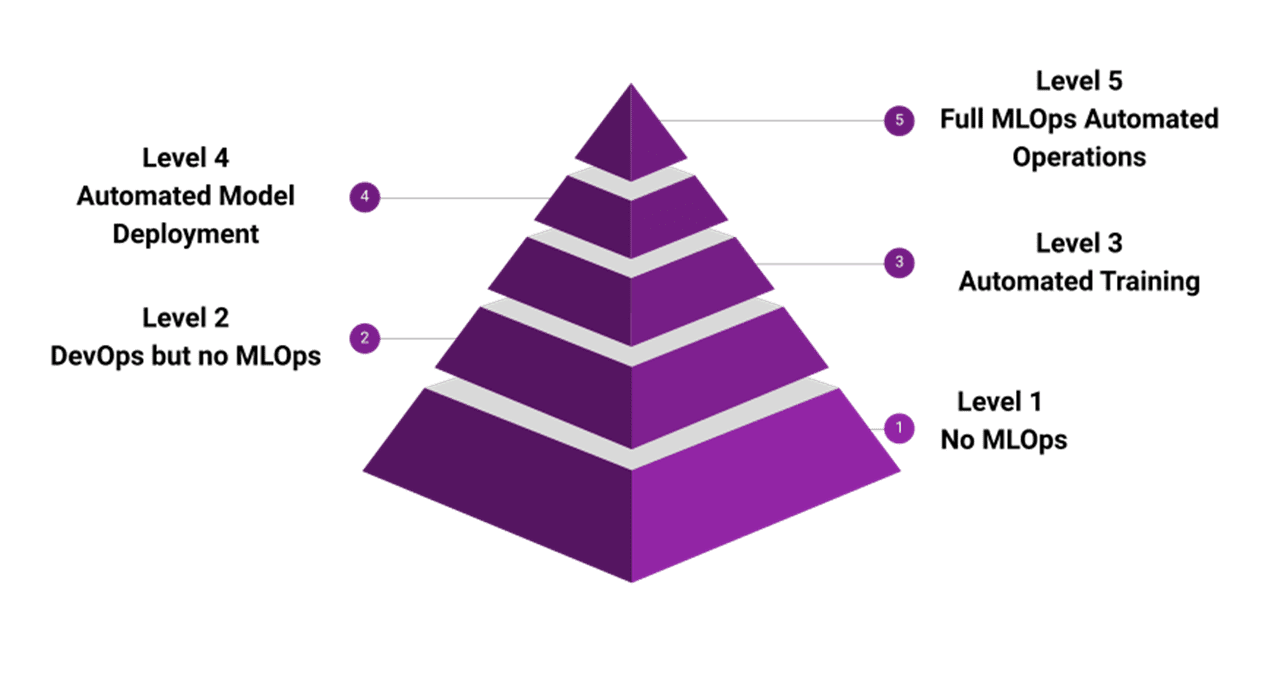
Image by Microsoft Azure
MLOps or Machine Learning Operations become integral to the enterprise lifecycle. So there are some best practices you can follow.
- Establishing a clear structural project
- Know your toolstack
- track expenses
- have all the criteria
- Evaluate MLOps maturity regularly
If its helpful then im happy.
Cornelius Judah Wijaya is a data science assistant manager and data writer. While working full-time at Allianz Indonesia, he loves sharing his Python and data tips through social and writing media.


