
image:
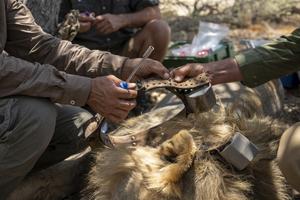
GAIA team collars a lion in Etosha National Park
view more
Credits: Photo by Jon A. Juarez
Roaring over long distances is an important lion behavior. They use unique sequences of moans and growls to communicate within their pride as well as with other animals. Scientists from the GAIA Initiative published their machine learning approach in the journal. ecological informatics This improves the way roaring behavior is studied. Based solely on acceleration data (ACC) recorded by the collar, this algorithm can reliably detect long-range roars without the use of microphones or energy- and storage-intensive audio files. For the first time, such an algorithm works reliably for both male and female lions, and even for mixed signals when lions are walking while roaring.
Lions live in highly social groups (pride) with close bonds and a complex communication system consisting of visual, chemical, physical, and acoustic signals. They use these signals to adjust their movements and avoid collisions. The only way lions communicate over long distances is by roaring. Because members of a pride are often scattered over large distances, battle cries play a central role in communication within a pride. Although the acoustic details of roars are already well documented and analyzed, the spatial behavior associated with roars and the function of roars in species-specific communication have been studied to a limited extent. “It is known that male lions do not roar to impress female lions. Although there is no scientific evidence yet, it is thought that lions may bark to maintain territory,” says Dr. Ortwin Aschenborn, wildlife veterinarian at the Leibniz Institute for Zoo and Wildlife Research (Leibniz IZW) and scientist at the GAIA initiative. “Long-distance communication in female lions is still completely unknown.”
Traditional audio recording techniques are impractical for this type of research. Handheld microphones can only pick up the sounds of individual lions sporadically from a distance. Audio recording devices attached to animals, such as “audio loggers” combined with collars, require large amounts of energy and storage space, and record large amounts of data that are not needed to answer these research questions. Analyzing roars in conjunction with spatial movement patterns and thus social behavior requires long-term records of when and where lions (or lionesses) roar. This information can be obtained from the analysis of so-called acceleration data (ACC) recorded by the collar. ACC data records even the slightest movements three-dimensionally and continuously over a long period of time, making it possible to identify various behaviors. Artificial intelligence is an essential aid in this process. Machine learning algorithms can be trained to identify specific patterns in acceleration data and assign them to specific behaviors. Movement patterns such as running, flying and swimming have already been detected with great reliability in many animal species and have been scientifically studied, for example in combination with simultaneously recorded GPS locations of the animals. However, classifying vocalizations from acceleration data is still rare due to significant methodological challenges.
GAIA’s “fully convolutional neural network” can identify lion roars in ACC data, even when they occur at the same time as other behaviors, such as running.
Unlike running or flying, the movement patterns associated with vocalization are often associated only with subtle, fine-scale movements that affect only one part of the animal’s body. The lion’s roar is very loud (can be heard up to 8 kilometers away) and the resulting ACC signal is relatively weak. Furthermore, vocalizations can also be mixed with other behavioral patterns. For example, when a lion moves while roaring (as it often does), the sensors record a mixture of different behavioral patterns. “Previous models for classifying lion roars from acceleration data were trained only on male lions that were not otherwise moving,” explains Wanja Last, wildlife AI expert at the GAIA initiative and PhD student at Leibniz-IZW. “With our new development, even more is possible. We have trained a so-called ‘U-Net’ that can detect the roars of male and female lions, both moving and stationary.”
“U-Net” is a type of “Convolutional Neural Network” (CNN), a machine learning approach primarily used for image and audio files. The data is organized into layers that are processed by convolution to generate output values (“roar” or “no roar” in the case of the lion study) from input values. The model was trained over several months using reference data from seven collared lions in Etosha National Park, which were equipped with both accelerometer-equipped GPS collars and audio loggers. Scientists recorded a total of 1,333 roaring events. Acceleration and audio data were synchronized so that the roar signal could be identified within the ACC data stream. After training, U-Net was able to perform this classification with 90-96% accuracy based solely on acceleration data. The AI only missed a few actual roars (false negatives). Conversely, approximately 81% of flagged roars were genuine. In just under 20% of cases, the AI was inaccurate (false positives). Both numbers apply equally to male and female lions. “Although walking roars have slightly lower classification confidence on average, subsequent filtering steps were able to improve detection to a level comparable to roars without walking,” Rust says.
Collars with ACC sensors can replace audio loggers in lions in certain applications, opening new opportunities for research.
Leibniz-IZW’s GAIA scientists believe that for certain research questions, it is feasible and reasonable to rely on AI-assisted classification of acceleration data to investigate animal behavior related to vocalizations. “Unlike audio loggers that store actual sound recordings, acceleration data can be stored for long periods of time using less energy and storage space,” said Dr. Jörg Merzheimer, a scientist at Leibniz-IZW’s GAIA initiative. However, what is recorded is not the actual sound, such as a roar, groan, or howl, but only the fact when and where it was generated (in combination with the GPS signature). “Furthermore, a well-trained classification model for acceleration data can also be applied to existing datasets, meaning the data could potentially be used to study vocal behavior that was not originally created with this research topic in mind,” says Melzheimer. “At the same time, it must be noted that this method only works if the AI or machine learning algorithm is successfully trained.” The team at the GAIA initiative succeeded in doing this for lion roars, but attempts in other species may be less successful or fail completely, as not all calls are associated with a distinctive or sufficiently pronounced ACC signal.
Building on this machine learning approach, the GAIA team plans to further investigate lion roaring behavior as an important aspect of intraspecific communication. Scientists also plan to develop the concept of “acoustic fences” to be installed at the boundaries of protected areas. In this fence, sensors and speakers strategically placed within the landscape tune in to lion communications at key moments. The goal is to keep lions within these protected areas and reduce contact and conflict with humans.
journal
ecological informatics
Research method
Data/statistical analysis
Research theme
animal
Article title
Did you hear that? Handling mixed behaviors when classifying animal behaviors from acceleration data using U-Net
Article publication date
April 20, 2026
Disclaimer: AAAS and EurekAlert! We are not responsible for the accuracy of news releases posted on EurekAlert! Use of Information by Contributing Institutions or via the EurekAlert System.

