Vogliano, C. et al. Progress towards SDG 2: Zero hunger in melanesia – A state of data scoping review. Glob. Food Secur. https://doi.org/10.1016/j.gfs.2021.100519 (2021).
Google Scholar
Cerf, M. E. The social-education-economy-health nexus, development and sustainability: Perspectives from low- and middle-income and African countries. Discov. Sustain. https://doi.org/10.1007/s43621-023-00153-7 (2023).
Google Scholar
Otiti, M. I. & Allen, S. J. Severe acute malnutrition in low- and middle-income countries. Paediatr. Child Health 31, 301–307. https://doi.org/10.1016/j.paed.2021.05.001 (2021).
Google Scholar
Omar, O. & El-Bastawissi, I. Y. SDGs in Africa and the Middle East Region 1–26 (Springer International Publishing, 2022).
Lamichhane, M., Mehan, S. & Mankin, K. R. Surface soil moisture prediction using multimodal remote sensing data fusion and machine learning algorithms in semi-arid agricultural region. Sci. Remote Sens. https://doi.org/10.1016/j.srs.2025.100255 (2025).
Google Scholar
Huang, J. et al. Dryland climate change: Recent progress and challenges. Rev. Geophys. 55, 719–778. https://doi.org/10.1002/2016rg000550 (2017).
Google Scholar
Jones, J. W. et al. Toward a new generation of agricultural system data, models, and knowledge products: State of agricultural systems science. Agric. Syst. 155, 269–288. https://doi.org/10.1016/j.agsy.2016.09.021 (2017).
Google Scholar
Rötter, R. P., Carter, T. R., Olesen, J. E. & Porter, J. R. Crop–climate models need an overhaul. Nat. Clim. Change 1, 175–177. https://doi.org/10.1038/nclimate1152 (2011).
Google Scholar
Asseng, S. et al. Uncertainty in simulating wheat yields under climate change. Nat. Clim. Change 3, 827. https://doi.org/10.1038/nclimate1916 (2013).
Google Scholar
Makowski, D. A simple Bayesian method for adjusting ensemble of crop model outputs to yield observations. Eur. J. Agron. 88, 76–83. https://doi.org/10.1016/j.eja.2015.12.012 (2017).
Google Scholar
Ling, X. et al. Effect of variation in the observations on the prediction uncertainty in crop model simulation: Use ORYZA (v3) as a case study. Ecol. Model. https://doi.org/10.1016/j.ecolmodel.2022.110233 (2023).
Google Scholar
Ellenburg, W. L. et al. Evaluation of a regional crop model implementation for sub-national yield assessments in Kenya. Agric. Syst. https://doi.org/10.1016/j.agsy.2023.103819 (2024).
Google Scholar
Wallach, D., Makowski, D., Jones, J. W. & Brun, F. Working with Dynamic Crop Models 209–250 (Academic Press, 2019).
Jansen, L., Undorf, S. & Gornott, C. Current and future adaptation potential of heat-tolerant maize in Cameroon: A combined attribution and adaptation study. Environ. Res. Lett. https://doi.org/10.1088/1748-9326/ada459 (2025).
Google Scholar
Romanovska, P., Undorf, S., Schauberger, B., Duisenbekova, A. & Gornott, C. Human-induced climate change has decreased wheat production in northern Kazakhstan. Environ. Res. Clim. https://doi.org/10.1088/2752-5295/ad53f7 (2024).
Google Scholar
Bai, H., Xiao, D., Tang, J. & Liu, D. L. Evaluation of wheat yield in North China Plain under extreme climate by coupling crop model with machine learning. Comput. Electron. Agric. https://doi.org/10.1016/j.compag.2024.108651 (2024).
Google Scholar
van Wart, J., Grassini, P. & Cassman, K. G. Impact of derived global weather data on simulated crop yields. Glob. Chang. Biol. 19, 3822–3834. https://doi.org/10.1111/gcb.12302 (2013).
Google Scholar
Van Wart, J. et al. Creating long-term weather data from thin air for crop simulation modeling. Agric. For. Meteorol. 209–210, 49–58. https://doi.org/10.1016/j.agrformet.2015.02.020 (2015).
Google Scholar
Toreti, A. et al. Using reanalysis in crop monitoring and forecasting systems. Agric. Syst. 168, 144–153. https://doi.org/10.1016/j.agsy.2018.07.001 (2019).
Google Scholar
Wei, C. et al. Bias analysis and correction of ERA5 reanalysis in the context of tropical cyclones. J. Geophys. Res. Atmos. https://doi.org/10.1029/2024jd042737 (2025).
Google Scholar
Irwandi, H., Rosid, M. S. & Mart, T. Effects of climate change on temperature and precipitation in the Lake Toba region, Indonesia, based on ERA5-land data with quantile mapping bias correction. Sci. Rep. 13, 2542. https://doi.org/10.1038/s41598-023-29592-y (2023).
Google Scholar
Xie, W. et al. The evaluation of IMERG and ERA5-Land daily precipitation over China with considering the influence of gauge data bias. Sci. Rep. 12, 8085. https://doi.org/10.1038/s41598-022-12307-0 (2022).
Google Scholar
Laux, P. et al. To bias correct or not to bias correct? An agricultural impact modelers’ perspective on regional climate model data. Agric. For. Meteorol. https://doi.org/10.1016/j.agrformet.2021.108406 (2021).
Google Scholar
Fazla, A., Aydin, M. E. & Kozat, S. S. Time-aware and context-sensitive ensemble learning for sequential data. IEEE Trans. Artif. Intell. 5, 2264–2278. https://doi.org/10.1109/tai.2023.3319308 (2024).
Google Scholar
Maraun, D. & Widmann, M. The representation of location by a regional climate model in complex terrain. Hydrol. Earth Syst. Sci. 19, 3449–3456. https://doi.org/10.5194/hess-19-3449-2015 (2015).
Google Scholar
Wong, G. et al. Stochastic model output statistics for bias correcting and downscaling precipitation including extremes. J. Clim. 27, 6940–6959. https://doi.org/10.1175/jcli-d-13-00604.1 (2014).
Google Scholar
Hoffmann, P., Menz, C. & Spekat, A. Bias adjustment for threshold-based climate indicators. Adv. Sci. Res. 15, 107–116. https://doi.org/10.5194/asr-15-107-2018 (2018).
Google Scholar
Araghi, A. et al. Investigation of satellite-related precipitation products for modeling of rainfed wheat production systems. Agric. Water Manag. https://doi.org/10.1016/j.agwat.2021.107222 (2021).
Google Scholar
Araghi, A., Martinez, C. J., Olesen, J. E. & Hoogenboom, G. Assessment of nine gridded temperature data for modeling of wheat production systems. Comput. Electron. Agric. https://doi.org/10.1016/j.compag.2022.107189 (2022).
Google Scholar
Nouri, M., Hoogenboom, G. & Veysi, S. Input uncertainty in CSM-CERES-wheat modeling: Dry farming and irrigated conditions using alternative weather and soil data. Eur. J. Agron. https://doi.org/10.1016/j.eja.2024.127401 (2025).
Google Scholar
Pelosi, A. & Chirico, G. B. Regional assessment of daily reference evapotranspiration: Can ground observations be replaced by blending ERA5-Land meteorological reanalysis and CM-SAF satellite-based radiation data?. Agric. Water Manag. https://doi.org/10.1016/j.agwat.2021.107169 (2021).
Google Scholar
Hess, P. & Boers, N. Deep learning for improving numerical weather prediction of heavy rainfall. J. Adv. Model. Earth Sys. https://doi.org/10.1029/2021ms002765 (2022).
Google Scholar
Tanimu, B. et al. Comparison of conventional and machine learning methods for bias correcting CMIP6 rainfall and temperature in Nigeria. Theor. Appl. Climatol. 155, 4423–4452. https://doi.org/10.1007/s00704-024-04888-9 (2024).
Google Scholar
Barlow, K. M., Christy, B. P., O’Leary, G. J., Riffkin, P. A. & Nuttall, J. G. Simulating the impact of extreme heat and frost events on wheat crop production: A review. Field Crop Res. 171, 109–119. https://doi.org/10.1016/j.fcr.2014.11.010 (2015).
Google Scholar
Vogel, J. et al. Identifying meteorological drivers of extreme impacts: An application to simulated crop yields. Earth Syst. Dyn. 12, 151–172. https://doi.org/10.5194/esd-12-151-2021 (2021).
Google Scholar
Moraga, J. S., Undorf, S., Uhe, P., Lord, N. & Addor, N. Bias correction of SMILEs: A bulk approach to preserve internal variability. EGU Gen. Assembly Conf. Abstr. https://doi.org/10.5194/egusphere-egu24-10602 (2024).
Dosio, A. & Paruolo, P. Bias correction of the ENSEMBLES high-resolution climate change projections for use by impact models: Evaluation on the present climate. J. Geophys. Res. https://doi.org/10.1029/2011jd015934 (2011).
Google Scholar
Cannon, A. J., Piani, C. & Sippel, S. Climate Extremes and Their Implications for Impact and Risk Assessment 77–104 (Elsevier, 2020).
Google Scholar
Seo, G.-Y. & Ahn, J.-B. Comparison of bias correction methods for summertime daily rainfall in South Korea using quantile mapping and machine learning model. Atmosphere https://doi.org/10.3390/atmos14071057 (2023).
Google Scholar
Sebbar, B.-E. et al. Machine-learning-based downscaling of hourly ERA5-land air temperature over mountainous regions. Atmosphere https://doi.org/10.3390/atmos14040610 (2023).
Google Scholar
Bhuiyan, M. A. E., DelSanto, A., Andreadis, K. & Palmer, R. N. Machine learning-based 100-year flood flow prediction model using basin characteristics and meteorological data in the Northeast United States. Artif. Intell. Earth Syst. https://doi.org/10.1175/aies-d-24-0008.1 (2025).
Google Scholar
Cho, D., Yoo, C., Im, J. & Cha, D. H. Comparative assessment of various machine learning-based bias correction methods for numerical weather prediction model forecasts of extreme air temperatures in urban areas. Earth Space Sci. https://doi.org/10.1029/2019ea000740 (2020).
Google Scholar
Trok, J. T., Barnes, E. A., Davenport, F. V. & Diffenbaugh, N. S. Machine learning–based extreme event attribution. Sci. Adv. 10, eadl3242. https://doi.org/10.1126/sciadv.adl3242 (2024).
Google Scholar
Sun, H. et al. Corrected ERA5 precipitation by machine learning significantly improved flow simulations for the third pole basins. J. Hydrometeorol. 23, 1663–1679. https://doi.org/10.1175/jhm-d-22-0015.1 (2022).
Google Scholar
Meema, T., Wattanasetpong, J. & Wichakul, S. Integrating machine learning and zoning-based techniques for bias correction in gridded precipitation data to improve hydrological estimation in the data-scarce region. J. Hydrol. https://doi.org/10.1016/j.jhydrol.2024.132356 (2025).
Google Scholar
Iqbal, Z. et al. Bias correction method of high-resolution satellite-based precipitation product for Peninsular Malaysia. Theor. Appl. Climatol. 148, 1429–1446. https://doi.org/10.1007/s00704-022-04007-6 (2022).
Google Scholar
Derin, Y., Bhuiyan, M. A. E., Anagnostou, E., Kalogiros, J. & Anagnostou, M. N. Modeling level 2 passive microwave precipitation retrieval error over complex terrain using a nonparametric statistical technique. IEEE Trans. Geosci. Remote Sens. 59, 9021–9032. https://doi.org/10.1109/tgrs.2020.3038343 (2021).
Google Scholar
Zhou, Y., Qin, N., Tang, Q., Shi, H. & Gao, L. Assimilation of multi-source precipitation data over Southeast China using a nonparametric framework. Remote Sens. https://doi.org/10.3390/rs13061057 (2021).
Google Scholar
Yin, J. et al. Blending multi-satellite, atmospheric reanalysis and gauge precipitation products to facilitate hydrological modelling. J. Hydrol. https://doi.org/10.1016/j.jhydrol.2020.125878 (2021).
Google Scholar
Mokhtar, A. et al. Estimation of SPEI meteorological drought using machine learning algorithms. IEEE Access 9, 65503–65523. https://doi.org/10.1109/access.2021.3074305 (2021).
Google Scholar
Barnard, D. M. et al. Are drought indices and climate data good indicators of ecologically relevant soil moisture dynamics in drylands?. Ecol. Indic. https://doi.org/10.1016/j.ecolind.2021.108379 (2021).
Google Scholar
Zhang, J. et al. Remote sensing drought factor integration based on machine learning can improve the estimation of drought in arid and semi-arid regions. Theor. Appl. Climatol. 151, 1753–1770. https://doi.org/10.1007/s00704-022-04305-z (2023).
Google Scholar
Orimoloye, I. R., Olusola, A. O., Belle, J. A., Pande, C. B. & Ololade, O. O. Drought disaster monitoring and land use dynamics: Identification of drought drivers using regression-based algorithms. Nat. Hazards 112, 1085–1106. https://doi.org/10.1007/s11069-022-05219-9 (2022).
Google Scholar
Asadollah, S. B. H. S. et al. Prediction of heat waves using meteorological variables in diverse regions of Iran with advanced machine learning models. Stoch. Environ. Res. Risk Assess. 36, 1959–1974. https://doi.org/10.1007/s00477-021-02103-z (2021).
Google Scholar
Nouri, M. & Veysi, S. CMIP6 multi-model ensemble projection of reference evapotranspiration using machine learning algorithms. Agric. Water Manag. https://doi.org/10.1016/j.agwat.2024.109190 (2024).
Google Scholar
Pantazi, X. E., Moshou, D., Alexandridis, T., Whetton, R. L. & Mouazen, A. M. Wheat yield prediction using machine learning and advanced sensing techniques. Comput. Electron. Agric. 121, 57–65. https://doi.org/10.1016/j.compag.2015.11.018 (2016).
Google Scholar
Yang, S. et al. Wheat yield prediction using machine learning method based on UAV remote sensing data. Drones https://doi.org/10.3390/drones8070284 (2024).
Google Scholar
Di Nunno, F. & Granata, F. Future trends of reference evapotranspiration in Sicily based on CORDEX data and machine learning algorithms. Agric. Water Manag. https://doi.org/10.1016/j.agwat.2023.108232 (2023).
Google Scholar
Helali, J. et al. Forecasting precipitation based on teleconnections using machine learning approaches across different precipitation regimes. Environ. Earth Sci. https://doi.org/10.1007/s12665-023-11191-9 (2023).
Google Scholar
Kheir, A. M. S. et al. Machine learning-based cloud computing improved wheat yield simulation in arid regions. Comput. Electron. Agric. https://doi.org/10.1016/j.compag.2022.107457 (2022).
Google Scholar
Jerome, H. F. Greedy function approximation: A gradient boosting machine. Ann. Stat. 29, 1189–1232. https://doi.org/10.1214/aos/1013203451 (2001).
Google Scholar
Huang, J., Liu, H., Xi, W. & Kaewunruen, S. Automated prognostics and diagnostics of railway tram noises using machine learning. IEEE Access 12, 183555–183563. https://doi.org/10.1109/access.2024.3512495 (2024).
Google Scholar
Hara, S. & Hayashi, K. Making tree ensembles interpretable: A bayesian model selection approach. Int. Conf. Artif. Intell. Stat. 85, 77–85 (2018).
Fan, G.-F., Yu, M., Dong, S.-Q., Yeh, Y.-H. & Hong, W.-C. Forecasting short-term electricity load using hybrid support vector regression with grey catastrophe and random forest modeling. Util. Policy https://doi.org/10.1016/j.jup.2021.101294 (2021).
Google Scholar
Yue, Z. J. et al. Toward trustworthy machine learning for daily sediment modeling in the riverine systems: An integrated framework with enhanced uncertainty quantification and interpretability. Water Resour. Res. https://doi.org/10.1029/2024wr038650 (2025).
Google Scholar
Zarei, M., Najarchi, M. & Mastouri, R. Bias correction of global ensemble precipitation forecasts by Random Forest method. Earth Sci. Inf. 14, 677–689. https://doi.org/10.1007/s12145-021-00577-7 (2021).
Google Scholar
Das, P. & Chanda, K. Selection of optimum GCMs through Bayesian networks for developing improved machine learning based multi-model ensembles of precipitation and temperature. Stoch. Environ. Res. Risk Assess. 39, 155–179. https://doi.org/10.1007/s00477-024-02856-3 (2024).
Google Scholar
Bhoopathi, S., Sumanth, K., Akanksha, L. & Pal, M. Evaluating the performance of ANN, SVR, RF, and XGBoost in the prediction of maximum temperature and heat wave days over Rajasthan, India. J. Hydrol. Eng. https://doi.org/10.1061/jhyeff.Heeng-6243 (2024).
Google Scholar
Maheswari, M. U. & Ramani, R. In 2023 9th International Conference on Advanced Computing and Communication Systems (ICACCS), 1428–1433 (2023).
Sánchez, J. C. M., Mesa, H. G. A., Espinosa, A. T., Castilla, S. R. & Lamont, F. G. Improving wheat yield prediction through variable selection using Support Vector Regression, Random Forest, and Extreme Gradient Boosting. Smart Agric. Technol. https://doi.org/10.1016/j.atech.2025.100791 (2025).
Google Scholar
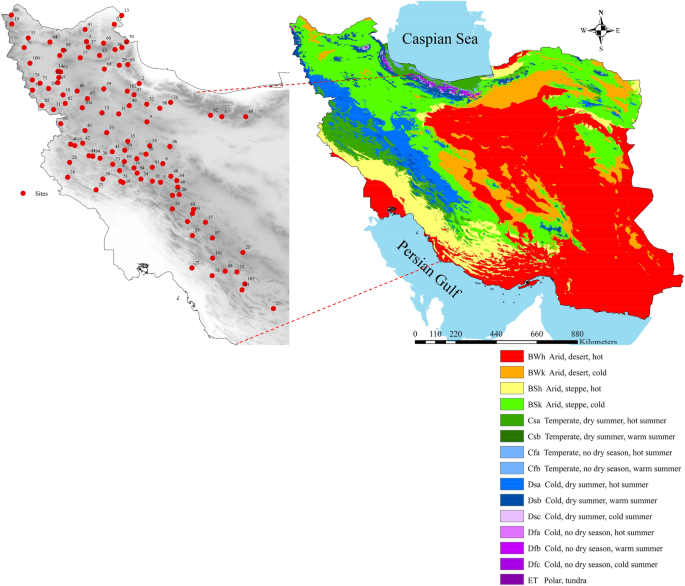
Beck, H. E. et al. Present and future Koppen-Geiger climate classification maps at 1-km resolution. Sci. Data 5, 180214. https://doi.org/10.1038/sdata.2018.214 (2018).
Google Scholar
Nouri, M. & Homaee, M. Contribution of soil moisture variations to high temperatures over different climatic regimes. Soil Tillage Res. 213, 105115. https://doi.org/10.1016/j.still.2021.105115 (2021).
Google Scholar
Sabziparvar, A. A., Movahedi, S., Asakereh, H., Maryanaji, Z. & Masoodian, S. A. Geographical factors affecting variability of precipitation regime in Iran. Theor. Appl. Climatol. 120, 367–376. https://doi.org/10.1007/s00704-014-1174-3 (2015).
Google Scholar
Nouri, M. Drought assessment using gridded data sources in data-poor areas with different aridity conditions. Water Resour. Manag. 37, 4327–4343. https://doi.org/10.1007/s11269-023-03555-4 (2023).
Google Scholar
Jin, X. & Han, J. Encyclopedia of Machine Learning 563–564 (Springer US, 2010).
Oloyede, M. O. & Hancke, G. P. Unimodal and multimodal biometric sensing systems: A review. IEEE Access 4, 7532–7555. https://doi.org/10.1109/access.2016.2614720 (2016).
Google Scholar
Li, Y., He, K., Sun, X. & Liu, H. in 2016 IEEE 18th International Conference on e-Health Networking, Applications and Services (Healthcom), 1–6.
Di Nunno, F. & Granata, F. Future trends of reference evapotranspiration in Sicily based on CORDEX data and Machine Learning algorithms. Agric. Water Manag. 280, 108232. https://doi.org/10.1016/j.agwat.2023.108232 (2023).
Google Scholar
Chen, T. & Guestrin, C. in Proc. of the 22nd ACM SIGKDD International Conference on Knowledge Discovery and Data Mining, 785–794 (Association for Computing Machinery, 2016).
Taha, A. A. & Malebary, S. J. An intelligent approach to credit card fraud detection using an optimized light gradient boosting machine. IEEE Access 8, 25579–25587. https://doi.org/10.1109/access.2020.2971354 (2020).
Google Scholar
Hearst, M. A., Dumais, S. T., Osuna, E., Platt, J. & Scholkopf, B. Support vector machines. IEEE Intell. Syst. Appl. 13, 18–28. https://doi.org/10.1109/5254.708428 (1998).
Google Scholar
Breiman, L. Random forests. Mach. Learn. 45, 5–32. https://doi.org/10.1023/A:1010933404324 (2001).
Google Scholar
Alibrahim, H. & Ludwig, S. A. IEEE Congress on Evolutionary Computation (CEC), 1551–1559 (2021).
Hempel, S., Frieler, K., Warszawski, L., Schewe, J. & Piontek, F. A trend-preserving bias correction – the ISI-MIP approach. Earth Syst. Dyn. 4, 219–236. https://doi.org/10.5194/esd-4-219-2013 (2013).
Google Scholar
Hoogenboom, G. et al. Decision Support System for Agrotechnology Transfer (DSSAT) Version 4.8.2 (www.DSSAT.net) (DSSAT Foundation, 2023).
Ritchie, J. T. Model for predicting evaporation from a row crop with incomplete cover. Water Resour. Res. 8, 1204–1213. https://doi.org/10.1029/WR008i005p01204 (1972).
Google Scholar
Saseendran, S. A. et al. Response of Crops to Limited Water: Understanding and Modeling Water Stress Effects on Plant Growth Processes Vol. 1, 1–38 (American Society of Agronomy, Inc., Crop Science Society of America, Inc., Soil Science Society of America, Inc., 2008).
Google Scholar
Nouri, M., Hoogenboom, G., Bannayan, M. & Homaee, M. CSM-CERES-wheat sensitivity to evapotranspiration modeling frameworks under a range of wind speeds. Water 14, 3023. https://doi.org/10.3390/w14193023 (2022).
Google Scholar
Ritchie, J. T. Modeling Plant and Soil Systems Agronomy Monographs 31–54 (Agronomy Society of America, 1991).
Google Scholar
Nouri, M., Homaee, M., Bannayan, M. & Hoogenboom, G. Towards modeling soil texture-specific sensitivity of wheat yield and water balance to climatic changes. Agric. Water Manag. 177, 248–263. https://doi.org/10.1016/j.agwat.2016.07.025 (2016).
Google Scholar
Moriasi, D. N. et al. Model evaluation guidelines for systematic quantification of accuracy in watershed simulations. Trans. ASABE 50, 885–900 (2007).
Google Scholar
Nouri, M., Ebrahimipak, N. A. & Hosseini, S. N. Estimating reference evapotranspiration for water-limited windy areas under data scarcity. Theor. Appl. Climatol. 150, 593–611. https://doi.org/10.1007/s00704-022-04182-6 (2022).
Google Scholar
Saemian, P. et al. Comprehensive evaluation of precipitation datasets over Iran. J. Hydrol. https://doi.org/10.1016/j.jhydrol.2021.127054 (2021).
Google Scholar
Nouri, M. Unveiling precipitation trend characteristics in changing poorly-gauged regions: Leveraging alternative raster sources. Water Resour. Manag. https://doi.org/10.1007/s11269-024-04009-1 (2024).
Google Scholar
Taghizadeh, E., Ahmadi-Givi, F., Brocca, L. & Sharifi, E. Evaluation of satellite/reanalysis precipitation products over Iran. Int. J. Remote Sens. 42, 3474–3497. https://doi.org/10.1080/01431161.2021.1875508 (2021).
Google Scholar
Keikhosravi-Kiany, M. S., Masoodian, S. A., Balling, R. C. & Darand, M. Evaluation of Tropical Rainfall Measuring Mission, Integrated Multi-satellite Retrievals for GPM, Climate Hazards Centre InfraRed Precipitation with Station data, and European Centre for Medium-Range Weather Forecasts Reanalysis v5 data in estimating precipitation and capturing meteorological droughts over Iran. Int. J. Climatol. 42, 2039–2064. https://doi.org/10.1002/joc.7351 (2021).
Google Scholar
Jose, D. M., Vincent, A. M. & Dwarakish, G. S. Improving multiple model ensemble predictions of daily precipitation and temperature through machine learning techniques. Sci. Rep. 12, 4678. https://doi.org/10.1038/s41598-022-08786-w (2022).
Google Scholar
Lin, X., Fan, J., Hou, Z. J. & Wang, J. Machine learning of key variables impacting extreme precipitation in various regions of the contiguous United States. J. Adv. Model. Earth Syst. https://doi.org/10.1029/2022ms003334 (2023).
Google Scholar
Tao, F., Zhang, Z., Liu, J. & Yokozawa, M. Modelling the impacts of weather and climate variability on crop productivity over a large area: A new super-ensemble-based probabilistic projection. Agric. For. Meteorol. 149, 1266–1278. https://doi.org/10.1016/j.agrformet.2009.02.015 (2009).
Google Scholar
Tebaldi, C. & Knutti, R. The use of the multi-model ensemble in probabilistic climate projections. Philos. Trans. A Math. Phys. Eng. Sci. 365, 2053–2075. https://doi.org/10.1098/rsta.2007.2076 (2007).
Google Scholar
Nouri, M., Homaee, M., Pereira, L. S. & Bybordi, M. Water management dilemma in the agricultural sector of Iran: A review focusing on water governance. Agric.. Water Manag. https://doi.org/10.1016/j.agwat.2023.108480 (2023).
Google Scholar
Mesgaran, B. & Azadi, P. A national adaptation plan for water scarcity in Iran. 36 (Working paper 6, Stanford Iran 2040 project, Stanford University, 2018).
Hengl, T. et al. SoilGrids250m: Global gridded soil information based on machine learning. PLoS ONE 12, e0169748. https://doi.org/10.1371/journal.pone.0169748 (2017).
Google Scholar