
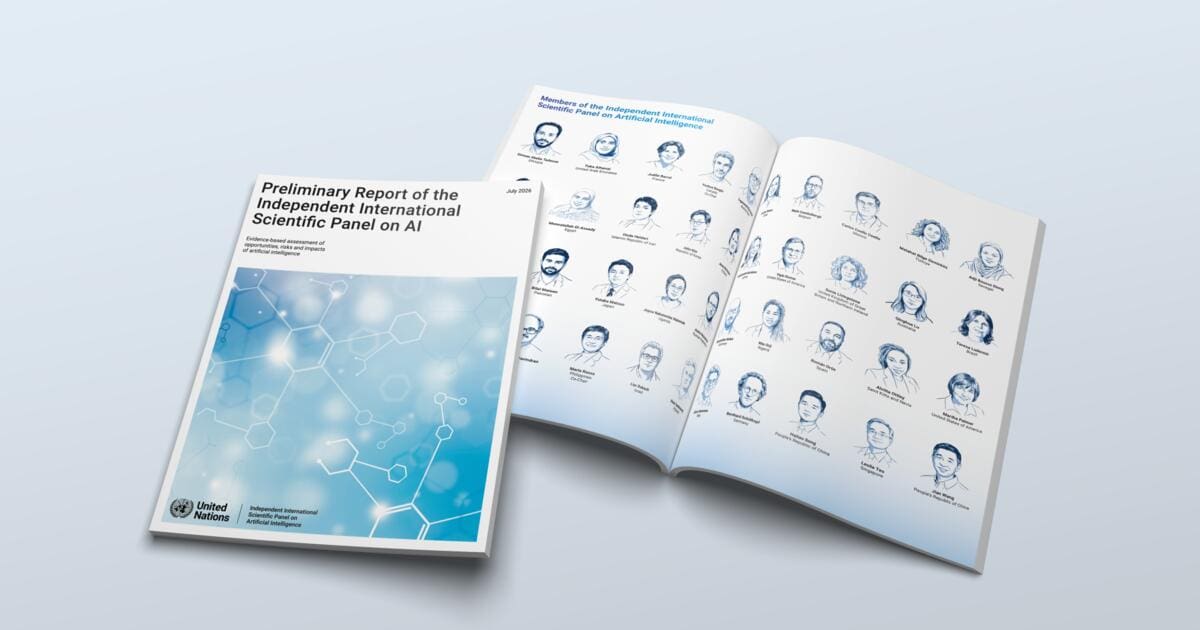
Mila founder Yoshua Bengio is co-chairing the first report of the new United Nations Scientific Panel on AI. The panel is a collaborative effort involving 40 experts from 37 countries who work independently from governments and businesses. The panel’s preliminary findings reveal a widening gap between rapidly advancing AI capabilities and policymakers’ ability to effectively govern them, highlighting the critical need for evidence-based understanding. UN Secretary-General António Guterres said leaders “can no longer claim otherwise” regarding available scientific data on AI, and said the report removes an important excuse for inaction. The assessment, mandated by a UN General Assembly resolution, marks the beginning of an ongoing effort to provide an independent, science-based assessment of the opportunities and risks of AI, and will be presented to global delegations in Geneva this week.
UN panel report: Assessing the gap between AI capabilities and safeguards
The rapidly accelerating development of artificial intelligence is outpacing humanity’s ability to understand and regulate it, according to a new report from an independent panel of experts convened by the United Nations. Developed by 40 independent experts from 37 countries, a deliberate effort to avoid country or corporate bias, the assessment establishes a fundamental understanding of AI capabilities and the growing gap between technological advances and effective governance. This structure emphasizes the report’s intention to provide truly independent international scrutiny of a field often dominated by commercial interests. Established last year through a United Nations General Assembly resolution, the panel’s mission is focused on providing evidence-based insights to inform the international debate on AI.
The preliminary report, released at a press conference in New York, highlights key findings that current security measures are insufficient to manage the escalating capabilities of AI systems. “Public policy makers cannot govern what they do not understand,” the report states, suggesting an urgent need to improve scientific literacy among those responsible for developing AI policy. The Panel intentionally refrained from providing specific policy recommendations, a strategic decision to maintain scientific objectivity and prevent the politicization of its findings. This report aims to provide a common knowledge base for governments around the world, particularly recognizing the limitations of current evidence on the macroeconomic and environmental impacts of AI. The panel’s findings will be presented this week at the United Nations’ Global Dialogue on AI Governance in Geneva, and will provide a common scientific starting point for international negotiations, and will continue to evolve through ongoing research and annual reports, with the next publication scheduled for May 2027.
Scientific data is now available and leaders can no longer claim otherwise, he said, adding that now everyone needs to be part of the solution.
Mira’s involvement reflects a commitment to applying rigorous scientific methods to the global governance of AI and ensuring that independent research informs AI development. The panel is made up of 40 experts from 37 countries, all contributing in their own capacity, and deliberately avoids affiliation with governments, companies, or institutions to maintain objectivity. The statement frames the report as removing a key justification for inaction on AI governance. Rather, this report serves as a fundamental baseline of evidence to facilitate informed decision-making for governments around the world, including those not directly involved in AI development.


