
overview
- Microsoft shares fell about 5% on Wednesday, falling below the $400 mark on concerns about massive spending on AI and increased competition.
- Investors are increasingly doubting whether Microsoft’s heavy investments in AI will yield sufficient returns, raising questions about the company’s future profitability.
- Despite its recent partnership with AMD to diversify its AI hardware supply, the core question remains whether Microsoft will be able to achieve an attractive return on its significant investment.
- Investors are looking for clearer evidence of sustained revenue growth from AI initiatives, and a stock return below $400 is seen as a psychological setback.
Microsoft shares tumbled Wednesday, falling about 5% to below $400, as massive AI spending, increased competition and growing doubts about future profitability undermined the stock’s recent recovery.
Microsoft stock falls 5% below $400 on concerns about a resurgence in AI spending
After briefly recovering from a deep drop in June, Microsoft Corp.’s stock price has suffered further declines, highlighting growing concerns over the company’s expensive artificial intelligence strategy.
After a heavy selloff sent Microsoft shares below the $350 level in June, the stock has rebounded and climbed back above the psychologically important $400 level. However, this rally failed to develop into a convincing bullish reversal.
On Wednesday, MSFT shares fell about 5%, falling back below $400, raising fresh concerns that the recovery may have run out of steam.
The renewed selling pressure reflects a broader shift in investor sentiment. The market is no longer simply asking whether Microsoft can be the biggest winner of the AI boom. Instead, investors are increasingly questioning whether the huge sums of money needed to compete in the AI space will ultimately yield sufficient returns.
Microsoft’s AI spending leads to growing debt
For much of the past two years, Microsoft was widely seen as one of the biggest beneficiaries of the AI revolution.
The company’s Azure cloud platform, leading enterprise software ecosystem, and close relationship with OpenAI place it at the center of the technology industry’s AI expansion.
However, that benefit comes at a significant cost.
Microsoft continues to invest billions of dollars in data centers, advanced processors, network infrastructure, power, and specialized computing power needed to support AI workloads.
The scale of this spending is becoming increasingly difficult for investors to ignore.
Microsoft’s traditional software business has historically offered attractive margins and relatively predictable recurring revenues. However, the shift to AI is moving the company toward a more capital-intensive model.
The concern is that Microsoft may be forced to spend huge sums of money just to maintain its competitive position, rather than generating proportionately greater returns from those investments.
AMD Partnership Provides Temporary Relief Only
Microsoft’s expanded partnership with AMD has recently provided a short-term boost to investor sentiment.
The deal brings AMD’s latest AI infrastructure to Microsoft Azure, potentially providing customers with an additional alternative to Nvidia-powered computing systems.
Microsoft plans to bring AMD technology to its AI services while also making that infrastructure available to Azure customers.
At the heart of the collaboration is AMD’s Helios AI infrastructure platform, which combines advanced Instinct AI accelerators with EPYC processors, networking technology, and supporting software.
The partnership represents an important strategic move as Microsoft seeks to diversify its AI hardware supply chain and reduce dependence on a single chip provider.
However, this announcement failed to solve the core problem facing MSFT investors.
The question is not simply whether Microsoft has access to enough AI hardware. The bigger concern is whether the company will be able to generate an attractive return on the huge investment required to implement it.
MSFT Stock Weaknesses – Breaking Major Support
Microsoft stock fell below the critical $400 level, but rebounded strongly last month to climb above $465. This area represents psychological and technical resistance, with numerous moving averages present and an important line in the sand. Buyers were unable to get above the 50 SMA on the weekly chart, which saw a four-week decline, with MSFT dropping below $350 at the end of June, below the weekly SMA of 100 and the March low. However, MSFT rebounded in July and regained the $400 level.
MSFT weekly chart – 100 SMA given up as support
Microsoft’s stock price has seen a remarkable rally in recent months, signaling a broader reset in the way investors value giant-cap technology leaders. After peaking in October at more than $555, the stock price fell sharply, losing about $200.
However, the 50-month SMA (yellow) once again held as support, and we saw a strong rebound in April and May. However, buyers gave up, sellers returned, and MSFT stock failed to break above the 50 SMA, opening the door to further decline.
MSFT Monthly Chart – Below SMA 50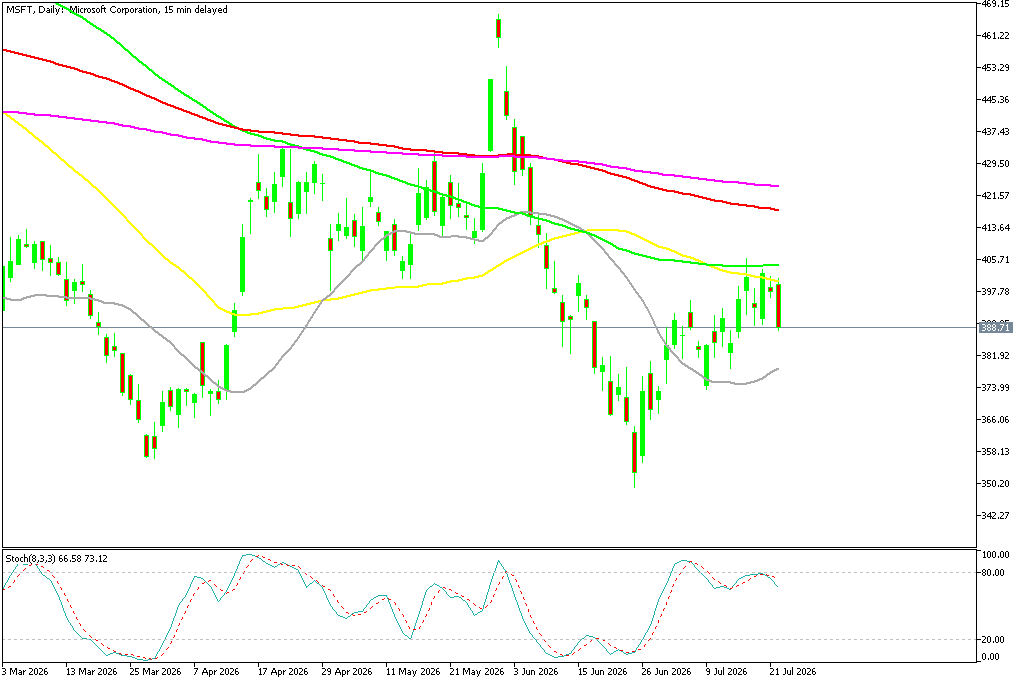
AI monetization doesn’t keep up with spending concerns
Microsoft’s biggest challenge may be converting demand for AI into meaningful incremental revenue.
The company continues to expand its Copilot ecosystem and introduce AI-powered products across its enterprise software portfolio.
However, operating advanced AI systems requires vast amounts of computing power, energy, storage, and semiconductor capacity.
As AI adoption increases, Microsoft’s costs could also rise significantly.
This is creating a growing gap between market enthusiasm for the revenue potential of AI and concerns about the costs required to generate that revenue.
Investors are increasingly looking for evidence that Microsoft’s AI products can generate enough additional revenue to offset the infrastructure costs associated with supporting them.
Until that becomes clear, increased capital spending may continue to be a major pressure factor on stock prices.
Competition and OpenAI risks increase investor anxiety
Microsoft also faces increasing competition in AI.
Alphabet, Amazon, Meta, and other technology companies continue to pour billions of dollars into developing AI infrastructure and proprietary platforms.
This raises the risk that Microsoft’s current advantage will narrow as competitors improve their technology and expand their cloud services.
The company’s relationship with OpenAI also remains an important area of focus for investors.
Microsoft’s partnerships with AI companies are a key element of the company’s AI investment thesis. However, expanding OpenAI’s relationships with other cloud providers could weaken Microsoft’s exclusivity and reduce one of its biggest competitive advantages.
Regulatory oversight adds further uncertainty.
Authorities continue to examine the competitive dynamics surrounding cloud computing, enterprise software, and AI. Although Microsoft’s core business remains resilient, increased regulatory intervention may result in additional costs and operational limitations.
Cost increases extend beyond artificial intelligence
Microsoft’s cost pressures aren’t limited to AI infrastructure.
The company is also facing increased expenses in other areas of its business, and the higher prices for Xbox hardware reflect broader inflationary pressures affecting components, memory and storage.
While the price increase may help offset some of these costs, it also highlights the broader inflationary environment the company faces.
For investors, the combination of increased AI spending and rising operating costs has raised concerns about whether Microsoft’s historically high profit margins can remain so strong.
MSFT’s stock price outlook becomes even more uncertain
Microsoft remains one of the world’s most powerful technology companies, backed by strong cash generation, a dominant enterprise software ecosystem, and a large cloud computing business.
But the stock market appears to be becoming less forgiving.
Investors are increasingly looking for evidence that spending on AI can lead to sustained revenue growth, rather than just increased capital spending.
Therefore, a return below $400 is a significant psychological setback for the stock. Unless Microsoft can convincingly regain those levels, the recent recovery will likely look more like a failed rebound than the start of a new bullish phase.
For now, the biggest risk facing MSFT isn’t the collapse of its core business. It’s possible that justifying the huge costs of winning the AI race may prove more difficult than investors initially expected.
Until Microsoft demonstrates that its AI investments can generate significant and sustainable returns, the stock could remain vulnerable to further volatility, especially if competition increases, spending continues to accelerate, or growth fails to meet increasingly demanding expectations.

Scardian Meta
lead analyst
Scardian Meta Lead Analyst. Skardian is a professional Forex trader and market analyst. He has been active in market analysis for the past 11 years. Prior to becoming our Head Analyst, Mr. Skerdian was a trader and market analyst at Saxo Bank’s local branch Accioner. Skardian specializes in model development and practical trading experiments. Scardian holds a master’s degree in finance and investments.


