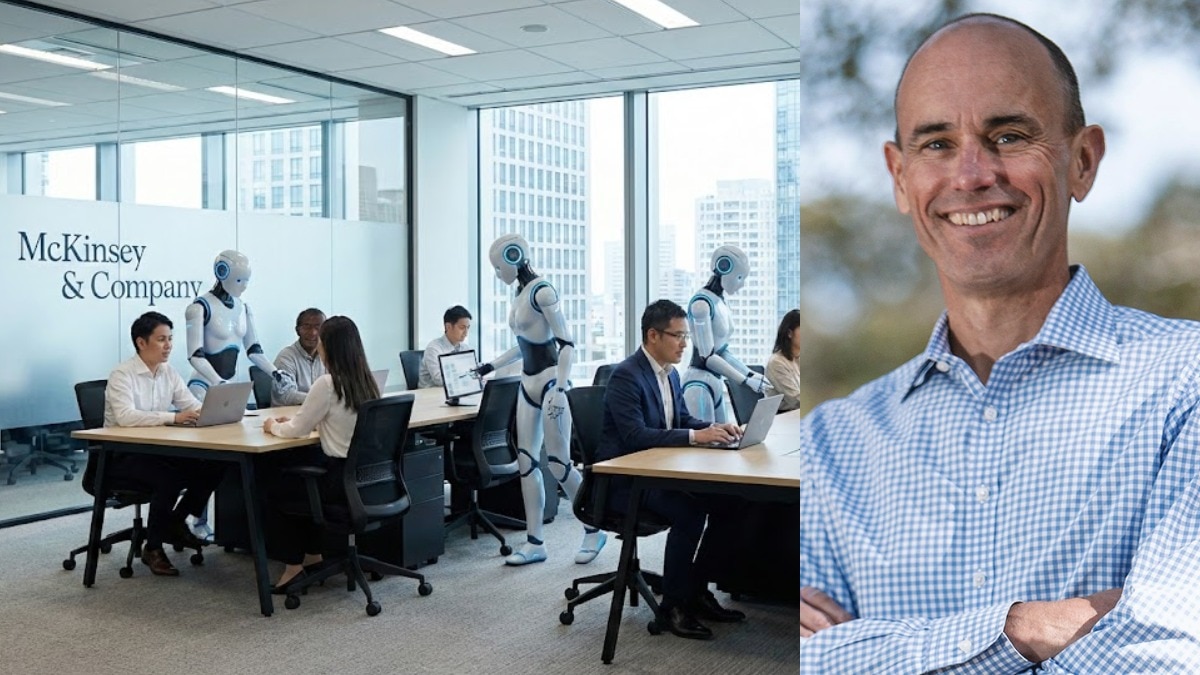
McKinsey & Company, a global consulting giant, currently has more than 60,000 employees. Of these, approximately 25,000 “employees” are AI agents who work alongside more than 40,000 human employees. According to CEO Bob Sternfels, this is just the beginning. The company currently aims to enable every human employee to use at least one AI agent to assist them in their work and increase productivity.
Speaking at the recent Consumer Electronics Show (CES) in Las Vegas, Sternfels said the number of his company’s AI agents has skyrocketed from just a few thousand to nearly 25,000 in less than two years. And in the future, the company aims to equip every employee with at least one AI agent. On an episode of Harvard Business Review’s IdeaCast, Sternfels revealed that McKinsey has big plans for integrating artificial intelligence. Just a year and a half ago, he said, the company employed only a few thousand agents, but that number has now grown significantly. The company now expects every employee to be “supported by at least one agent” within the next 18 months. A company spokesperson confirmed this figure to Business Insider.
For context, AI agents are not simple chatbots. These are autonomous systems that can solve problems, design workflows, perform tasks, and provide output with minimal human prompting. McKinsey deployed these agents to support research, data analysis, documentation, and client deliverables that once relied heavily on junior consultants. And the reason is said to be efficiency and productivity.
Sternfels revealed that this AI-driven transformation at McKinsey is part of what he calls the “25 Squares” model. Under this model, the company is increasing customer-facing roles by about 25% while reducing non-customer-facing jobs by about the same amount. Additionally, the company was able to save 1.5 million hours over the past year by having AI agents take over routine search and synthesis tasks. For example, Stampfels revealed that agents created 2.5 million charts in just six months, freeing up consultants to focus on higher-value work such as strategy development, customer engagement, and decision-making.
While AI agents have proven to work well alongside humans, Sternfels is clear that AI will not replace humans, at least in the most important areas. Humans, he argues, hold decisive advantages in three areas: setting aspirations, exercising judgment, and being truly creative.
Nevertheless, the impact of AI on employment cannot be ignored. At McKinsey & Company, output in non-customer-facing departments has already fallen by about a quarter, even though it has increased by about 10 percent. At the same time, hiring criteria are changing.
But McKinsey, which now counts 25,000 AI agents as part of its workforce, is one of several major companies like Amazon that are aggressively pushing AI in the name of efficiency and productivity, gradually replacing some human labor with machine intelligence.
– end