
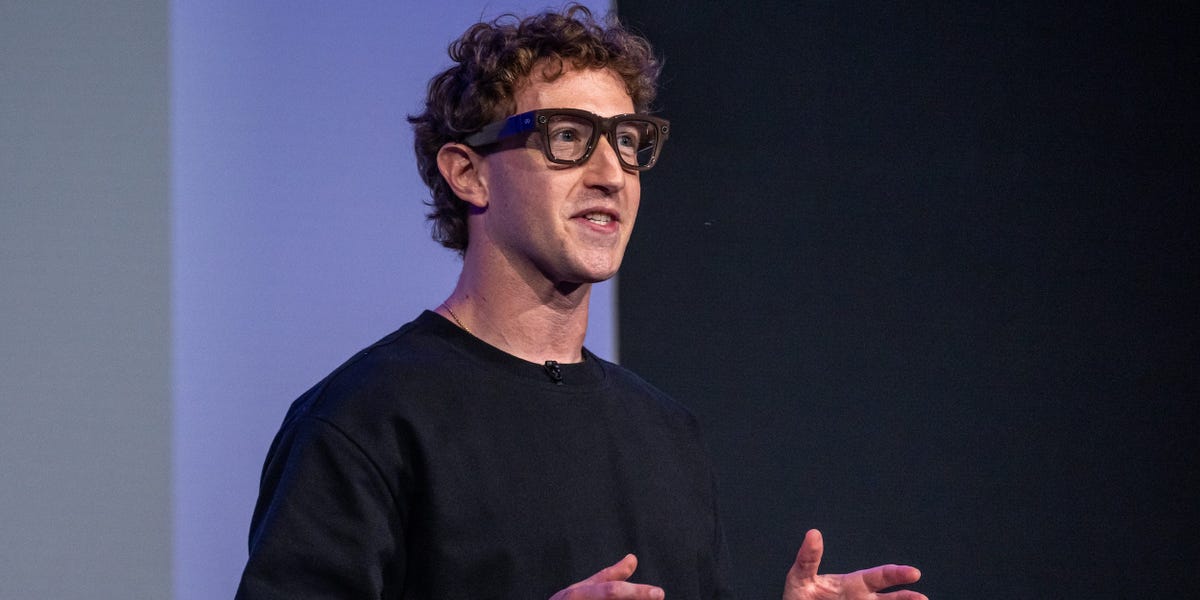
Meta CEO Mark Zuckerberg isn’t buying concerns about job losses due to AI.
“I think people think it’s inevitable,” Zuckerberg said in a recent live interview on Complex’s “Idea Generation.” “I don’t think so, actually.”
Zuckerberg said the employment situation would improve if companies focused more on “individual superintelligence” rather than “automating all knowledge work.” This is a not-so-subtle plug for Meta’s AI vision, taking a veiled dig at some of the biggest AI companies like Anthropic and OpenAI. Meta’s CEO said the future is “not great” when “a small number of companies” focus on automating knowledge work.
“I think it would probably be pretty good if there was a balance where some companies focused on helping businesses work more efficiently and other companies focused on a vision of personal superintelligence that empowered individuals and made them more productive at every step,” he said.
Anthropic CEO Dario Amodei has been candid about his belief that up to half of entry-level white-collar jobs could disappear over the next one to five years. Some, such as OpenAI CEO Sam Altman, suggest that fears of a so-called jobs apocalypse are not coming true.
Zuckerberg said companies are always looking for ways to become more efficient. The goal is to keep employees ahead of the pace of automation.
“If you focus on empowering people and making them more productive, and that happens faster than companies can get better at automating things, then in theory you should have more jobs in the future, not less,” he said.
Despite being a much more established technology company, Meta has struggled in the AI race. Zuckerberg called the billions of dollars Meta has spent poaching talent and shifting its AI strategy a “reboot.” Meta’s head of AI, Alexandr Wang, is considered one of the top prizes in the AI talent war and led the recent release of Muse Spark, the first large-scale language model released since Meta invested $14 billion in Scale AI.
Asked if he was “satisfied” with his meta position in the generative AI race, the famously competitive Zuckerberg suggested there was always more work to be done. He pointed out that Meta’s Superintelligence Institute was established less than a year ago.
“If you had told me that we would be where we are today in terms of advancements in the model, I would have been very happy with it,” Zuckerberg said. “But I’ve gotten used to the good news along the way, so I think it should be better now.”
Former Facebook executive Chamath Palihapitiya recently offered an even harsher assessment of Meta’s position in the generative AI race, saying it’s “highly unlikely” the social networking giant will catch up.
“I don’t know enough about the organization and I don’t understand the political dynamics well enough to understand why it failed so miserably,” Palihapitiya, who currently co-hosts the popular All In Podcast, told Axios’ Dan Primack. “But they failed big time.”
Meta own number of employees
In its most recent 10th quarter filing, Meta announced that its overall workforce increased by 1% year-over-year to a total of 77,986 as of April.
The filing was made before Meta laid off about 10% of its employees in May. Business Insider previously reported that about 8,000 roles were eliminated, including jobs on Meta’s integrity, cybersecurity, and content design teams.
In a memo announcing the employee cuts, the company said the move was necessary to “enable our continued efforts to operate the company more efficiently and offset other investments we are making.”