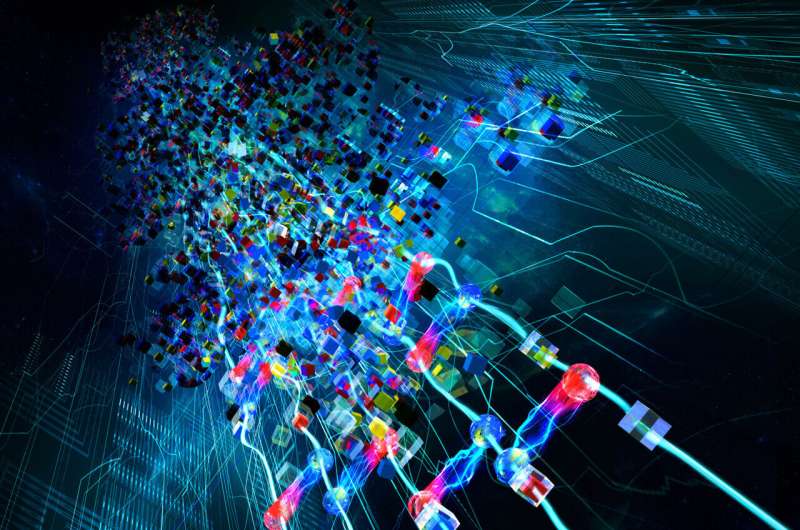
The technique, developed at the University of Innsbruck, generates quantum circuits based on a user's specifications and tailors them to the capabilities of the quantum hardware on which they will run. Credit: Harald Ritsch, University of Innsbruck
Researchers from the University of Innsbruck have presented a new method to prepare a quantum operation on a given quantum computer, using a machine learning generative model to find the right sequence of quantum gates to perform the operation.
Recently published studies have Nature Machine IntelligenceThis represents a major step forward in realizing the limits of quantum computing.
Generative models, such as diffusion models, are one of the most important recent developments in machine learning (ML), and models such as stable diffusion and DALL·E have revolutionized the field of image generation. These models are able to generate high-quality images based on text descriptions.
“Our new model for programming quantum computers does something similar, but instead of generating images, it generates quantum circuits based on a textual description of the quantum operations that will be performed,” explains Gorka Muñoz Gil from the Department of Theoretical Physics at the University of Innsbruck in Austria.
To prepare a particular quantum state or execute an algorithm on a quantum computer, we need to find the right sequence of quantum gates to perform such operations. This is relatively easy in classical computing, but poses a major challenge in quantum computing due to the peculiarities of the quantum world.
Recently, many scientists have proposed ways to build quantum circuits, many of which rely on machine learning techniques. However, training these machine learning models is often very difficult because the machine learning models must simulate the quantum circuits as they learn. The diffusion model avoids these problems due to its training method.
“This brings enormous advantages,” explains Muñoz Gil, who developed the new method together with Hans J. Briegel and Florian Frutter. “Moreover, we show that the denoising diffusion model is generatively accurate and very flexible, allowing us to generate circuits with different numbers of qubits, and different types and numbers of quantum gates.”
The model can also be customized to create circuits that take into account the connectivity of quantum hardware — the way qubits are connected within a quantum computer. “Once you train the model, it's very cheap to create new circuits, and you can use it to discover new insights into the quantum operations that interest you,” Muñoz-Gil says.
Developed at the University of Innsbruck, the technique generates quantum circuits based on a user's specifications, tailored to the capabilities of the quantum hardware on which the circuits will run – a major step towards unlocking the limits of quantum computing.
For more information:
Florian Fürrutter et al. “Quantum Circuit Synthesis Using Diffusion Models” Nature Machine Intelligence (2024). DOI: 10.1038/s42256-024-00831-9
Courtesy of University of Innsbruck
Quote: Machine Learning Method Generates Circuit Synthesis for Quantum Computing (May 21, 2024) Retrieved May 26, 2024 from https://techxplore.com/news/2024-05-machine-method-generates-circuit-synthesis.html
This document is subject to copyright. It may not be reproduced without written permission, except for fair dealing for the purposes of personal study or research. The content is provided for informational purposes only.