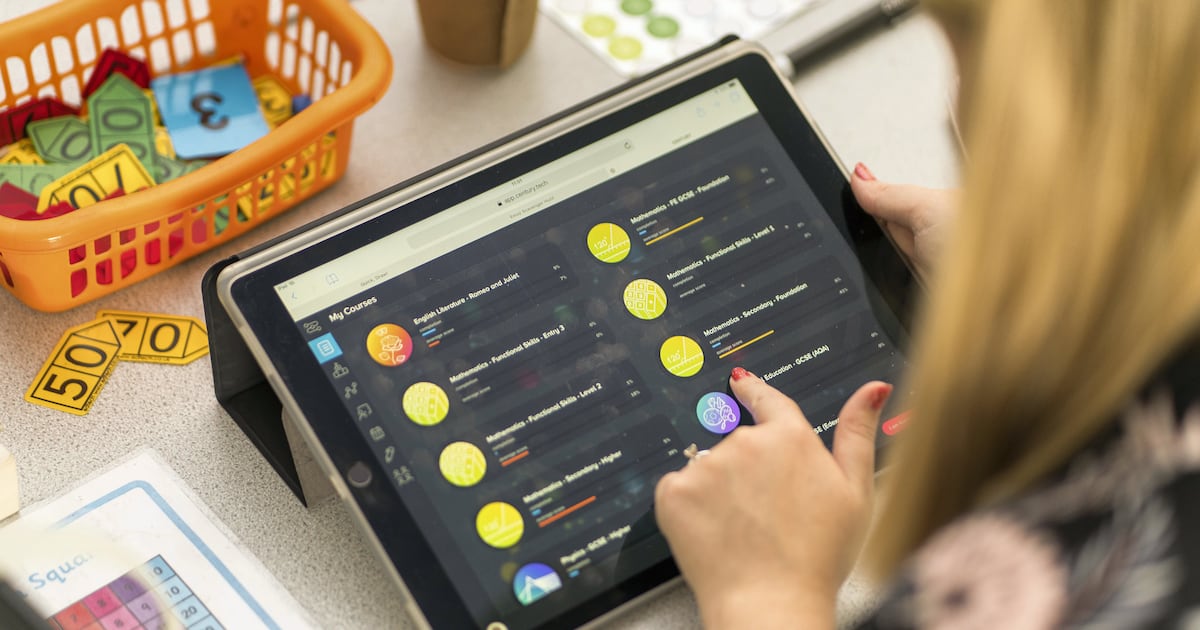
The role of artificial intelligence in the classroom quickly came into focus after tech giant Anthropic announced its Claude for Teachers program.
It’s a specialized version of Claude, Anthropic’s AI assistant and ChatGPT competitor, large-scale language model (LLM).
One of its important functions is to create lesson plans for teachers that are aligned with the relevant curriculum.
Currently available only in the US, but may be introduced worldwide at a later date. With or without Claude for Teachers, the use of AI by educators is already a reality.
In the US, private education company Alpha has launched a school centered on AI tutors that “provide students with one-on-one personalized education” with courses tailored to their pace and level. Some educators in the UAE are already implementing AI.
A recent survey found that almost half of teachers in the Emirates use ChatGPT at least once a week, and the technology is being implemented in lesson design and material creation.
A 2024 study by the Organization for Economic Co-operation and Development (OECD) found that 75% of teachers in the UAE use AI in their work, the highest figure in the OECD alongside Singapore.
Why should teachers use AI?
Bobby Johar, head of primary digital learning and teaching at Nord Anglia International School Dubai, said AI is reducing administrative tasks by assisting with lesson planning, resource creation and assessment analysis (understanding performance). This will allow teachers to focus on teaching and supporting students, he said.
“AI saves teachers time, supports quality planning and personalization, and provides students with faster feedback and more customized learning,” he said.
“That time can be reinvested in high-quality instruction, one-on-one support, student well-being, professional development, and building stronger relationships with students.”
This view is echoed by Vikas Pota, founder of T4 Education (an online platform that connects teachers and schools) and the Global EdTech Award, whose winners were announced at the World Schools Summit in Abu Dhabi last November.
He said that over time the “time-consuming tasks” that AI currently performs “have been built over and over again and taken away from teachers actually teaching.”
Reducing teacher workloads may improve staff recruitment and retention, but this may be offset if schools impose additional duties.
“[AI] It will also help us more effectively achieve the important goal of closing learning gaps in the classroom: personalized learning for each student,” Pota said.
Dan Clark, principal at Queen Elizabeth School Dubai, which opens next month, said: “When you’re faced with a class of about 20 children, all with very different needs, even for the best teachers, one of the most difficult things to do is to differentiate the work they’re doing.”
“Let’s say you’re creating something like a worksheet. If you have kids in your class with different needs, it’s very difficult to create six different versions of a particular learning resource.
“If you have an AI platform that understands children’s needs and how to meet them, you can feed it a master resource, and AI allows it to be customized to each child with specific needs.”
What are the disadvantages?
While using AI in schools can offer benefits such as cost savings through time savings, there are also potential pitfalls.
For example, could institutions become dependent on technologies that have low initial implementation costs but may not be cheap in the long run?
Yigit Saf, an education expert at Dubai-based consulting firm Arthur D. Little, said education accounts for 4% to 6% of global GDP, and technology companies such as Anthropic expect to make big profits.
“Right now, Claude for Teachers and other platforms that replace typical AI support for teachers have a profit mindset built into them, if not in the short term, then in the long term,” he said.
“Right now, it’s kind of a land grab to get these tools somehow adopted by the education sector.”
However, Sahu said AI is likely to save schools a lot of money by reducing the cost of functions such as marketing.
Another concern is that teachers may end up using AI to perform tasks they may feel they should do themselves.
Such issues have been raised regarding students. In 2023, Curtin University in Dubai announced plans to reinstate handwritten exams due to cheating using ChatGPT. In one class, a third of the students were using LLM to write essays.
Mr Clark said he would be concerned if, for example, technology was being used to help teachers write reports about students.
“That feels completely hostile to what we’re trying to do in schools, because we want kids to feel well-known and we want teachers to know kids well. I don’t think outsourcing things like reporting to AI furthers that objective,” he said.
“I wouldn’t call this cheating. I think there are some very advantageous uses for AI that can help good teachers become even better teachers because it reduces the very long and detailed production time for certain types of educational resources.
“On the other hand, especially with higher end products in the education market, we have to be careful not to inadvertently destroy the sense of connection that is the purpose of school and the sense of attention that children get from experts.”
For example, ensuring the confidentiality of individual student data, such as educational performance or health status, is another matter, given that personal information may be fed into AI to come up with personalized learning options.
“Schools need clear policies around privacy, data protection, accuracy, responsible use and fairness,” Dzhokhar said.
Regulation of AI in the classroom
Many schools have developed policies to cover these issues. For example, the Herefordshire March Academy Federation, which runs many state schools in England, said in its 2025-26 AI policy that teachers using AI must protect student data.
The policy also requires teachers to “clearly indicate when and where AI will be used.”
So how widely is AI likely to be used in schools in the future? Clark said most teachers are probably using AI in some way at the moment, but they may be doing it because they like the technology, rather than as part of a coordinated program within their school.
Sahu said some institutions may be more willing to adopt this technology than others.
“There are different grades within that range and we need to look at which schools fall into which level.” [level] We will continue to move forward in this new reality,” he added.
“In the Gulf region, people generally have a very open mindset. Especially in a center like Dubai, there are a lot of expats who are very aware of the educational requirements for their children. On top of that, private sector education is adapting to those requirements, so there is an open mindset.”