

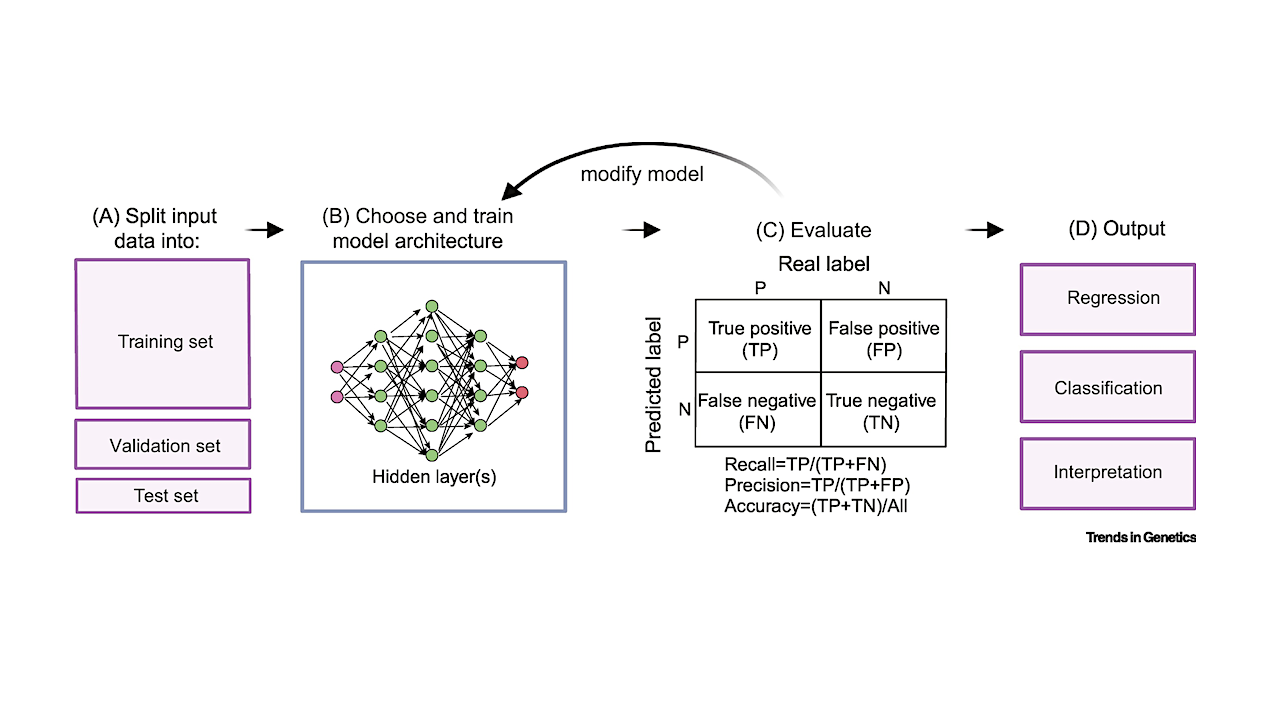
Over the past decade, the rapid expansion of large-scale data and advances in computational power have enabled machine learning (ML), particularly deep learning, to reshape many areas of biological research. Evolutionary genetics and molecular evolution are poised for a similar transformation. In this review, we discuss important advances and ongoing challenges in applying ML to the study of genetics and evolution, and highlight the potential of artificial intelligence to link genotype, phenotype, and evolutionary history.
highlights
Recent advances in machine learning (ML), particularly deep learning, are enabling breakthrough advances in biology and are poised to play a key role in evolutionary biology.
- ML models are becoming increasingly capable of linking genetic variation to molecular function and integrating structural, regulatory, and phenotypic data at multiple scales.
- ML models can now be used directly on raw SNPs, haplotypes, or allele frequency spectra, reducing reliance on summary statistics and enabling the discovery of previously unrecognized evolutionary patterns.
- The new approach goes beyond correlations and uses causal inference to generate mechanistic insights into evolutionary processes.
- Integrating multi-omics data through ML reveals hidden layers of complexity that shape adaptation and diversification, such as epistasis, controlled evolution, and phenotypic plasticity.
Evolutionary Genetics and Machine Learning for Molecular Evolution, Trends In Genetics (Open Access)
Astrobiology, genomics, evolutionary theory, machine learning,



