The challenge of modeling the dynamic behavior of quantum materials significantly limits the understanding of their fundamental properties, as computational demands increase exponentially in both time and scale. Hubert Pugzlys, Shreyas Varude, Sam Dillon and colleagues currently at various institutions are presenting a new machine learning framework that overcomes these limitations by accurately extrapolating quantum spin dynamics across both time and space. Autoregressive neural networks trained on simulations of complex quantum models significantly extend the range of traditional numerical methods and provide predictions that are consistent with known analytical solutions. This innovative approach outperforms other machine learning techniques and demonstrates robust error control, establishing a powerful new paradigm for studying the dynamics of complex quantum systems and promises to unlock deeper insights into the behavior of these materials.
Machine learning estimates quantum mechanical correlations
Understanding how quantum materials respond dynamically is central to uncovering their fundamental properties, but simulating their behavior over long periods of time and at large scale remains a major challenge due to rapidly increasing computational demands and quantum entanglement. The researchers introduced a new machine learning framework that allows extrapolation of dynamic spin correlations in both time and space, going beyond current computational limits. This approach avoids the exponential increase in computational demands typically associated with quantum mechanical simulations and promises a deeper understanding of the fundamental properties of complex quantum materials.
High-resolution real-time correlation dynamics
In this work, we detail a new approach to computing the dynamical properties of strongly correlated quantum systems, with a particular focus on improving the resolution of real-time evolutionary simulations. Standard simulation methods often have difficulty capturing high-frequency features, limiting our understanding of these materials. Scientists have developed ways to enhance physically-based simulations by using neural networks to improve the resolution of these simulations and extract more information from existing data. This combination of physics and machine learning provides powerful new tools for studying complex quantum systems.
Extrapolation of quantum dynamics beyond the limits of simulation
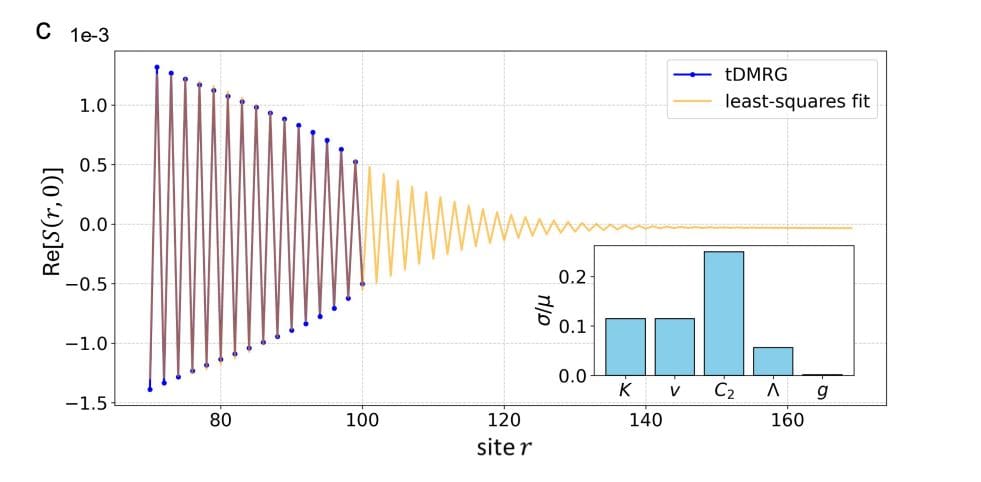
Scientists have developed a new machine learning framework to extend the study of complex quantum systems beyond the limits of traditional numerical methods. The research team was able to estimate dynamic spin correlations in both time and space, going beyond the scope of traditional simulations. The research team focused on the one-dimensional spin 1/2 XXZ model, a well-studied system that exhibits strong quantum correlations, and used time-dependent density matrix renormalization group simulations to generate data for machine learning extrapolation. A key innovation was the use of multilayer perceptron neural networks, which outperformed other techniques in predicting long-term dynamics and leveraged the principles of Luttinger liquid theory to accurately extrapolate data and open new avenues for studying quantum critical behavior.
Prediction of quantum mechanics using machine learning
In this study, we introduce a new machine learning framework to overcome the limitations imposed by traditional numerical methods and investigate the dynamical behavior of complex quantum systems. Scientists developed an autoregressive approach trained using data from time-dependent density matrix renormalization group simulations to accurately predict the evolution of spin correlations over extended time scales and spatial ranges. Benchmarks against analytically solvable systems confirmed the reliability of the method, with the team's multilayer perceptron model consistently outperforming other approaches and demonstrating its ability to estimate beyond the scope of standard computational techniques.
👉 More information
🗞 Autoregressive neural network extrapolation of quantum spin dynamics over time and space
🧠ArXiv: https://arxiv.org/abs/2512.13103