

Bitcoin (BTC) has fallen 5% in the past 24 hours to below $67,000, erasing yesterday’s gains as renewed institutional outflows and rising geopolitical tensions put pressure on the overall crypto market.
However, our machine learning algorithms suggest that the continued decline will be short-lived and the asset is on track to recover to some of this year’s highest levels by the end of the month.
Machine learning algorithm predicts Bitcoin price
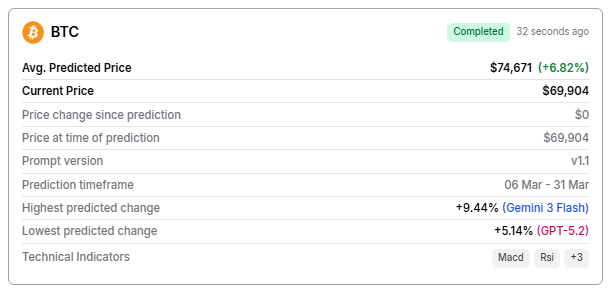
More precisely, Finbold’s AI prediction agent combined input from ChatGPT, Grok, and Gemini artificial intelligence (AI) models to generate more objective price targets for the flagship cryptocurrency.
Bitcoin is expected to eventually rise to $74,671, which would represent a 6.82% increase from current levels and return the cryptocurrency to roughly its early February levels.
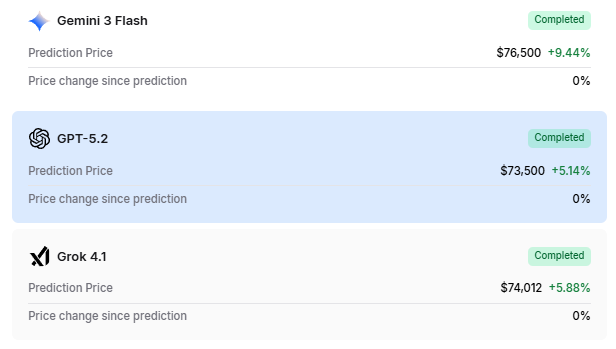
All three Large-Scale Language Models (LLMs) were positive that “digital gold” has only suffered a slight setback.
Gemini gave the boldest number, predicting a price of $76,500 (+9.44%). Meanwhile, Grok and ChatGPT set targets at $74,012 (+5.88%) and $73,000 (+5.14%) respectively.
This bullish stance can be compared to the bullish stance expressed by DeepSeek, which claims that Bitcoin will continue to rise into 2026, although it will fall short of regaining all-time highs.
Bitcoin price outlook
As mentioned earlier, Bitcoin experienced further corrections due to capital outflows and rising geopolitical tensions. In fact, the fund recorded net outflows of approximately $228 million on March 5, after three consecutive days of total inflows exceeding $1 billion. As a result, a key source of buying pressure that had supported Bitcoin’s recent price stability has been removed.
Escalating tensions between the U.S. and Iran also pushed global oil prices higher, hitting a one-year high and renewing concerns about inflation. All of this has led investors to move towards more traditional safe-haven assets compared to cryptocurrencies.
At the same time, a massive $2.2 billion Bitcoin option expiry introduced further short-term volatility as market participants hedged their positions near the “max pain” level near $69,000.
Technically, Bitcoin is once again facing strong resistance near $71,500. On the downside, analysts are focused on the $68,000 to $68,500 support zone, which coincides with the low of the recent trading range and the 38.2% Fibonacci retracement of the current bull market. But in the short term, a combination of ETF outflows and macro headwinds are pushing momentum to the downside.
Featured image via Shutterstock


