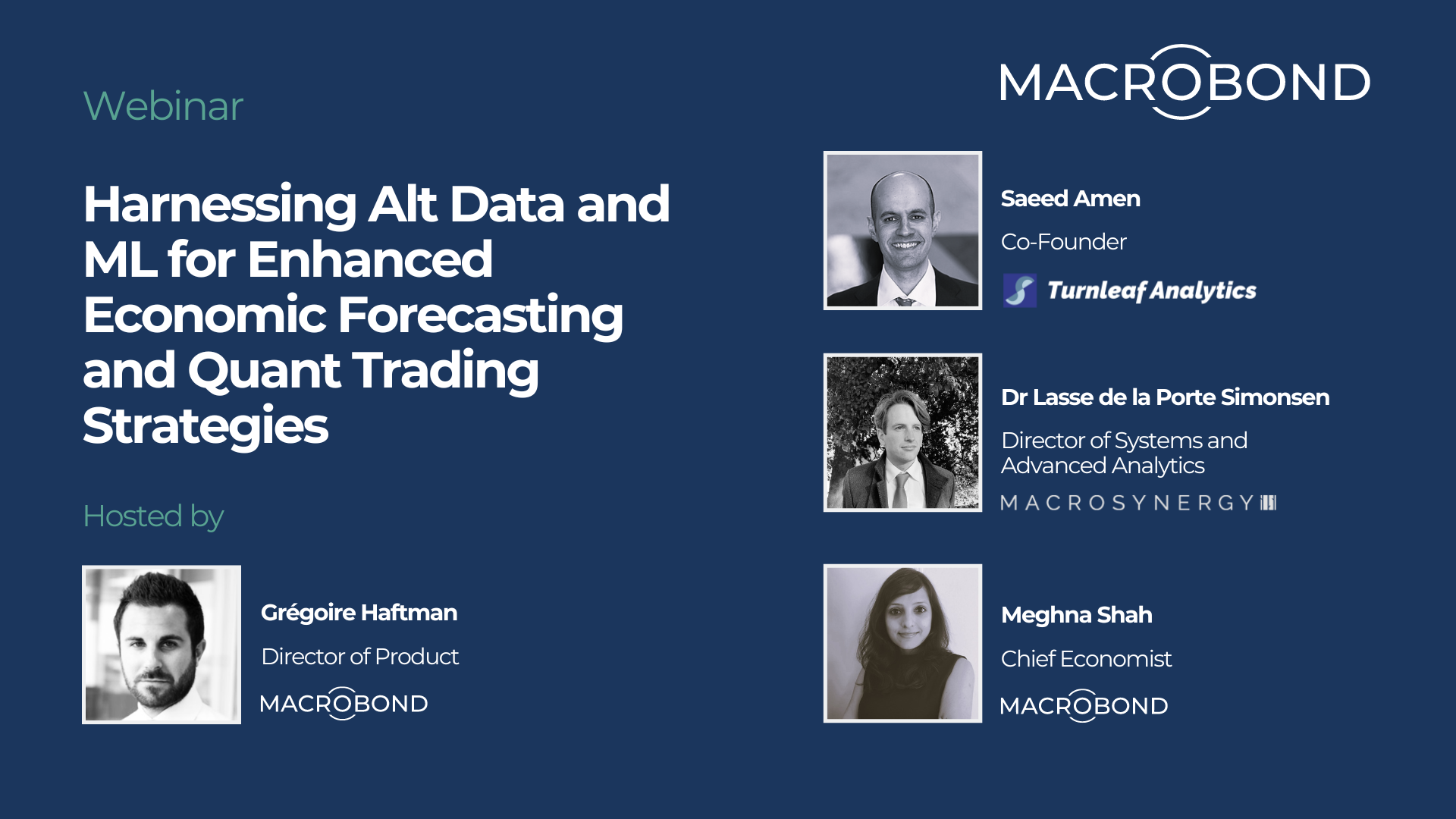
On June 19, 2024, Webinars This blog shares insights from Saeed Amen of Turnleaf Analytics, Dr. Lasse de la Porte Simonsen of Macrosynergy, and our in-house economist Meghna Shah on how the use of alternative data, including machine learning (ML) models, can enhance economic forecasts and trading strategies.
introduction
In today's dynamic financial environment, traditional data alone is no longer sufficient to understand complex and rapidly evolving market trends. The emergence of alternative data and machine learning has revolutionized economic forecasting and quantitative trading strategies, providing financial professionals with unprecedented insight and forecasting accuracy.
So how do we unleash the power of alternative data? What principles can we apply, and what use cases can it address?
Understanding Alternative Data
Alternative data refers to non-traditional data sources that directly or indirectly provide valuable information about economic activity and market trends. These sources include satellite imagery, social media trends, trade data, and even environmental indicators. Unlike traditional data, which is frequently subject to delays and revisions, alternative data provides real-time insights, enabling faster and more accurate economic forecasts.
The rise of alternative data is not new, but it has grown exponentially amid the COVID-19-driven digital transformation, as more and more sources publish data that reflect the current economic and financial landscape. The Internet of Things (IoT) is another example of data that provides readily available information about real-world patterns.
The role of machine learning
Machine learning algorithms excel at processing vast amounts of data and identifying patterns invisible to the human eye. By feeding alternative data into machine learning algorithms, financial analysts can develop models that forecast economic indicators, such as inflation rates, with remarkable accuracy. For example, Macrobond uses alternative data to augment traditional datasets to create richer, more timely economic forecasts.
Practical Applications
The panelists discussed practical applications of using alternative data and its benefits. Below are some examples that can be applied to economic forecasting and quantitative trading strategies, respectively:
Economic Forecasting. Turnleaf Analytics uses alternative data to provide macroeconomic forecasts with an emphasis on inflation data. By incorporating high-frequency indicators such as Broadway ticket sales and pollution levels, their models provide timely and accurate forecasts.
The benefit of this approach is that it allows policymakers and investors to make informed decisions based on the latest economic conditions.
Quantitative Trading Strategies: Macrosynergy has partnered with JP Morgan to leverage alternative data to create backtestable macroeconomic strategies, which involve systematically analyzing data to develop and test trading algorithms to ensure robustness across a range of market conditions.
The benefit for traders is that they can gain a competitive advantage by leveraging data-driven strategies born from empirical observation and validated through extensive backtesting.
Challenges and Solutions
While the benefits of alternative data and ML are clear, there are challenges related to data quality, availability of historical observations, point-in-time accuracy, and integrating diverse datasets. Macrobond addresses these challenges by time-stamping data and storing and publishing corrections alongside the original data, enabling accurate backtesting and forecasting.
Conclusion
The integration of alternative data and machine learning into economic forecasting and quantitative trading strategies represents a major advancement in financial analytics. Leveraging these technologies, financial professionals can gain deeper insights, make more informed decisions, and gain an edge in increasingly complex markets.