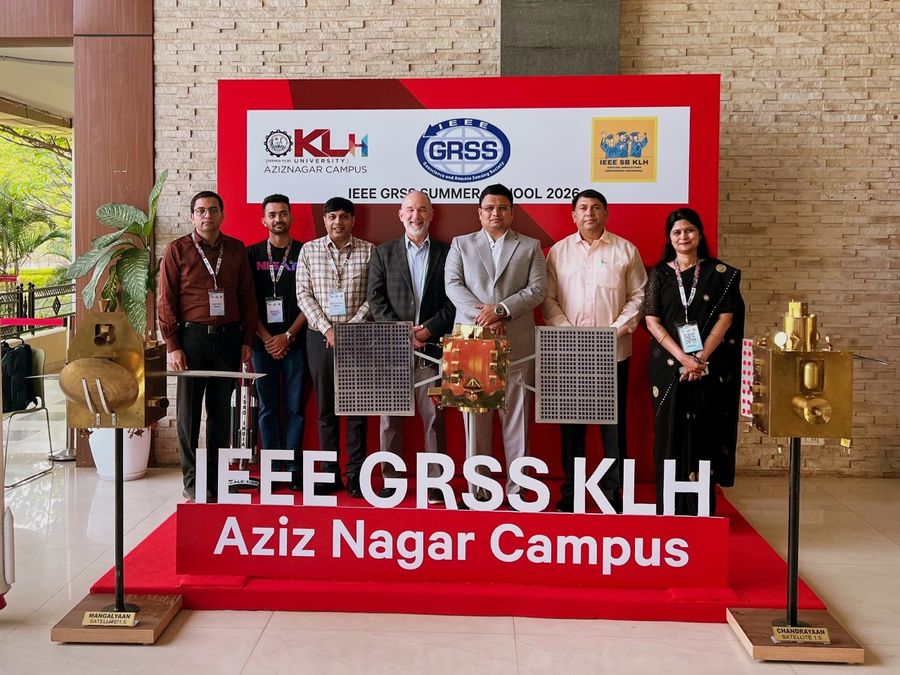
KLH Aziz Nagar Campus successfully hosted the IEEE GRSS Summer School 2026 on the theme “Applying SAR and Machine Learning to Indian Agriculture” from March 23 to 26, 2026, which attracted researchers, academicians, industry experts, and students from across India and abroad.
Organized by IEEE Student Branch KLH GRSS Chapter in collaboration with IEEE GRSS Hyderabad Chapter and supported by IEEE Geoscience and Remote Sensing Society (GRSS), the four-day program served as a dynamic platform for knowledge exchange in artificial intelligence, geosciences, remote sensing, and synthetic aperture radar (SAR) technology. We focused on strengthening participants’ capabilities through a combination of strong theoretical foundations and hands-on experience with advanced tools that will shape the future of agriculture.
The main highlight of the program was the participation of eminent international experts including Dr. Paul Rosen (NASA-JPL, USA), Dr. Kumar Vijay Mishra (US Army Research Laboratory, USA), Professor Alejandro C. Fry (Victoria University of Wellington, New Zealand), as well as eminent national speakers such as NRSC-ISRO Director (Outreach), Dr. R. Srinivas, Vijender B. Reddy. (ISRO), and Narayana Rao B. (NIT Warangal).
NRSC also unveiled a “Space on Wheel” exhibit featuring satellite models and insights into major space efforts. This session provided a valuable global perspective on leveraging SAR data and machine learning for crop monitoring, soil moisture estimation, yield prediction, and climate-resilient agriculture.
Practical workshops and case-based sessions allowed participants to work with real-world datasets and advanced geospatial tools, deepening understanding and encouraging innovation-driven thinking among students and early career researchers.
Speaking on the occasion, Mr. Koneru Lakshman Havish, Vice Chancellor, Er. KL Deemed University said, “Technology is redefining the future of agriculture and initiatives like the IEEE GRSS Summer School empower young minds to translate innovation into real-world impact. At KLH, we are committed to developing a workforce that not only understands advanced technologies but can apply them to address critical challenges in India’s agricultural ecosystem.”
The event was successfully organized under the guidance of Principal Dr. A. Ramakrishna and due to the dedicated efforts of convener Dr. Musumi Ajay Chaurasia and the organizing team. The program ended on an inspiring note, with participants gaining a wealth of knowledge, global experience, and renewed motivation to leverage technology to transform the future of agriculture.
KLH Aziz Nagar Campus will continue to focus on interdisciplinary research, global collaboration, and a future-ready learning ecosystem, further strengthening its role as an innovation hub for emerging technologies that contribute to sustainable development.