image:
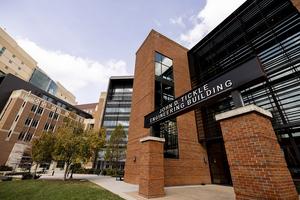
Exterior view of the John D. Tickle Engineering Building on the University of Tennessee, Knoxville campus.
view more
Credit: University of Tennessee
Sergey Kalinin, the Weston Fulton Professor of Materials Science and Engineering at the Tickle School of Engineering at the University of Tennessee, Knoxville, has been awarded the 2026 Southeastern Conference Faculty Achievement Award. This award is one of the SEC’s highest honors and recognizes excellence in teaching, research, and service.
“We are very grateful for this recognition,” Kalinin said. “This reflects not only the work of our team, but also the collaborative efforts of many colleagues at UT, the unwavering support of UT leadership, and the opportunity we now have to shape the future of materials science.”
Kalinin received the honor for driving innovation at the intersection of artificial intelligence and materials science, reshaping the way new materials are designed, tested, and researched.
Automate the future of materials discovery
Materials science supports nearly every modern technology, from infrastructure and energy systems to microelectronics and advanced manufacturing. However, Kalinin points out that until recently, the process of discovering and validating new substances remained relatively unchanged compared to the original research experience 30 years ago.
Over the past decade, advances in big data and machine learning have enabled researchers to computationally predict promising new materials. There has been a recent focus on automating the experimental side of science, and Kalinin’s work is at the forefront of that change.
He is developing machine learning-driven systems that can not only predict new materials, but synthesize and characterize them at unprecedented speeds. At UT, Kalinin and his collaborators have built some of the country’s first fully autonomous experimental platforms, including scanning probe and electron microscopes that can operate at an accelerated pace with minimal human intervention.
For now, UT remains one of the only universities in the country with these capabilities fully built and operational.
“Developing these systems requires expertise across many disciplines, including materials science, machine learning, computer science, instrumentation, and engineering,” he said. “No one can accomplish anything alone.”
This highly collaborative approach brings together researchers across disciplines and builds capabilities that remain rare in the United States.
prepare the next generation
Beyond research, Kalinin prepares students to lead in the rapidly evolving world of science. Recognizing the growing disparity in the workforce, he developed new courses that introduce students to machine learning in materials science and autonomous laboratory design, equipping them with skills that are increasingly in demand in academia and industry.
“We need people who understand both experimental research and AI tools,” Kalinin says. “The future belongs to those who can use machine learning as part of their experimental hands-on work in R&D labs, manufacturing, and product lines. This combination remains extremely rare and extremely valuable.”
Positioning universities as leaders
Kalinin sees this moment as a huge opportunity not only for his field but also for the university as a whole. As federal agencies and industry continue to invest in AI-driven discovery, institutions that can connect materials science, artificial intelligence, and manufacturing are positioned to lead in the next era of technological advancement.
“If we can build an infrastructure that directly connects AI-powered materials discovery to manufacturing and deployment, UT will become a leading hub for advanced materials innovation,” Kalinin said.
About award
The SEC Faculty Achievement Award recognizes one faculty member from each SEC university for outstanding contributions in research and scholarship over a 10-year period.
Previous University recipients include Paul Armsworth, Distinguished Professor of Ecology and Evolutionary Biology; Alison Buchan, Carolyn W. Fitt Professor of Microbiology; Elvio Dagoatto, Distinguished Professor of Theoretical Condensed Matter Physics; Lewis Gross, professor emeritus of ecology and evolutionary biology; J. Wesley Hines, Chancellor Emeritus Professor of Nuclear Engineering. Suzanne Lenhart, Chancellor’s Professor and James R. Cox Professor of Mathematics; Hap McSween, Chancellor Emeritus Professor of Earth and Planetary Sciences; Susan Leachert, Distinguished Professor and Chancellor’s Professor of Ecology and Evolutionary Biology; Tony Schmitz, Richard Rosenberg Distinguished Professor of Mechanical, Aerospace, and Biomedical Engineering; Daniel Simberloff, Gore Hanger Professor of Environmental Studies; Gregory Stewart, Professor of Psychology. Carol Tenopil, Chancellor’s Professor Emeritus of Information Science; Leon Tolbert, Ming H. Kao Professor, Chancellor’s Professor of Electrical Engineering and Computer Science; and Penny White, professor emeritus of law.
Disclaimer: AAAS and EurekAlert! We are not responsible for the accuracy of news releases posted on EurekAlert! Use of Information by Contributing Institutions or via the EurekAlert System.