

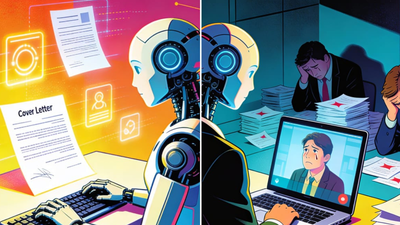
Have you turned to artificial intelligence (AI) to stand out in your work process, only to be rejected in the first round? Or are you a hiring manager who used AI to scrutinize applications and select the best candidates, only to end up with a different result than you had in mind?The answer lies in the approach itself. Relying on artificial intelligence in your job search could do more harm than good.As the country's labor market shows signs of slowing, the growing use of artificial intelligence in recruiting is changing the way Americans search for jobs. From automated interviews to AI-generated cover letters, technology is now part of nearly every stage of the hiring process. But is it working? In 2025, more than half of the organizations surveyed by the Society for Human Resource Management reported using AI tools to recruit employees. At the same time, nearly one-third of ChatGPT users turned to OpenAI chatbots for help with job applications. However, recent research shows that candidates who rely on AI in the application process are actually less likely to be hired, even as employers struggle to cope with the flood of applications. Anais Gardin, a researcher at Dartmouth College, told CNN Business: “Today,[companies']ability to select the best workers may be getting worse because of AI.” Galdin and Jesse Silbert of Princeton University looked at tens of thousands of cover letters submitted to job posting platform Freelancer.com and found that cover letters have become longer and more sophisticated since the launch of ChatGPT in 2022. But employers don't attach much importance to them, making it difficult to differentiate strong candidates from a wide pool of candidates. As a result, hiring rates and average starting salaries have declined, CNN reported. “If we don't do anything to improve the flow of information between workers and companies, this could be the outcome,” Silbert said, referring to the study's findings.
negative cycle
As the number of applications increases, companies also tend to automate interviews.According to a survey conducted in October by recruiting software company Greenhouse, 54% of U.S. job seekers said they had participated in an AI-driven interview. While virtual interviews became common during the 2020 pandemic, many employers are now using AI systems to conduct interviews without necessarily removing subjectivity from hiring decisions. “Algorithms can mimic and even amplify human biases,” said Jure Holtrop, a researcher who studies the use of asynchronous video interviews, algorithms and large-scale language models in recruitment.“All developers need to be aware of that,” CNN quoted an expert as saying. Greenhouse CEO Daniel Chait said the growing use of AI by both applicants and employers is creating a negative cycle. “Both sides are saying, 'This is not possible, this is not working, and things are getting worse,'” Chait told CNN.
What's next?
Despite these concerns, adoption of the technology continues, with one estimate predicting that the recruitment technology market will grow to $3.1 billion by the end of this year. At the same time, resistance is growing from lawmakers, labor organizations, and workers concerned about discrimination. Liz Shuler, president of the AFL-CIO union, said AI-driven hiring is “unacceptable.” “AI systems are denying workers the opportunity to qualify based on arbitrary criteria like name, zip code, or even how often they smile,” Schuller said in a statement to CNN. Several US states, including California, Colorado, and Illinois, have introduced new laws and regulations aimed at setting standards for the use of AI in employment. But a recent executive order signed by President Donald Trump has raised questions about the future of state-level surveillance. Samuel Mitchell, a Chicago-based employment lawyer, said the order does not “pre-empt” state law but adds to the “continued uncertainty” surrounding regulation. He added that existing anti-discrimination laws continue to apply even when companies use AI systems, creating legal challenges already. In a lawsuit backed by the American Civil Liberties Union, a hearing-impaired woman is suing HireVue, an AI-powered recruitment company, for failing to meet legal accessibility standards for automated interviews. HireVue denies the claims, telling CNN that its technology reduces bias through “validated behavioral science foundations.” Despite these challenges, more and more AI is gaining access to employment. New tools make resume screening more sophisticated and may help some candidates who may have been overlooked. But for people who value personal interaction, this change is unsettling. Jared Looper, an IT project manager in Salt Lake City, Utah, previously worked as a recruiter and recently took an AI-driven interview during his job search. He described the experience as “cold” and said he initially hung up when contacted by the automated system. Looper said he worries about job seekers who haven't yet adapted to an employment environment where appeals to algorithms have become essential. “Some good people are going to be left behind.”


