Thank you very much for your time today. I would like to once again express my appreciation for the opportunity to conduct this interview. In this discussion, I would like to ask about the overall direction of digital transformation in Japan. As mentioned earlier, Japan is sometimes described as facing an “innovation paradox.” Thirty years ago, it was home to many of the world’s leading technology companies, yet today it is often said to lag behind in areas such as cloud utilization, software development, and new forms of transformation. At the same time, the country faces challenges including declining productivity, population decrease, and a shortage of successors. In this context, digital transformation is essential. As the leader of a company that integrates global cloud solutions with Japan’s unique technological strengths, how do you view the current momentum of digital transformation in Japan?
I believe the expression “innovation paradox” captures something very essential about Japan. For many years, Japan led the world in hardware and manufacturing. However, over the past 20 to 30 years, the structure of international competition itself has changed dramatically. It is not simply that Japan lagged in software development or IT adoption; rather, a combination of language, education, market structure, and industrial culture has made it more difficult to connect with global standards. That is the reality as I see it.
Over the past three decades, globalization has accelerated rapidly worldwide, establishing common platforms for software, services, and cloud infrastructure built around English. In contrast, Japan’s education system and business environment have largely operated in Japanese. While this has been a significant strength domestically, it has also tended to make the market more inward-looking.
Even when excellent technologies and services exist, the language and market structure — which do not assume global expansion — often create a ceiling for growth.
In addition, Japanese companies have unique talent and organizational structures. In many countries, careers are built on professional specialization. In Japan, however, loyalty to the first company remains strong, and IT professionals are less likely to move fluidly between firms. As a result, business operations and IT functions have often become separated, increasing dependence on vendors.
Within this structure, it is difficult for business leaders and IT specialists to drive DX from the same perspective, which can suppress the speed of transformation.
That said, these characteristics do not represent weaknesses alone. Japan has strengths such as a strong quality orientation and meticulous service culture. When these are combined with cloud and AI technologies, there is tremendous potential to create new value.
The key question is whether there are companies that can serve as bridges between Japan’s domestic strengths and global standards. Those that can fulfill this role will be the ones that accelerate Japan’s digital transformation in the years ahead.
On the other hand, you mentioned that there is still significant potential in areas such as AI utilization, new technologies, Japan’s unique spirit of omotenashi, punctuality, and attention to detail. However, Japan also faces serious demographic challenges, including an annual population decline of approximately 600,000 people and a shortage of engineers. Your company employs more than 2,000 engineers and has established a training center in Tokyo. Could you tell us about your talent strategy for driving this transformation?
Human capital is the most important asset in corporate management. At the core of management is how to transform individual capabilities into the driving force of the business. What JBS has long valued is building our own system for developing that capability. To that end, we established our own training center in Tokyo and created a structured environment for systematic development.
We welcome approximately 200 new graduates each year, and more than half do not have prior IT experience. What matters is not only experience when joining our company, but also the aspiration to become a professional. With proper education and hands-on experience, individuals can grow into experts within a few years. Demonstrating this has been one of our strengths.
Our development framework rests on two pillars. The first is environment. From day one, we provide all new employees with the latest PCs, smartphones, software, cloud platforms, and AI tools. By engaging daily with advanced technologies and learning to master them, employees accelerate their growth. The quality and quantity of exposure to technology significantly influence development speed.
The second pillar is practical experience. After training, employees participate in real client projects, serving as a primary vendor for major enterprises. Through these projects, they gain the knowledge and judgment that can only be acquired in the field. The experience of delivering real results dramatically accelerates the growth of young engineers. It is not uncommon for employees in their 20s to serve as specialists or leaders, thanks to this environment and accumulation of experience.
Furthermore, through collaboration with hardware and software manufacturers and major corporations, we have a system in which employees can absorb advanced expertise directly in the field. The integration of education and practical experience forms the foundation of our talent development.
Above all, what JBS values most in human capital is creating a system in which employees can maximize their potential. This mindset is indispensable to delivering the best value to customers. By supporting employee growth and encouraging challenge, new value is generated in turn. This virtuous cycle is the essence of JBS’s human capital.
A symbolic example is our communication space, “Lucy’s,” often described as being Japan’s best employee cafeteria. It functions not only as a gathering place for employees, but also as a venue where customers and partner companies come together, deepening mutual understanding through dialogue.
Ultimately, what JBS values most is people. All value is created by people. When each employee sincerely engages with customers, engages in dialogue, and builds trust, new value is created. That steady accumulation of trust is the source of JBS’s competitiveness.
I would also like to ask about your company’s journey to date. Since your founding in 1990, you have achieved impressive growth and are now listed on the Prime Market. What were the key turning points in your growth?
To be honest, when we founded the company, we did not imagine that it would grow to its current scale. The first ten years were particularly challenging. Securing business from major Japanese corporations was not easy. We were small, with a limited track record, and had no choice but to build trust from scratch.
The turning point came through connections with overseas companies. A friend who worked at IBM introduced us to foreign-affiliated clients in need of English-compatible PCs. When we visited them and explained our services, they made purchasing decisions on the spot. Foreign financial institutions such as First Boston and Lehman Brothers became some of our earliest major clients. They evaluated us not on our size or history, but on the quality and speed of our service. This experience became the origin of JBS’s commitment to quality and responsiveness.
Around 2000, following Vodafone’s acquisition of a Japanese company, we secured a large-scale IT renewal project. At the time, it was the largest project in our history. Its success led to further opportunities with major Japanese corporations, including megabanks. From 2000 to 2010, JBS entered a full-fledged growth trajectory.
After 2011, as cloud services began to spread, we made a decisive choice to specialize in Microsoft cloud services. Our competitors were far larger than we were, but by concentrating on a specific domain and deepening our expertise, we established a strong presence. This strategy of focus and specialization forms the foundation of JBS’s current competitiveness.
Today, you are highly regarded in the Microsoft cloud domain. In such a competitive market, what is your competitive advantage?
Our greatest strength lies in our solid enterprise customer base and the track record we have built in cloud support over many years. While many competitors cover a broad range of fields, we have consistently maintained a strategy of specializing in Microsoft-centered cloud migration and operations. We serve with 72% of TOPIX100 companies, and support a cloud user base of 2.35 million accounts. This foundation is a major pillar supporting our growth.
We focus particularly on mid-sized to large enterprise clients. Through continuous dialogue, we carefully uncover latent challenges and needs, translating them into engineering services that drive growth. This “accompanying approach,” grounded in deep understanding of our customers’ businesses, is our defining characteristic.
In addition, as an independent systems integrator with approximately 2,800 employees, we possess the scale necessary to directly handle major enterprise projects while maintaining the flexibility, neutrality, and agility that independence affords. Many competitors are ten times our size, yet through accumulated expertise and proven performance, we have become a partner of choice for many enterprise companies.
I would like to ask about AI, particularly Microsoft Copilot. You moved quickly to deploy it company-wide. How do you approach providing it to your customers?
As an IT provider, deeply understanding and actively using the latest AI technologies in our own daily operations is itself a significant competitive advantage. JBS has clearly committed to evolving into an “AI-native” organization, and we were among the first IT companies in Japan to implement company-wide adoption.
As of September 2025, all 2,839 employees use full Copilot licenses in their daily work, embedding practical AI knowledge throughout the organization. The next phase will be translating the insights we’ve gained internally into tangible value for our customers.
However, our AI strategy is not limited to Microsoft Copilot. Depending on business domains and data characteristics, we adopt a multi-AI strategy, combining models such as OpenAI ChatGPT, and Anthropic Claude as appropriate.
At the core of this foundation is Microsoft Entra ID, which we have operated for many years. JBS manages approximately 2.35 million accounts, one of the largest operations in Japan among SIers. Managing this scale of identity infrastructure provides technical assurance that even global enterprises with tens of thousands of employees or more can deploy AI and business systems securely under unified identity governance.
Looking ahead, Microsoft Agent 365 will play a critical role as a platform for integrated management of multiple AI systems. With Agent 365, we can centrally govern operations, permissions, logs, and data handling, enabling secure and compliant multi-AI deployment.
Our ability to verify security, permission management, AI governance, and large-scale rollout within our own operational environment, and to accumulate that knowledge as proven expertise, serves as strong assurance for major enterprises. This operational capability, tailored to the complex requirements of the Japanese market, forms JBS’s unique competitive advantage.
Beyond Copilot, how are you approaching other AI technologies, such as AI agents?
The market is shifting from generative AI to the era of AI agents. Companies are moving beyond limited proof-of-concept phases and beginning full-scale, organization-wide implementation. AI is transitioning from being a personal tool to becoming an organizational capability — a significant inflection point.
In this context, we are actively developing AI agents. However, our focus is not merely on creating products to sell. What we prioritize is embedding AI into our customers’ actual business processes and co-creating solutions that deliver genuine value on the ground.
Currently, we are developing AI agents specialized for sales operations, designed to comprehensively support business processes. We base development on ideas gathered from employees working in the field, collaborating to enhance operational efficiency. We believe that the wisdom of those with field experience is the key to successfully leveraging AI.
First and foremost, we must transform ourselves into an organization that collaborates effectively with AI. JBS has established an AI ambassador system, educational programs, and certification exams to cultivate a culture in which employees fully leverage AI. By refining ourselves as a real-showcase, we aim to convert accumulated insights into tangible value for our customers.
Regarding your business model, in addition to license and product sales and project-based revenue, you have evolved and expanded into recurring revenue streams that include maintenance and operations.
Many of our customers are large enterprises with tens of thousands of employees. Relationships often begin with Microsoft 365 implementation and identity management foundations. These foundational systems become the base for recurring revenue and long-term trust. From there, Azure utilization, new development projects, and ongoing maintenance and additional initiatives expand naturally. This continuously expanding relationship is a defining feature of our model.
Through ongoing dialogue, we carefully uncover latent needs and build long-term trust while proposing optimal technologies and solutions.
We do not simply provide technology. We strive to understand our customers’ businesses and support them in alignment with technological innovation and business change. That is the JBS approach.
Through sustained value delivery, project-based and recurring revenues create a reinforcing cycle of growth. Accompanying our customers’ growth while expanding both relationships and business scope — this circular business model is one of JBS’s great strengths.
Turning to your global strategy, how do you differentiate yourself overseas?
We do not enter overseas markets with the aim of targeting specific countries. Our purpose is to support our customers’ global expansion by ensuring reliable IT infrastructure. We have established bases in the United States, Mexico, Singapore, Thailand, and China, all aligned with the philosophy of accompanying our customers abroad.
In recent years, demand has grown rapidly among Japanese companies seeking to centrally integrate global IT environments through cloud technologies. Few Japanese firms can deliver this consistently high quality across borders. JBS can provide the same level of quality and meticulous service overseas as in Japan, positioning us uniquely to support global IT integration for Japanese enterprises with “Japan-quality” standards.
This strength has been highly valued, and many companies continue to select us as their partner.
Could you also comment on your investor base? Has interest from overseas investors increased?
Since our listing on the Prime Market, the interest from both domestic and international institutional investors seems to be gradually increasing.
However, for overseas investors, the Japanese SIer business model can appear somewhat unique. In many countries, internal IT professionals typically lead system development in-house. The Japanese structure — where companies outsource IT functions extensively to external integrators — is not always intuitively understood.
As we continue to grow and solidify our role in supporting Japanese companies’ global expansion, we believe understanding and evaluation from overseas investors will deepen further. The more clearly we articulate how we create value within Japan’s unique market structure, the more internationally recognized JBS’s position will become.
Finally, as you celebrate your 35th anniversary, how do you envision the future of JBS?
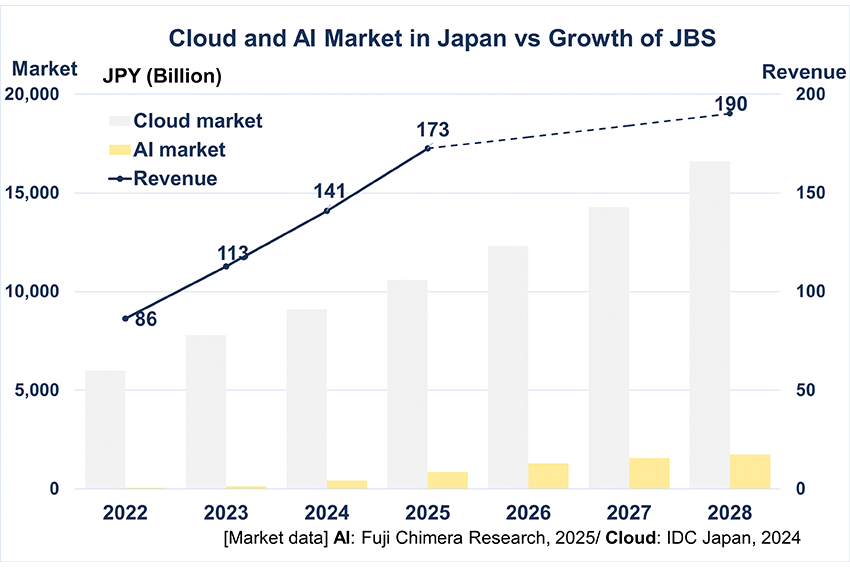
We have set a target of ¥190 billion by 2028, and we believe it is fully achievable.
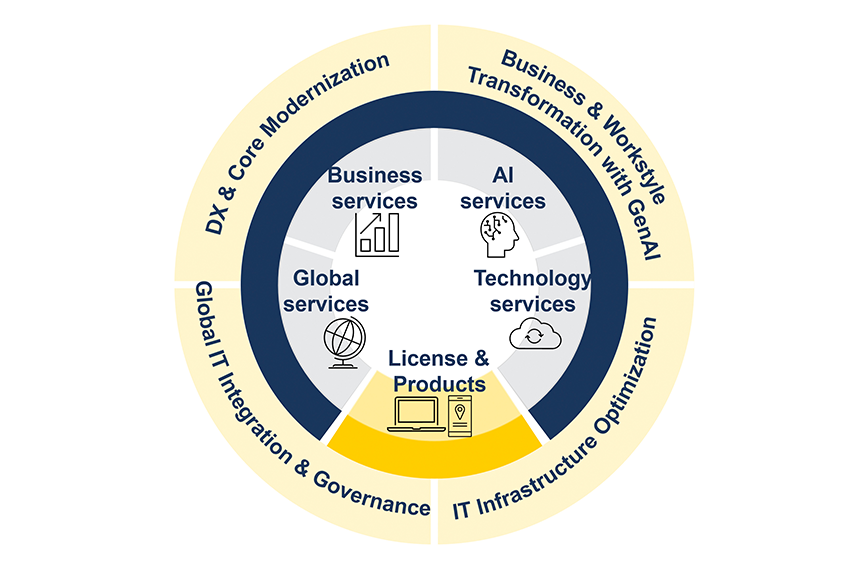
JBS has expanded its customer base through license and product sales while deepening long-term relationships to broaden our support scope. In the next growth phase, we will strategically expand beyond IT infrastructure into business services, AI, and global domains.
By establishing a business model in which project and recurring revenues reinforce one another, and by maintaining our independence while supporting major enterprises, we aim to solidify a distinctive position both domestically and internationally. That is the future JBS envisions at its 35-year milestone.
Lastly, if you were to describe JBS in one phrase, what kind of company is it?
We aspire to be a trusted partner that supports Japanese companies challenging the world through the power of technology.
As professionals in cloud utilization, we aim to enhance our customers’ technological capabilities and drive digital transformation with strength and reliability. To remain the partner that customers first turn to — that is the vision of JBS.
For more information, visit their website at: www.jbs.co.jp/en